

TL;DR
Hotel chargeback documentation works best when ID scans, guest details, signed registration records, incident notes, and payment records are kept together. Hotels should build a repeatable evidence package, avoid storing unnecessary data, and use secure ID scanning workflows that support PMS transfer, reports, and audit access.
Hotel chargeback documentation ID scanning gives hotels a practical way to preserve check-in evidence before a payment dispute arrives. In 2026, the strongest response packages usually connect a verified guest identity, stay details, authorization records, staff notes, and supporting reports in one clear timeline. GuestBan ID Scanning is built for hotel teams that need ID capture, PMS transfer, stored guest records, and chargeback-ready reporting without turning the front desk into a paperwork desk.
Table of Contents
What is hotel chargeback documentation ID scanning?
Hotel chargeback documentation ID scanning is the practice of capturing a guest identity document during check-in and storing related guest, stay, authorization, and incident records for later dispute response.
Hotel chargeback documentation ID scanning: a hotel evidence workflow that uses scanned IDs, guest details, registration records, payment context, and signed reports to support a chargeback response package.
Key insight: a scanned ID is not the whole dispute response. The stronger evidence set is the combination of identity, payment EMV authorization, stay activity, signatures, staff notes, and retrieval history.
Evidence types hotels should connect
A useful chargeback file reads like a timeline, not a pile of screenshots. Each item should answer one practical question: who checked in, what was authorized, what room or service was used, what staff observed, and where the record came from.
| Evidence item | What it helps show | Common source |
|---|---|---|
| Scanned ID image or parsed ID data | Guest identity presented at check-in | ID scanner record |
| Guest name, address, date of birth, document type | Identity match and audit detail | Scanner or PMS |
| Signed registration card or report | Guest acknowledgement of stay terms | Front desk workflow |
| Folio, room number, arrival and departure dates | Stay details tied to the disputed transaction | PMS |
| Card authorization details | Payment approval context | Payment processor or PMS |
| Incident notes and DNR reports | Staff observations and property history | Security or operations log |
| Retrieval timestamp and staff user | Chain of access for records | Secure portal or audit trail |
How can ID scanning help with chargeback responses?
ID scanning can help with chargeback responses by preserving identity evidence, reducing manual-entry errors, linking check-in records to PMS data, and producing printable reports for dispute packages. The value comes from complete records, clear timestamps, and consistent retention practices rather than the scan alone.
Hotels typically face disputes that question cardholder authorization, service delivery, or the identity of the person who stayed. ID scanning supports the identity side of the file, while PMS, payment, and registration records support the transaction side.
A practical workflow follows five steps:
- Scan the guest ID during check-in.
- Verify that the ID details match the reservation and payment workflow.
- Transfer accurate guest data into the PMS when supported.
- Store the scanned record and related reports in a controlled system.
- Retrieve a clean evidence packet if a dispute arrives.
Hotels comparing scanner workflows can review the operational tradeoffs in ID Scanner vs Manual ID Entry Hotel Check-In: 2026 Front Desk Comparison. Manual entry may still work for small properties, but scanner-based capture creates more consistent records when staff volume, late arrivals, and multi-property oversight become harder to manage.
Where scanning fits in the dispute timeline
Scanning belongs at check-in because later evidence collection is usually weaker. A guest ID captured during arrival can be connected to the reservation, room assignment, signature, and staff interaction while the event is fresh.
- Before arrival: reservation details, deposit rules, cancellation terms, and payment method are collected.
- At check-in: ID scan, identity review, registration signature, and front desk notes are created.
- During the stay: folio activity, room changes, damages, warnings, or incident reports are recorded.
- After checkout: final folio, receipt delivery, and any follow-up communication are retained.
- After dispute notice: records are exported into a response package with a clear timeline.
What should a hotel chargeback evidence package include?
A hotel chargeback evidence package should include identity records, proof of stay, proof of authorization, signed policies, staff notes, payment records, and a concise summary that connects each document to the disputed transaction.
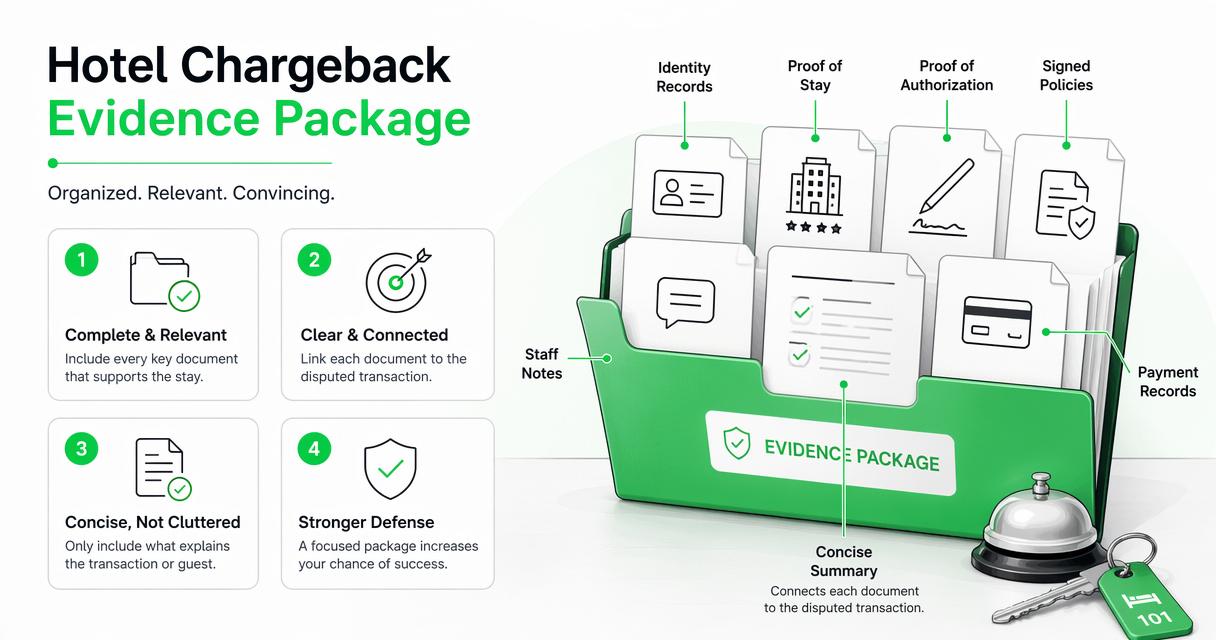
A strong package avoids clutter. Every file should explain the transaction or guest interaction. Irrelevant information can distract from the claim and may create privacy concerns depending on the hotel’s jurisdiction and retention policy.
Hotels also need to separate operational records from dispute evidence. A Do-Not-Rent note may help explain risk history or staff action, but the chargeback response should still focus on the specific reservation, date, guest, and transaction in question.
Reusable chargeback documentation checklist
This checklist gives front desk, operations, and loss prevention teams a repeatable structure for response preparation.
- Reservation record: confirmation number, booking source, arrival date, departure date, room type, and rate plan.
- Guest identity record: scanned ID image or parsed ID details, document type, issuing region, and check-in timestamp.
- Registration record: signed registration card, digital signature report, accepted hotel policies, and guest acknowledgements.
- Payment evidence: authorization approval, card-present or card-not-present context, folio, receipts, and refund history.
- Stay proof: room assignment, key issuance notes if available, folio activity, housekeeping notes, and service usage.
- Incident context: staff notes, damage reports, noise complaints, law enforcement reports, or Do-Not-Rent incident reports when relevant.
- Communication records: email confirmations, text messages, signed forms, and documented guest follow-up.
- Export summary: one-page explanation that maps evidence to the chargeback reason code or processor request.
Keep the package focused. Evidence should show identity, authorization, service delivery, and policy acknowledgement without adding unrelated personal data.
What should hotels avoid when storing ID evidence?
Hotels should avoid collecting excessive ID data, storing records without access controls, mixing unrelated incident notes into every dispute, and assuming a scanned ID automatically wins a chargeback. Good documentation still depends on policy, relevance, security, and response quality.
Privacy rules vary by location, document type, purpose, and retention period. Hotels operating across states should review local requirements before standardizing scanner practices. GuestBan’s state-by-state resource on hotel ID scanning laws is a useful starting point for legal and operations teams, although hotels should confirm policies with counsel.
Common documentation mistakes include:
- Keeping ID images longer than the business purpose supports.
- Giving too many employees access to stored identity records.
- Exporting full guest files when only a few documents are relevant.
- Failing to document staff observations when incidents happen.
- Relying on memory after a chargeback notice arrives weeks later.
Payment messaging standards also sit behind many card workflows. ISO 8583 is an international standard for financial transaction card originated interchange messaging, used by systems that exchange electronic card transaction messages. Hotels do not need to manage ISO 8583 directly for evidence files, but the definition helps explain why payment data, authorization context, and processor records are separate from front desk ID records.
How GuestBan ID Scanning handles chargeback documentation
The GuestBan ID Scanning platform helps hotels build stronger chargeback records by combining ID capture, guest detail storage, PMS transfer, printable reports, and incident documentation in a hotel-focused workflow.
The system supports multiple ID types, including U.S. and Canadian driver licenses, passports, passport cards, visas, green cards, Puerto Rico IDs, select Mexico ID cards, and select international ID cards. That range matters for hotels serving domestic, cross-border, and international travelers.
GuestBan ID Scanning also supports property-level and network-wide Do-Not-Rent controls with front desk alerts. For broader risk workflows, the related guide to Hotel Do Not Rent List Software: 2026 Guide for Safer Guest Controls explains how DNR records, alerts, role-based access, and incident notes support safer decisions across one property or many.
guestban.com also emphasizes secure web access, cloud storage, role-based permissions, multi-user controls, and reports that can be retrieved when a dispute or incident review requires documentation.
GuestBan documentation features by evidence need
| Hotel evidence need | GuestBan ID Scanning support | Chargeback value |
|---|---|---|
| Identity capture | Scans driver licenses, passports, and other supported IDs | Shows the ID presented at check-in |
| Guest data accuracy | Captures guest details for review and PMS transfer | Reduces manual-entry mismatch risk |
| Report creation | Provides printable reports and stored records | Speeds response package preparation |
| Incident context | Supports Do-Not-Rent incident reports | Adds relevant operational history when needed |
| Multi-property oversight | Enables property-level and network-wide DNR management | Helps groups apply consistent controls |
| Access control | Uses web access, cloud storage, and permissions | Limits who can view sensitive records |
How should multi-property hotel groups standardize records?
Multi-property hotel groups should standardize chargeback documentation by using one evidence checklist, consistent scanner settings, defined retention rules, and role-based access across every location.
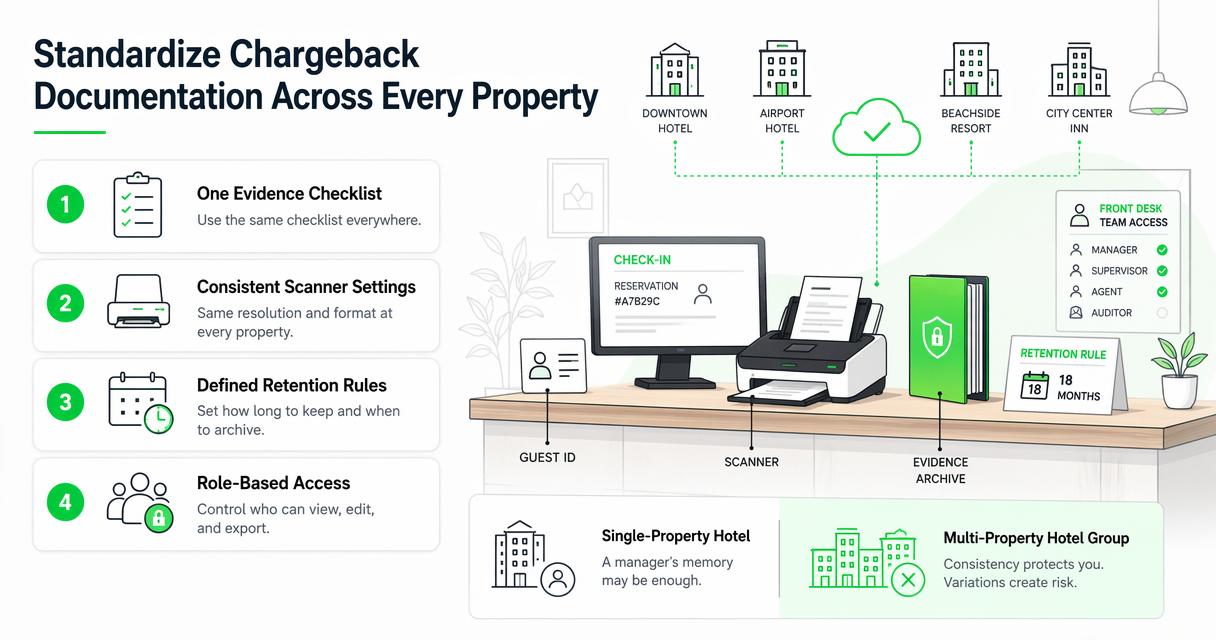
A single-property hotel can often rely on a manager’s memory. A hospitality group cannot. Variations in check-in scripts, ID capture practices, file names, and note quality make disputes harder to defend at scale.
A practical group standard should define:
- Required fields: guest name, ID type, reservation number, room number, folio number, check-in time, and staff user.
- Required documents: ID record, registration report, folio, authorization record, and any incident report.
- Naming convention: property code, date, reservation number, and dispute case number.
- Access rules: front desk view rights, manager export rights, and administrator retention rights.
- Review cadence: monthly sample audits for missing signatures, incomplete notes, and unresolved DNR entries.
Hotel groups evaluating scanner features can compare core buying criteria in Hotel ID Scanning Software: 2026 Buyer Guide for Faster, Safer Check-In. The most useful systems connect check-in speed with documentation quality, not just barcode capture.
What changes should hotels expect in 2027?
Hotels should expect 2027 chargeback documentation to become more automated, more privacy-sensitive, and more dependent on clean links between PMS records, identity capture, payment context, and incident reporting.
Card disputes are already document-heavy, and hotel operations keep moving toward connected systems. The next phase is not just better scanning. The bigger shift is evidence assembly, where systems help staff retrieve the correct records without exporting unrelated guest data.
Likely developments include:
- More PMS-connected evidence packets: scanner records, folios, signatures, and stay history grouped by reservation.
- Shorter internal retrieval times: secure portals replacing shared folders and manual screenshot collection.
- More granular permissions: tighter controls over who can view, print, or export ID images.
- Cleaner audit trails: user, timestamp, property, and action history tied to sensitive records.
- Policy-aware retention: settings that better match jurisdiction, brand policy, and business purpose.
The strongest 2027 strategy is not collecting more information. The stronger strategy is collecting the right information, protecting it, and retrieving it quickly when the record matters.
FAQ
Hotel teams usually ask similar questions when connecting ID scanning, chargebacks, and guest records. The answers below focus on practical documentation rather than legal advice or payment network rules.
Does a scanned ID guarantee a hotel will win a chargeback?
A scanned ID does not guarantee a hotel will win a chargeback. It can support the response by showing identity information presented at check-in, but processors often need broader evidence, including authorization records, stay proof, signed policies, folios, and relevant communication. The best result comes from a complete, organized package.
Should hotels store the full ID image or only parsed guest data?
The right approach depends on hotel policy, jurisdiction, risk level, and business purpose. Some properties store full ID images for chargeback, safety, or incident review. Others limit retention to parsed fields. Hotels should use documented retention rules, restrict access, and review state or regional ID scanning requirements before deciding.
What records help when a guest claims the stay was unauthorized?
Useful records include the scanned ID, registration signature, reservation confirmation, payment authorization, folio, room assignment, arrival and departure dates, and staff notes from check-in. If the guest interacted with the property during the stay, service records or documented communications can also help connect the person, room, and transaction.
How long should hotels keep chargeback documentation?
Retention periods should match payment dispute timelines, brand standards, insurance needs, and privacy obligations. Hotels should avoid indefinite storage without a defined reason. A written schedule should explain which records are kept, who can access them, how exports are logged, and when records are deleted or archived.
Conclusion
Hotel chargeback documentation ID scanning works when it becomes part of a disciplined evidence workflow, not a one-time front desk task. Hotels should standardize ID capture, registration signatures, PMS records, payment evidence, incident notes, and report exports into one repeatable package. For properties that need hotel-focused ID capture, DNR alerts, PMS transfer, and chargeback-ready records, GuestBan ID Scanning offers a practical path to stronger documentation. Visit guestban.com to evaluate the workflow, then assign one manager to test the checklist against the last three disputes and identify missing evidence before the next chargeback arrives.