

TL;DR
TL;DR: Hotel ID scanning helps prevent chargebacks when the front desk verifies the guest before keys are issued, not after a dispute arrives. Match ID, reservation, payment details, timestamps, signatures, and incident notes, then store records so managers can retrieve them fast.
Chargebacks rarely start in accounting; they usually start at the front desk when identity, payment, reservation, and stay records don't line up. Hotel ID scanning for chargeback prevention gives managers a practical way to verify the person checking in, reduce manual entry errors, and keep timestamped records before a disputed transaction becomes expensive. For properties that want a purpose-built workflow, GuestBan ID Scanning helps hotels connect ID capture, guest records, alerts, and documentation in one operational process.
Hotel ID scanning: a front desk process that captures data from a government-issued ID, ties it to a reservation or guest profile, and stores a retrievable record for verification, safety, and dispute support.
Table of Contents
What is hotel ID scanning for chargeback prevention?
Hotel ID scanning for chargeback prevention is the use of verified guest identity records to stop weak or fraudulent hotel transactions before check-in is completed. The process works best when staff compare the scanned ID with the reservation name, payment card, arrival details, signatures, and any risk notes before issuing room keys.
Most hotel chargeback advice focuses on evidence after the dispute. Prevention is different. It asks one operational question: should this guest, payment method, and reservation be accepted right now?
"An ounce of prevention is worth a pound of cure.", Benjamin Franklin, Founders Online
A scanned ID record does not guarantee a hotel will win every dispute. It does, however, make the check-in decision cleaner and the later record stronger. I'd rather see a hotel stop a mismatched card and ID at 8:05 p.m. than build a perfect chargeback packet three weeks later.
Core terms managers should standardize
Chargeback: a cardholder dispute that can reverse hotel revenue after a stay, no-show fee, damage charge, or incidental authorization.
Card-present verification: a front desk check that the payment card, cardholder, and guest identity reasonably match at arrival.
Audit trail: a timestamped record showing who performed an action, when it happened, and what information was captured.
Retrievable guest record: a stored profile that managers can locate by name, date, reservation, room, or incident.
Why identity checks stop disputes earlier
Identity checks stop disputes earlier because they force staff to resolve mismatches before the guest receives access to the room. A good scan-and-match process can flag different names, questionable documents, repeated risk history, missing signatures, and incomplete payment records while the guest is still at the desk.
Hotels increasingly depend on online travel agencies, virtual cards, mobile wallets, prepaid reservations, and after-hours arrivals. That mix makes convenience better for guests, but it also creates more points where identity can separate from payment authority. A fraud prevention tool such as Riskified is defined by Wikipedia as a SaaS fraud and chargeback prevention technology provider, which shows how common chargeback prevention has become across commerce, even though hotel operations need front desk-specific controls.
A property should treat ID scanning as a decision point, not just a file upload. The scan should help answer four questions quickly:
- Is the person present the named guest or an approved additional guest?
- Does the payment method match the reservation and policy?
- Is the ID readable, current, and consistent with the guest profile?
- Are there prior incidents, do-not-rent alerts, or special notes staff must review?
For teams building the full front desk process, the 2026 hotel front desk ID capture checklist is a useful companion because it turns policy into repeatable desk behavior.
Prevention beats documentation when the mismatch is visible
Documentation matters, but it is reactive. Prevention happens when a clerk sees that the cardholder name differs from the ID, the reservation was booked by a third party, or the guest refuses to provide required identification.
That moment needs a calm script, a manager escalation path, and a record of the decision. If staff override the mismatch without notes, the hotel loses the best chance to prevent the dispute.
What evidence should hotels capture before check-in approval?
Hotels should capture enough evidence to show that the guest, reservation, payment, and stay were connected at the time of check-in. The most useful records are timestamped, searchable, permission-controlled, and tied to the reservation number or guest profile.
Do not collect data just because the scanner can read it. Collect what your policy requires, what local law allows, and what your payment and privacy obligations support. I recommend managers review retention rules with counsel or compliance staff, especially for passports, driver's licenses, and payment-related records.
Chargeback prevention evidence checklist
| Evidence item | Why it helps prevention | Manager check |
|---|---|---|
| Scanned government ID | Confirms the person at the desk | Name, photo, expiration, document type |
| Reservation details | Connects identity to booking | Guest name, dates, rate, OTA source |
| Payment record | Links stay to authorization | Cardholder name, last four digits, approval code |
| Timestamped check-in | Shows when verification occurred | Date, time, staff user, property |
| Signature or policy acceptance | Confirms terms were presented | No-show, smoking, damage, incidentals |
| Incident notes | Explains unusual decisions | Refusal, mismatch, manager override |
| Room and folio record | Connects service delivery to charge | Room number, folio, checkout status |
The checklist is intentionally short. Front desk teams follow short lists under pressure. Loss-prevention teams can add deeper fields later, but the first goal is to make the minimum proof complete every time.
How should the front desk match ID, reservation, and payment?
The front desk should match ID, reservation, and payment through a repeatable sequence that leaves no silent gaps. A hotel can approve check-in faster when staff follow the same order every time and escalate exceptions before issuing keys.
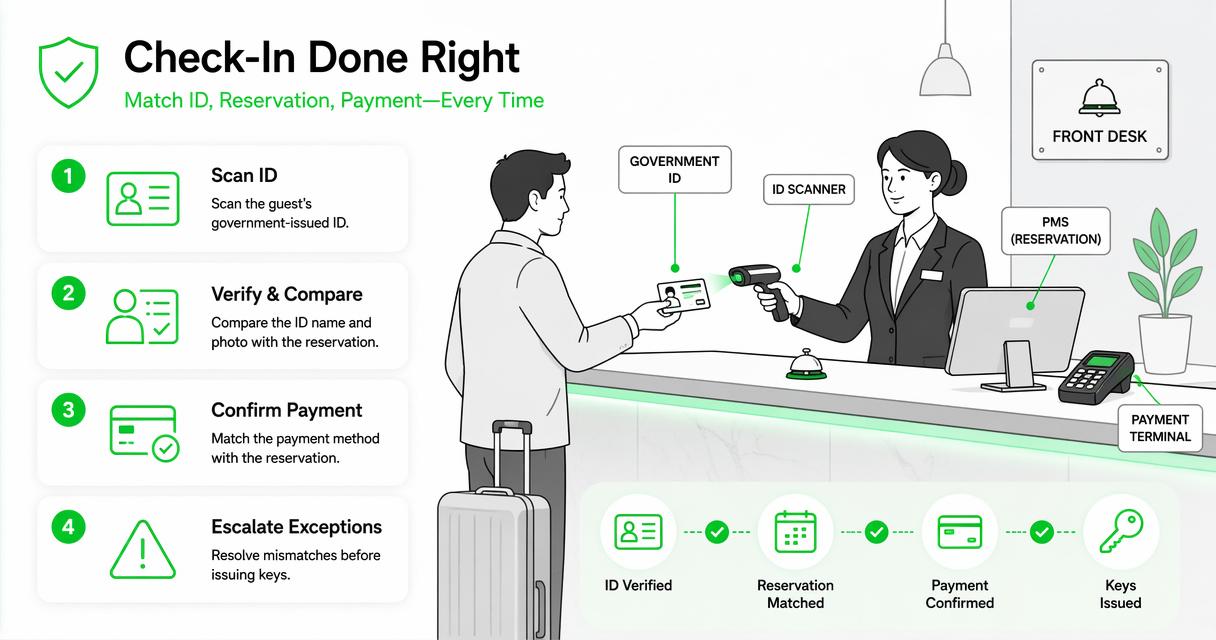
- Scan the guest's government-issued ID.
- Compare the ID name and photo with the person present.
- Match the ID name to the reservation or approved guest list.
- Confirm the payment card or authorization method matches policy.
- Capture required signatures and policy acknowledgments.
- Review alerts, notes, or do-not-rent history.
- Save the record with timestamp, staff user, and reservation details.
- Escalate mismatches before keys are made.
This sequence protects honest guests too. A clear process reduces awkward judgment calls, keeps staff from making inconsistent exceptions, and gives managers a fair record of what happened.
For a deeper check-in workflow, see how to verify guest ID at hotel check-in. That guide is especially useful for training new clerks who need scripts for normal stays and exception handling.
Exception rules should be written, not improvised
A hotel should define what happens when the guest is not the cardholder, the ID is expired, the reservation was made by a company, or the booking uses a virtual card. Staff need approved paths, such as adding an authorized guest, requesting a new payment method, calling a manager, or refusing check-in under policy.
Written exception rules prevent two risks at once: unnecessary guest friction and unsafe overrides.
How GuestBan ID Scanning handles this workflow
The GuestBan ID Scanning platform is designed for hotel teams that want ID capture to support real front desk decisions, not just create a folder of images. In a prevention workflow, the platform helps staff capture guest identity details, keep records organized, and make information easier for managers to retrieve when a payment question or incident comes up.
I like systems that reflect how hotels actually run. A front desk clerk needs speed. A general manager needs accountability. A loss-prevention lead needs history across shifts or properties. GuestBan ID Scanning fits that practical middle ground by connecting verification records with operational notes and alerts.
guestban.com also frames ID scanning as part of a broader safety and risk-control program, not a standalone gadget. That distinction matters because chargeback prevention often overlaps with guest screening, incident documentation, and staff safety.
Where the platform adds operational value
- Faster lookup: managers can retrieve guest records without searching paper files.
- Cleaner documentation: scanned ID data can reduce manual spelling and entry errors.
- Better consistency: staff follow the same capture process across shifts.
- Risk context: guest notes and alerts can support smarter approval decisions.
- Multi-property control: hospitality groups can standardize records across locations when policy allows.
For broader buyer comparisons, the guest verification software guide for hotels explains how to evaluate ID capture, PMS transfer, alerts, records, privacy, and front desk workflows.
What should managers avoid when scanning IDs?
Managers should avoid treating ID scanning as automatic proof, unlimited data collection, or a substitute for staff judgment. A scan is useful only when it is accurate, policy-based, legally appropriate, and tied to a reservation, payment, or incident record.
Common failure points include unclear retention rules, staff sharing logins, missing manager notes, and records stored outside the official guest profile. Another problem is over-collection. If a hotel stores more personal information than it needs, the risk shifts from chargeback prevention to data exposure.
"Do not store sensitive authentication data after authorization.", PCI Security Standards Council, PCI DSS v4.0.1
That PCI DSS rule is about payment authentication data, not guest IDs, but the principle is useful: collect with purpose, protect what you keep, and don't store restricted data just because it is available.
A practical control list for managers:
- Use individual staff logins, not shared front desk accounts.
- Limit ID record access by role.
- Define retention periods by property policy and legal requirements.
- Record overrides with manager name and reason.
- Review exception reports weekly.
- Train staff on privacy language for guests.
If your hotel also manages do-not-rent decisions, connect chargeback notes to incident quality. The hotel do-not-rent incident report template shows the type of witness, photo, police, and follow-up fields that make records more credible.
How should hotels retrieve records during a dispute?
Hotels should retrieve dispute records by reservation number, guest name, check-in date, room number, and staff user so evidence can be assembled quickly. The best records show a clear timeline from booking to check-in, stay, checkout, and any post-stay charge.
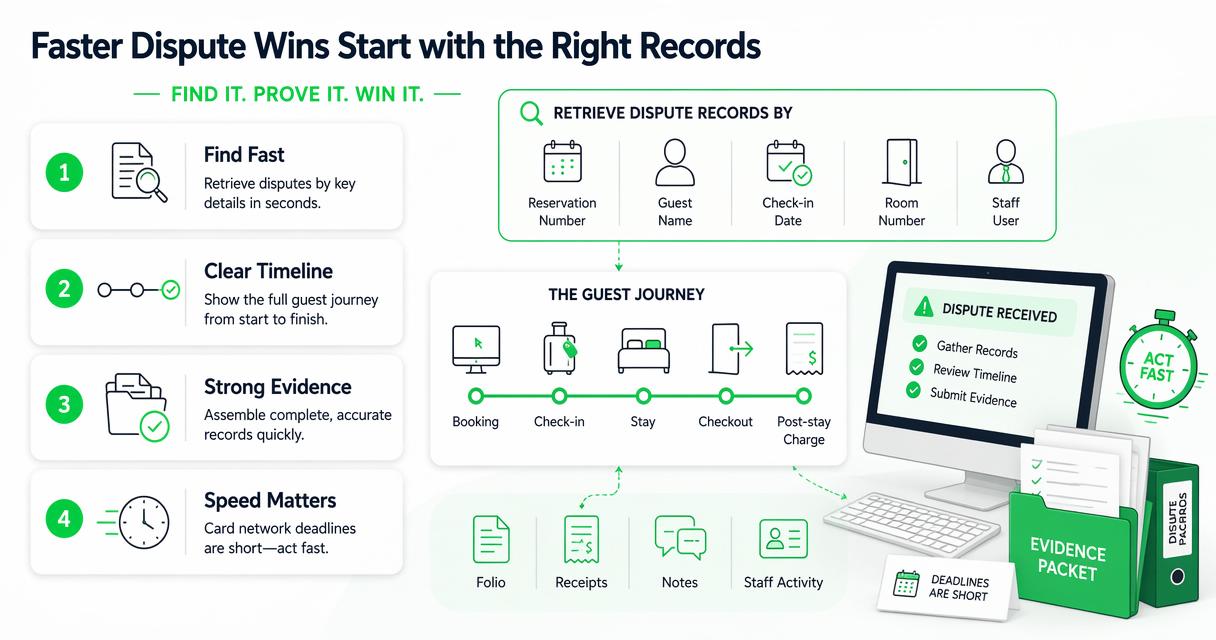
When a dispute arrives, speed matters because card networks and processors set response windows. Even without quoting a universal deadline, managers know the pattern: late evidence is often useless evidence. A searchable record system keeps the hotel from relying on memory, screenshots, or paper folders.
For chargeback response support, assemble records in this order:
- Reservation confirmation and booking source.
- Scanned ID verification record.
- Payment authorization or folio record.
- Signed registration card or policy acceptance.
- Room, stay, and checkout records.
- Incident notes, photos, or manager reports if relevant.
- Staff timeline with timestamps.
This package is stronger when every item was created during normal operations. Evidence produced after the dispute can look defensive. Evidence captured at check-in looks like standard policy.
Retrieval quality is a prevention metric
If managers can't find records, the prevention program is incomplete. I'd track retrieval time as a basic performance measure: how long does it take to pull a complete guest file for a disputed stay?
A good target is not a public benchmark; it is an internal standard. Start with same-day retrieval, then tighten the workflow as staff get comfortable.
What will change in 2027?
In 2027, hotel ID scanning will likely move closer to real-time guest risk review, stronger permission controls, and better PMS-connected recordkeeping. The direction is clear: hotels want fewer manual steps, but they also need cleaner audit trails and privacy-aware storage.
AI-assisted document checks may become more common, especially for detecting unreadable scans, inconsistent names, or possible duplicate records. Still, managers should be careful with automation. A risk alert should support a human decision, not silently deny service without review.
Hospitality groups will also push for network-level controls. One property's chargeback pattern, damage history, or safety incident may matter to another property under the same ownership. That makes governance more important: who can see what, how long records stay available, and how guests can be treated fairly.
The hotels that do best will keep the process simple for clerks and disciplined for managers. More technology won't fix unclear policy.
Recent posts and related reading
Recent hotel risk conversations show that identity, safety, and documentation are converging into one front desk discipline. Chargebacks are only one part of the risk picture, but they connect directly to guest verification, incident notes, and access decisions.
Useful next reads from the GuestBan library include:
- Chargebacks and fraud in the hotel industry for broader fraud context.
- Enhancing security with an ID scanner for hotels for safety and operational use cases.
- Cloud storage for scanned guest IDs for retention, permissions, reports, audit logs, and secure workflows.
These topics belong together because a hotel's strongest record is rarely one document. It is the chain of identity, authorization, stay activity, staff action, and manager review.
FAQ
These common questions come up when hotel owners, general managers, and loss-prevention teams build an ID-based chargeback prevention process.
Does scanning a guest ID guarantee a hotel will win a chargeback?
No. ID scanning does not guarantee a chargeback win because the outcome depends on the dispute reason, card rules, processor requirements, hotel policy, and quality of the full evidence package. It does improve the hotel's position by showing identity verification, timestamps, staff action, and a clearer link between the guest and the stay.
Should hotels scan every guest ID or only risky reservations?
Most properties get better consistency when they apply the same ID verification policy to every check-in, then add extra review for exceptions. Selective scanning can create staff confusion and uneven guest treatment. Managers should set one baseline process, train it clearly, and document approved exceptions such as corporate bookings or authorized additional guests.
What ID information should a hotel keep?
A hotel should keep only the ID information required for its business purpose, policy, and legal obligations. Common fields include name, document type, expiration status, timestamp, and a link to the reservation record. Retention, masking, access permissions, and deletion rules should be reviewed with legal or compliance advisors.
How does ID scanning help with card-not-present bookings?
ID scanning helps card-not-present bookings by confirming who actually arrived for the reservation. The front desk can compare the scanned guest ID with the booking name, approved guest list, payment instructions, and hotel policy before issuing keys. That check reduces the chance of accepting a stay that later looks unauthorized.
Conclusion
Chargeback prevention starts before the room key is made. The practical move for 2026 is to standardize ID scanning, match identity to reservation and payment details, capture timestamped records, document exceptions, and make every file easy for managers to retrieve.
If your team is still relying on photocopies, handwritten notes, or memory, start with one property and one checklist this week. Then review five recent disputes and ask what record would have prevented each one. To see how GuestBan ID Scanning can support a cleaner front desk verification workflow, visit guestban.com and build hotel ID scanning for chargeback prevention into your normal check-in policy.