
TL;DR
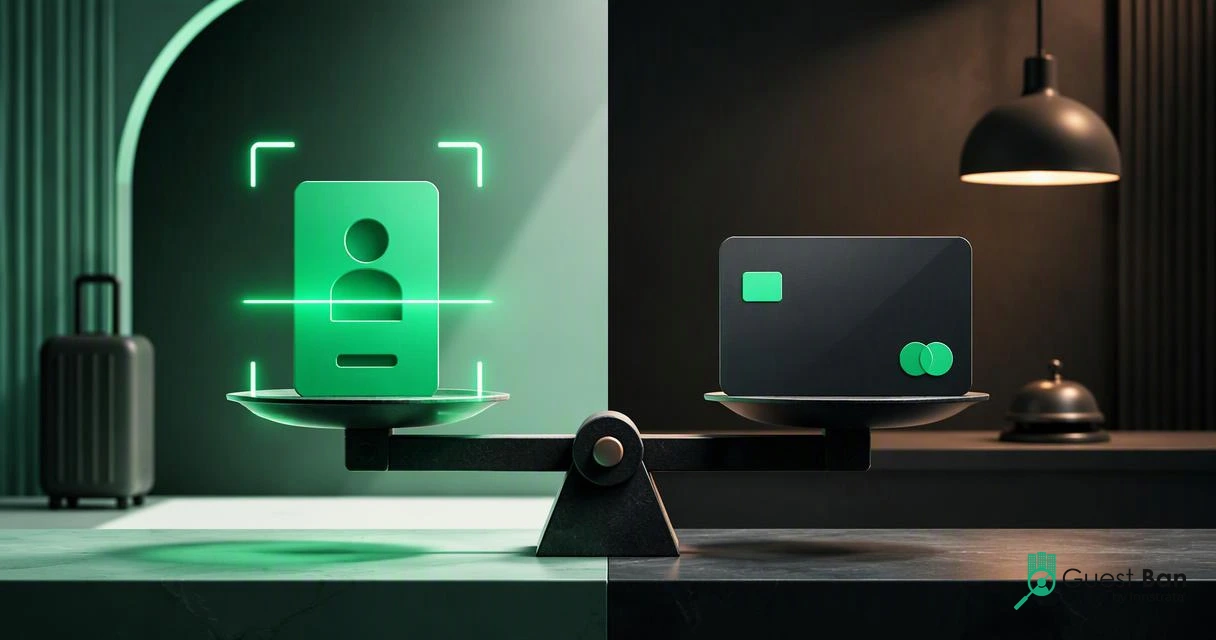
Hotel ID scanning and credit card authorization solve different check-in risks: the card proves payment access, while the ID helps verify identity, age, records, and documentation. Hotels should use both with clear privacy rules, staff scripts, and PMS workflows instead of treating one as a substitute for the other.
A credit card authorization can protect revenue, but it does not prove the person at the desk is who they claim to be. The practical answer to hotel ID scanning vs credit card authorization is simple: use authorization to secure payment, and use ID scanning to support identity verification, guest safety, age checks, records, and dispute documentation. GuestBan ID Scanning (https://guestban.com/) fits this operational gap by helping hotels capture guest identity data in a structured way during check-in.
Authorization hold: An authorization hold is a temporary hold placed by a credit or debit card provider on approved funds, reducing the cardholder's available balance until the hold clears or converts to a charge.
Hotel ID scanning: Hotel ID scanning is the process of capturing data from a government-issued ID or passport to help verify guest details, reduce manual entry, support policies, and create auditable check-in records.
Table of Contents
What does each check-in tool actually prove?
Credit card authorization proves access to a payment method, while ID scanning helps prove identity-related facts about the guest. A credit card, as defined in common banking usage, lets a cardholder buy goods or services on credit; a debit card draws from available funds. Neither card type automatically confirms age, legal name, address, or whether the person presenting it matches the reservation.
Hotels often ask for both because they answer different questions:
- Can this guest pay? Use credit or debit authorization.
- Who is staying? Use ID verification or scanning.
- Does the guest meet policy requirements? Check age, name, local rules, and internal restrictions.
- Can staff document the stay if a dispute occurs? Keep appropriate records under a defined retention policy.
Key takeaway: A card approval is not an identity check; an ID scan is not a payment guarantee.
In my view, the confusion starts when hotels treat the front desk as one single risk checkpoint. Payment risk, guest conduct risk, underage check-in risk, and documentation risk all overlap, but they are not the same risk.
Hotel ID scanning vs credit card authorization: side-by-side
The best comparison is based on the job each tool performs, not on which one feels more familiar to the front desk.

Front desk comparison table
| Check-in factor | Credit card authorization | Hotel ID scanning |
|---|---|---|
| Primary purpose | Confirms a card can cover room, tax, deposit, or incidentals | Captures identity details from a government ID or passport |
| Payment protection | Strong for funds availability and deposits | Indirect, helps match guest to reservation and payment record |
| Fraud prevention | Helps flag declined, stolen, or insufficient payment cards | Helps detect name mismatch, underage guests, repeat problem guests, or fake-looking documents |
| Chargeback support | Shows authorization attempt and transaction trail | Adds identity documentation that may support the stay record |
| Guest safety | Limited, unless tied to incidentals or cardholder data | Stronger for knowing who is on property and supporting do-not-rent workflows |
| Privacy risk | High if card data is mishandled | High if ID images or data are over-collected or retained too long |
| PMS workflow | Usually built into payment processing | Best when connected to PMS or centralized guest records |
| Best use | Securing revenue before keys are issued | Verifying and documenting the person receiving keys |
For chargeback-heavy properties, the two records should work together. A clean authorization trail plus identity documentation can help the hotel explain who checked in, what was presented, and how the stay was approved. For a deeper workflow view, see this guide to hotel chargeback documentation with ID scanning.
"If you collect it, protect it.", Federal Trade Commission, Protecting Personal Information: A Guide for Business
That FTC line is short, but it is the right mindset for both card data and ID data. A hotel should not collect more than it needs, and it should not keep sensitive data longer than the business purpose requires.
When should hotels rely on card authorization?
Hotels should rely on card authorization when the main question is whether the property can collect payment, deposits, or incidentals. Authorization is especially useful before issuing keys, extending a stay, approving a room move with added charges, or allowing incidentals at outlets.
A front desk team should treat authorization as a payment control, not a guest screening tool. The card network result may say the transaction is approved, declined, referred, or requires another step, but it does not tell staff whether the guest is old enough to rent the room or whether the ID matches the reservation.
Use a clear payment workflow:
- Confirm reservation name and payment policy.
- Request the physical card or approved digital payment method.
- Run authorization for room, tax, deposit, and incidentals.
- Record the authorization result in the PMS.
- Re-authorize when extending stays or increasing exposure.
- Reverse unused holds according to processor and hotel policy.
Card handling also carries a separate compliance burden. Hotels should avoid copying card numbers, storing unnecessary payment details, or creating side records outside approved payment systems. The 2022 paper on smart contracts, data sharing, and secure payment reflects a broader trend: payment security is moving toward controlled, auditable systems rather than informal data handling.
Operational rule: If the risk is unpaid room revenue, start with authorization; if the risk is unknown guest identity, do not stop at authorization.
When should hotels scan an ID?
Hotels should scan an ID when they need accurate identity capture, age verification, guest record consistency, passport details, or documentation for risk control. This matters most for cash-paying guests, walk-ins, extended stays, late-night arrivals, local guests, and properties with prior loss events.

ID scanning reduces manual typing errors because the front desk can capture data directly from the document rather than rekeying names and addresses. It also creates a more consistent process across shifts, which helps when a manager later reviews a stay, incident, refund request, or chargeback claim.
Useful ID scanning moments include:
- Walk-in check-in: Verify who is renting before issuing keys.
- Cash payment: Document identity because no cardholder record may exist.
- Extended stay: Keep guest records consistent across long stays and renewals.
- Underage policy checks: Confirm date of birth instead of relying on a visual guess.
- Do-not-rent review: Check internal records before approving the stay.
- Passport capture: Record international guest details with less manual entry.
Privacy planning matters here. Research on self-sovereign identity and cyber insurance architecture and a 2023 survey on smartphone security and privacy threats both point to the same modern reality: identity data has value, so access, retention, and security controls must be deliberate.
Hotels that want a policy template before changing the front desk flow can use this 2026 hotel ID scanning compliance checklist. It covers notice, consent, access, retention, deletion, vendor review, PMS workflows, and staff training.
"Security is a process, not a product.", Bruce Schneier, The Process of Security
That quote is useful for hotel operators because scanning hardware alone does not create a safe process. The policy, staff script, retention settings, and manager review are what make identity capture defensible.
How GuestBan ID Scanning handles the workflow
GuestBan ID Scanning is designed to make identity capture part of the check-in workflow rather than a separate clipboard process. The goal is not to replace payment authorization; the goal is to pair verified guest data with the hotel's operating rules.
The GuestBan ID Scanning platform can support front desk teams that need faster guest capture, better record consistency, and clearer documentation for managers. For properties comparing options, hotel ID scanning software should be judged by PMS fit, passport support, retention controls, do-not-rent workflows, and how easily staff can explain the process to guests.
A strong combined workflow looks like this:
- Ask for ID and payment using a standard script.
- Scan the ID to capture guest details accurately.
- Match the name against the reservation and payment method when policy requires it.
- Run the card authorization for room, tax, deposit, and incidentals.
- Document exceptions, such as declined cards, alternate payers, or local policy approvals.
- Store only approved data for the approved retention period.
- Review flagged stays through a manager or loss-prevention process.
GuestBan ID Scanning also makes sense for multi-property groups that need repeatable procedures. Centralized records can help managers see patterns across locations, not just isolated front desk notes. For that broader setup, the guide to centralized hotel ID scanning software explains how shared workflows can support consistency across properties.
If you are mapping this for your own property, I would start with one question: what decision should staff make differently after scanning the ID? If the answer is clearer age checks, safer cash check-ins, stronger do-not-rent screening, or better documentation, the workflow has a real business purpose. You can review more examples on guestban.com.
FAQ: hotel ID checks and payment authorization
Common hotel questions usually come down to whether ID scanning and card authorization are substitutes, and they are not.
Can a hotel accept credit card authorization without scanning an ID?
Yes, a hotel can authorize a card without scanning an ID if its policy and local rules allow it. That choice only confirms payment access. It does not provide the same identity record, age verification, or guest documentation that ID scanning can support.
Does ID scanning prevent credit card chargebacks by itself?
No, ID scanning does not prevent every chargeback by itself. It can support the hotel's evidence package by documenting who checked in, what identity information was presented, and how the stay was approved. Payment records, folios, signatures, communications, and PMS notes still matter.
Should hotels scan IDs for cash-paying guests?
Hotels often have a stronger reason to scan IDs for cash-paying guests because there may be no cardholder record tied to the stay. ID capture can help verify the renter, apply age rules, support safety procedures, and document the transaction when payment authorization is not available.
What should hotels tell guests who ask why their ID is scanned?
Staff should give a plain-language answer: the hotel scans IDs to verify guest information, apply safety and age policies, reduce check-in errors, and maintain required records. The answer should also explain what data is captured, who can access it, and how long it is retained.
Conclusion
Hotel ID scanning vs credit card authorization is not an either-or decision for 2026 operations. Authorization protects payment access; ID scanning supports identity, age, safety, records, and documentation. The strongest hotel workflow uses both, with a written policy that limits data collection and trains staff to explain the process clearly.
Your next step is practical: audit five recent check-ins, one standard card stay, one cash stay, one extended stay, one late-night arrival, and one disputed folio. If you cannot quickly prove who checked in, how payment was approved, and what exceptions staff allowed, tighten the workflow. To see how a hotel-first identity process can fit that gap, evaluate GuestBan ID Scanning and visit guestban.com for the next operational step.