

TL;DR
Hotels usually need to verify and record foreign guest identity, but a passport scan is not always legally required. Managers should separate legal registration duties from internal hotel policy, collect only necessary fields, and use secure ID scanning workflows when a copy is justified.
Foreign guests expect a smooth check-in, but front desk teams often face a harder question: do hotels need to scan passports for foreign guests, or is viewing the document enough? The safest 2026 answer is country-specific: many jurisdictions require hotels to verify identity and record guest details, while the right to scan or store a passport image depends on local lodging law, immigration rules, privacy law, and hotel policy. GuestBan ID Scanning helps hotels turn identity checks into cleaner guest records, but the first step is knowing what the law actually asks your property to collect.
Table of Contents
What does passport scanning mean at hotel check-in?
Passport scanning at hotel check-in means using a scanner, camera, or mobile capture tool to read passport information and create a digital record for verification, registration, PMS entry, or risk management.
Passport scan: a digital image or extracted data record from a passport identity page, machine-readable zone, or chip-enabled document.
Biometric passport: a passport with an embedded microprocessor chip that stores biometric information used to authenticate the holder, as described by Wikipedia's biometric passport definition.
Hotels often use the phrase "scan a passport" loosely. It can mean three different things, and each has a different privacy and compliance profile.
Passport capture methods compared
| Method | What the hotel keeps | Typical use | Privacy risk |
|---|---|---|---|
| Visual inspection | Nothing, or a manual note | Identity check | Lowest |
| Data extraction | Name, document number, nationality, date of birth | PMS and police registration fields | Moderate |
| Image copy | Full passport page image | Local legal copy requirement, chargeback evidence, audit file | Higher |
| Chip read | Chip data from biometric passport | Advanced identity authentication | Higher if not tightly controlled |
A manager should not treat these methods as interchangeable. A field-only scan that extracts guest data is not the same as storing a full passport image. For a deeper operational comparison, see passport scanning vs passport photocopying for hotels.
Do hotels need to scan passports for foreign guests?
Hotels do not universally need to scan passports for foreign guests; they usually need to verify identity and record legally required guest details. Some countries or cities require guest registration reports, and some hotel policies require scans, but privacy rules often favor collecting the minimum information needed rather than storing a full passport image.
The key distinction is legal duty versus operational preference. A government may require the hotel to record a foreign guest's name, nationality, passport number, address, arrival date, or departure date. That does not automatically mean the hotel must keep an image of the passport.
Key takeaway: Ask, "What fields must we report or retain?" before asking, "Can we keep a passport copy?"
Foreign guest rules are common in Europe, Asia, the Middle East, and parts of Latin America. Still, the exact process can vary by country, region, city, property type, guest nationality, and length of stay.
Practical decision table for managers
| Situation | Is a scan usually necessary? | Better manager question |
|---|---|---|
| Law requires guest identity verification | Not always | Which ID fields are mandatory? |
| Law requires electronic police or tourism reporting | Sometimes | Does the portal require an image or only data? |
| Hotel wants faster PMS entry | Optional | Can we extract fields without storing the image? |
| Hotel wants chargeback support | Policy-based | What evidence is proportionate and secure? |
| Guest objects to scanning | Depends | What does law, booking policy, and privacy notice say? |
When a guest refuses, train staff to avoid improvising at the desk. A clear escalation process protects the hotel and the traveler; this related guide explains whether a guest can refuse hotel ID scanning.
What laws usually require from hotels
Hotel identity rules usually require verification, accurate registration records, and sometimes transmission to local authorities; they do not always require retaining a full passport image.
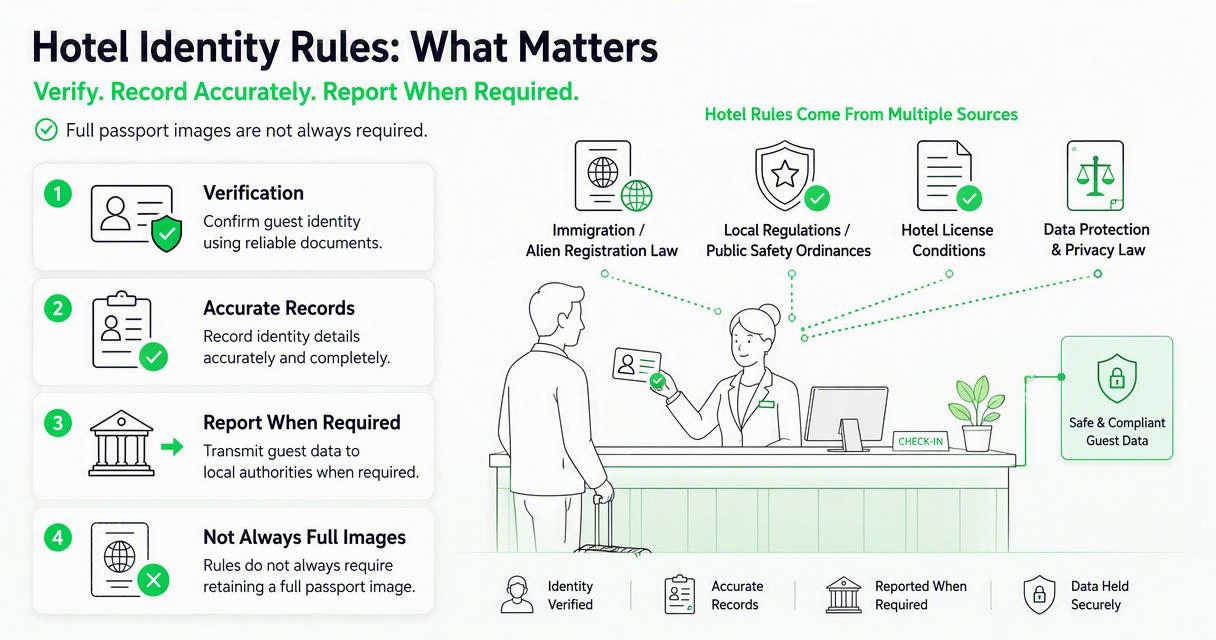
In practice, hotel rules come from several sources at once:
- Immigration or alien registration law: often focused on foreign nationals.
- Local lodging or tourism law: may apply to all guests or specific accommodation types.
- Police reporting rules: may require daily or real-time guest data submission.
- Tax and city registration rules: may need residency, address, or stay details.
- Privacy law: limits what the hotel can collect, store, share, and keep.
For hotels serving international guests, the compliance challenge is that the front desk feels one workflow, while the law may contain several separate duties.
"Personal data shall be: adequate, relevant and limited to what is necessary in relation to the purposes for which they are processed.", European Union, General Data Protection Regulation, Article 5
That data minimization rule matters in the European Union and is influential beyond it. If your property can satisfy a legal registration duty by recording specific fields, keeping a full passport image may need a separate legal basis, retention policy, and access control.
Hotels outside the EU still face similar expectations from card networks, regulators, insurers, and guests. The management principle is simple: document the reason for each data point you collect.
Identity verification terms to separate
- Verification: checking that the person presenting the passport matches the document.
- Registration: recording required stay and identity details in a hotel register or PMS.
- Reporting: sending required guest data to police, immigration, or tourism authorities.
- Retention: keeping guest records for the required period and deleting them afterward.
- Screening: checking guest records against internal risk alerts or loss prevention rules.
These steps often happen together, but they should be governed separately. I recommend mapping each step in a written check-in standard operating procedure, then matching every field to a legal or operational purpose.
When passport scanning is operationally reasonable
Passport scanning is operationally reasonable when it reduces manual errors, supports required reporting, improves check-in speed, and avoids unnecessary full-document storage.
Manual passport entry is slow. It also creates avoidable mistakes in names, dates, document numbers, and nationalities. Those errors can break police reports, confuse PMS profiles, delay night audit, and weaken the hotel's position during disputes.
A well-designed scan workflow can help when it captures structured data, validates staff review, and sends clean fields into the PMS. If your property is trying to reduce front desk typing, this guide on hotel guest data capture automation covers the broader workflow.
The best hotel process is not "scan everything." It is "capture the right data once, secure it, and use it consistently." GuestBan ID Scanning is built for that kind of controlled front desk workflow, especially where managers want faster records without leaving staff to interpret every document manually.
Good reasons to scan or parse passport data
- Required reporting: the jurisdiction requires electronic guest registration.
- PMS accuracy: the property wants fewer spelling and date errors.
- Faster check-in: the desk handles buses, tours, or peak arrival waves.
- Audit consistency: managers need standardized records across properties.
- Fraud reduction: the hotel needs better document-to-guest matching.
- Guest safety: the property needs reliable identity records during emergencies.
Parsing passport data is usually easier to justify than keeping an image forever. If the scan produces only the fields your property needs, you reduce privacy exposure while improving operations.
What passport data should hotels collect?
Hotels should collect the smallest set of passport data that satisfies law, security, payment, and operational needs for the stay.
Common fields include full name, nationality, date of birth, passport number, issuing country, arrival date, departure date, and room assignment. Some jurisdictions also ask for home address, visa details, or signature. Your final list should come from local counsel, government guidance, and your own risk policy.
Do not assume that more data equals more protection. Full passport images contain sensitive details that may not be needed for every stay. They also raise the stakes if data is accessed improperly.
"Everyone has the right to respect for his or her private and family life, home and communications.", European Union, Charter of Fundamental Rights of the European Union, Article 7
This privacy principle is a useful lens even when your hotel is not in Europe. Guests understand ID checks, but they expect the hotel to handle identity documents with restraint.
Field-by-field collection guide
| Data element | Usually reasonable? | Manager note |
|---|---|---|
| Full legal name | Yes | Needed for registration and PMS match |
| Passport number | Often | Common for foreign guest records |
| Nationality | Often | Common in lodging reports |
| Date of birth | Sometimes | Use if required or needed for verification |
| Full passport image | Depends | Keep only with legal basis or clear policy need |
| Visa page | Rarely | Usually only if local rules require it |
| Biometric chip data | Rarely | Needs strong justification and security |
| Emergency contact | Optional | Better collected separately with consent |
A simple rule works well: if a front desk agent cannot explain why the hotel needs a field, the field belongs on a manager review list.
How managers should control passport data
Managers should control passport data through written policies, role-based access, retention limits, staff training, and regular checks against local law.
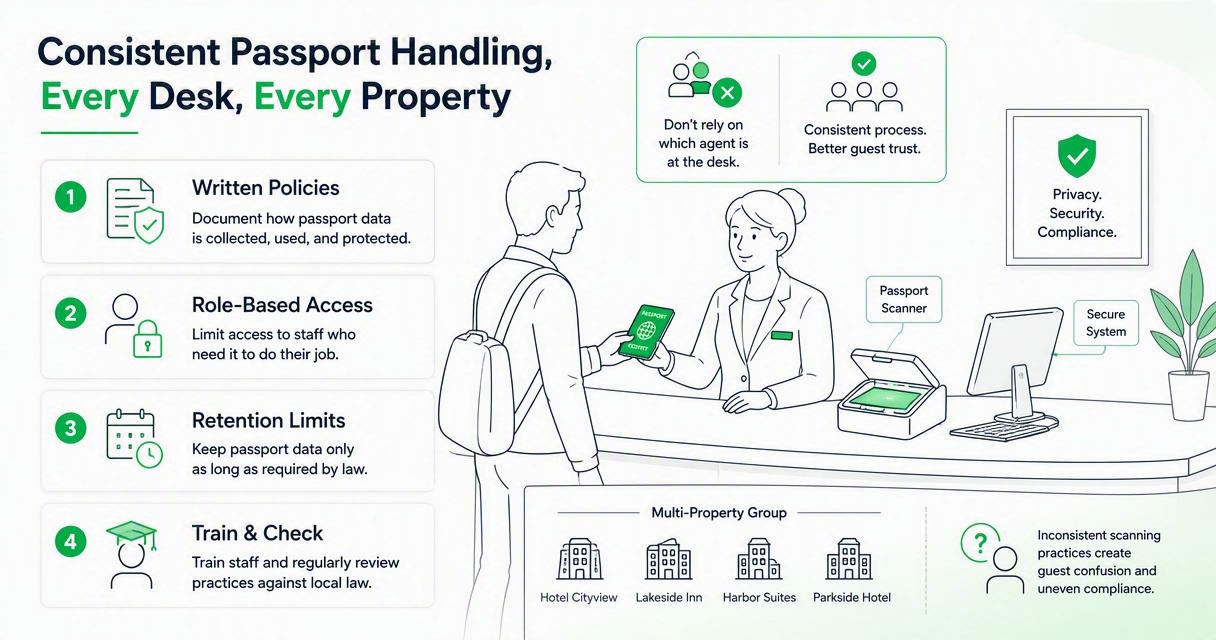
Passport handling should not depend on which agent is working the desk. In multi-property groups, inconsistent scanning practices create guest confusion and uneven compliance. A short, practical standard is better than a long policy no one reads.
I like a one-page "foreign guest ID workflow" at each front desk. It tells the agent what to inspect, what to capture, what to say to guests, where records go, and when to escalate.
Manager checklist for passport handling
- Confirm local requirements: identify which guests, fields, reports, and retention periods apply.
- Separate fields from images: decide when data extraction is enough and when an image is allowed.
- Update the privacy notice: tell guests what is collected, why, and how long it is kept.
- Limit access: give passport records only to staff who need them.
- Set deletion rules: remove records when retention duties expire.
- Train scripts: teach agents how to explain the process without sounding accusatory.
- Audit monthly: sample records for missing fields, excess images, and policy drift.
- Standardize across properties: keep brand rules consistent unless local law differs.
For identity workflows beyond passports, hotels can also review guest verification software for hotels to connect ID checks with operating controls.
How GuestBan ID Scanning handles passport checks
GuestBan ID Scanning helps hotels capture guest ID details in a controlled workflow so managers can improve accuracy while keeping policy decisions clear.
The platform is most useful when the hotel has already defined what it needs to collect. Then the front desk can use a repeatable process rather than free-typing passport data or saving inconsistent copies. With GuestBan ID Scanning, the operational goal is simple: cleaner guest records, faster check-in, and fewer avoidable data-entry gaps.
A good tool should support the hotel's rules, not replace them. Your counsel or compliance lead should still confirm the local law, but the system can help staff follow the approved workflow once that rule is set.
For properties comparing hardware and desk setup, the best document scanners for hotel front desks in 2026 guide can help operations teams choose equipment that fits passports, IDs, counter space, and PMS workflows.
What should hotels expect in 2027?
Hotels should expect more digital identity checks, more privacy scrutiny, and less tolerance for unmanaged passport copies in 2027.
Travel identity is moving toward app-based credentials, biometric passports, electronic visas, and pre-arrival verification. That does not remove the hotel's duty to verify guests. It changes where the check happens and how much data the property needs to store.
The likely direction is practical, not futuristic: fewer photocopies, more field-level extraction, better consent language, and stronger audit trails. Operators that still keep passport images in shared folders or paper binders will look increasingly dated.
The International Journal of Information Management article on emerging digital systems notes that new technologies create challenges for "research, practice and policy," a point that fits hospitality identity checks as guest data moves across more platforms ScienceDirect, 2022. Tourism research also keeps emphasizing sustainable and responsible development, which includes how destinations and businesses treat people, communities, and data Sustainability, 2021.
2027 preparation list
- Replace photocopy-first habits with field-level capture where lawful.
- Review whether passport images are actually required in each market.
- Add guest-facing language to confirmations and check-in instructions.
- Centralize retention settings across the PMS, scanner, and storage tools.
- Train managers to handle privacy questions calmly and consistently.
If your team is modernizing check-in, GuestBan ID Scanning is worth reviewing as part of a broader front desk data capture plan. You can also visit guestban.com when you are ready to compare options.
FAQ: Hotel passport scanning for foreign guests
These questions cover the situations hotel managers and front desk teams face most often when handling foreign guest passports.
Can a hotel legally hold a guest's passport?
A hotel should not hold a guest's passport unless local law specifically allows or requires it, or the guest clearly agrees for a short operational reason. In many situations, the hotel only needs to inspect the document and record required details. Keeping the physical passport creates guest trust issues and operational risk.
Is scanning safer than photocopying a passport?
Scanning can be safer than photocopying when the system extracts only needed fields, limits access, encrypts storage, and follows deletion rules. A scan is not automatically safer if the hotel stores full images forever or allows broad staff access. The process, not the technology alone, determines risk.
Can hotels scan passports for domestic guests too?
Hotels may verify domestic guests with accepted ID, but the need to scan or store passport data depends on local law and hotel policy. Domestic guests may present a driver's license, national ID card, or passport. Apply the same data minimization rule: capture what is needed, not every available detail.
What should staff say if a foreign guest asks why their passport is needed?
Staff should give a short, factual answer: "We need to verify identity and record the guest details required for hotel registration. We collect only the information our policy and local rules require." If the property stores an image, staff should also explain the reason, retention period, and escalation option.
Conclusion
The answer to "do hotels need to scan passports for foreign guests" is not a universal yes. Hotels usually need to verify identity and record required guest details; scanning becomes necessary only when local rules, reporting systems, or a documented hotel policy justify it. Your next step is to audit the exact fields your property collects, remove anything you cannot justify, train staff on a single script, and choose tools that support that policy. If you want a cleaner check-in process built around controlled ID capture, evaluate GuestBan ID Scanning and head to guestban.com to plan your next front desk upgrade.