

TL;DR
Connect ID capture to the reservation, factual front desk notes, and a defined security handoff. Keep room eligibility separate from gaming access, and pair identity records with payment authorization rather than treating a scan as complete chargeback protection.
A casino hotel needs separate decisions about room eligibility, gaming access, and payment approval. Hotel ID scanning for casino hotels should connect those decisions without confusing them.
Casino hotel ID scanning: The electronic capture of identification details to support lodging registration, age checks, and authorized guest-record matching at a property with both accommodation and gambling facilities.
I recommend designing the handoff between departments before selecting hardware. GuestBan ID Scanning is a hotel-focused option for connecting ID capture with property management system workflows and do-not-rent records.
Table of Contents
What should casino hotel ID scanning verify?
Casino hotel ID scanning should support identity matching, date-of-birth checks, and guest-record review before room access is approved. Staff should compare the guest with the presented document and apply the property's lodging rules. A room-registration check doesn't automatically establish permission to enter gaming areas or purchase alcohol.
Separate registration, gaming, and payment decisions
There isn't one universal age threshold for every casino hotel interaction. Confirm the applicable jurisdiction, gaming rules, and property check-in policy rather than applying a blanket age rule across the building.
Three controls with different purposes
| Control | What it supports | Separate decision required |
|---|---|---|
| Lodging ID capture | Matching the arriving guest to registration details | Whether the guest meets room-booking policy |
| Gaming age verification | Checking age against applicable entry requirements | Whether casino access is permitted |
| Payment authorization | Establishing payment approval under the payment workflow | Whether funds and authorization meet hotel policy |
For staff training, use the underage guest prevention guide to build consistent checks and exception handling. Keep hotel do-not-rent decisions distinct from regulated gaming exclusion processes.
How do you connect ID capture with security escalation?
- Explain the ID capture purpose before scanning.
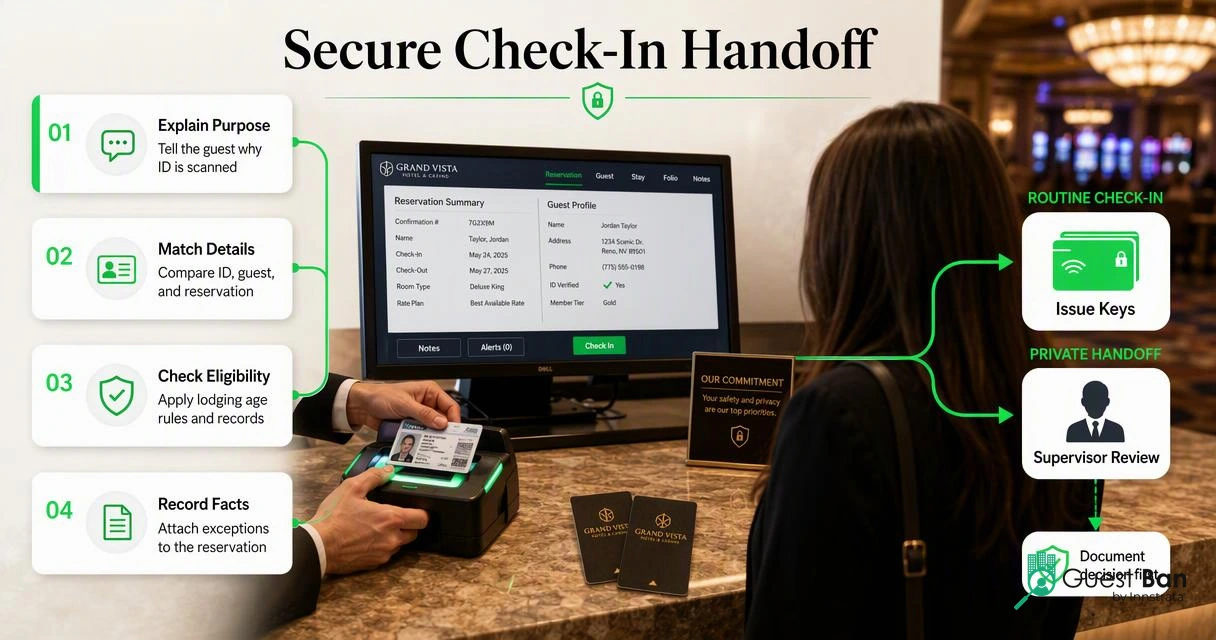
- Compare the guest, document, and reservation details.
- Apply lodging age rules and check authorized guest records.
- Record factual exceptions against the correct reservation.
- Route unresolved concerns to a named supervisor or security contact.
- Document the decision before issuing keys.
Use one record and a clear handoff
I recommend a short exception path beside the normal check-in path. If a record needs review, a supervisor can handle it while another agent continues routine arrivals. Staff should use a private handoff rather than discuss sensitive notes across the lobby.
A useful incident entry contains:
- Reservation or guest-record identifier.
- Date, time, and staff member.
- Observed behavior or document discrepancy, without speculation.
- Reviewing supervisor and action taken.
- Follow-up owner and review date.
For example, a hypothetical name mismatch should create a review task, not an automatic accusation. The supervisor checks the booking explanation and records whether registration proceeds.
A guest-record alert is a prompt for authorized review, not a substitute for judgment.
Security should record incident outcomes in the approved system. Front desk staff need the resulting instruction, such as supervisor approval required, rather than unrestricted access to every investigative detail.
How GuestBan ID Scanning handles this
The platform brings hotel ID capture, PMS integration, and do-not-rent record workflows into the same operational discussion. For casino hotels, I would evaluate it around the complete arrival process: capturing the document, matching the registration, presenting relevant guest information, and supporting a consistent staff response.
Validate the workflow against your actual PMS
Use a demonstration with sample reservations to establish exactly which fields reach your PMS, how existing guest records are matched, and where staff see alerts. Confirm supported documents, permissions, and property-group settings for the proposed configuration.
My acceptance checklist would include:
- A routine arrival with a matching reservation.
- A returning guest with an existing property record.
- A supervisor-approved exception with a documented outcome.
- A multi-property record review with the correct access boundaries.
Treat these as purchasing requirements to verify, not assumed features of every installation. A successful pilot should show staff completing each task clearly, including the handoff between reception and authorized reviewers.
For multiple properties, define which records remain local and which may be shared. A lodging restriction should include its scope, reason, approving role, and review date so another property can interpret it correctly.
Keep payment evidence and privacy controls separate
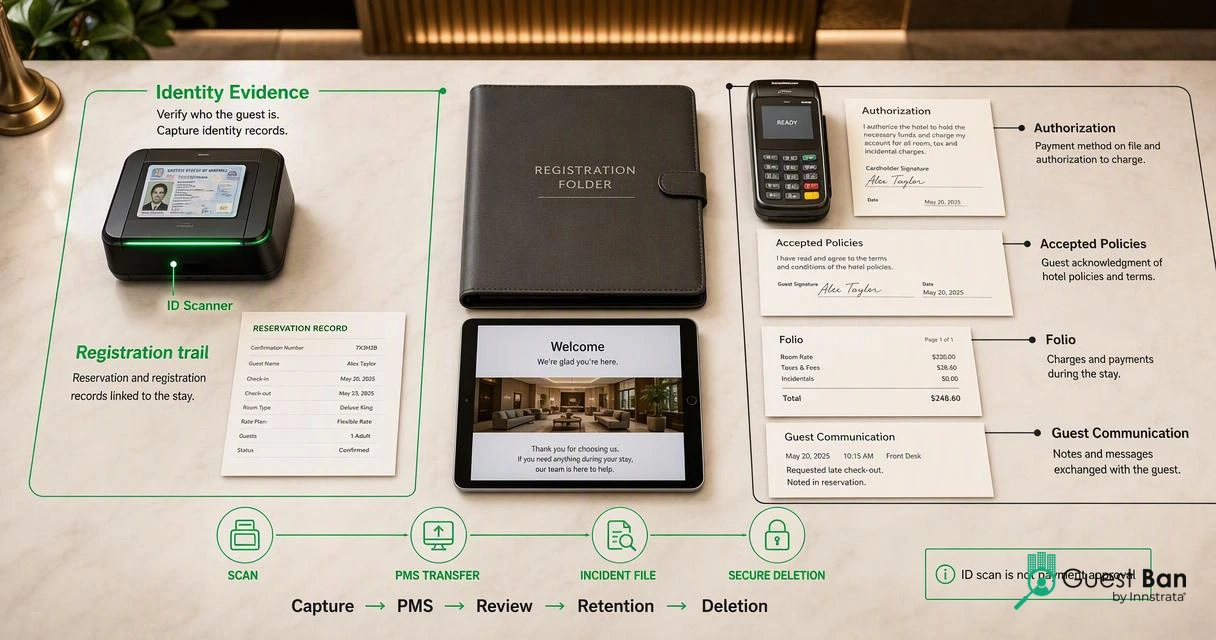
A useful casino hotel record combines identity evidence with separate payment documentation and purpose-limited access. ID capture supports the registration trail; payment authorization, accepted terms, and transaction records serve different purposes. Privacy controls should follow the data through capture, PMS transfer, incident review, retention, and deletion.
Build evidence around the reservation
An ID scan alone doesn't prove that a cardholder authorized a transaction or that a chargeback will be decided in the hotel's favor. For card-paid stays, retain the relevant authorization record, accepted policies, folio, and communications under approved procedures.
For cash-paid stays, document the deposit, receipt, and refund conditions separately. Identity capture doesn't establish how much cash changed hands. The hotel chargeback documentation guide provides a focused follow-up for organizing dispute evidence.
Approve access and retention before rollout
Give front desk, security, and management access according to their responsibilities. Ask whether extracted fields are enough for each purpose before retaining full document images. Establish deletion schedules and a controlled process for justified legal holds.
Use the 2026 hotel ID scanning compliance checklist to review notice, consent where required, vendor responsibilities, and staff training.
Collect for a defined purpose, restrict access by role, and retain records under an approved schedule.
Casino hotel ID scanning FAQ
These answers separate lodging registration from gaming access, payment disputes, and cross-property record sharing.
Does scanning an ID prove that the document is genuine?
Reading an ID's barcode or text isn't the same as authenticating the document. Ask the vendor which validation checks are included and which require separate services or hardware. Staff should still compare the photo with the guest and follow a documented review process when the document or reservation needs clarification.
Should every casino hotel department see the scanned ID?
No. Access should reflect each department's approved task, not simply its location within the resort. Reception may need registration fields, while security may need an incident reference and relevant identity details. Management should approve access boundaries, review permissions periodically, and establish when sharing is necessary and legally permitted.
Can one scan cover hotel check-in and casino entry?
One capture may support multiple approved workflows, but it doesn't automatically satisfy every department's requirements. Hotel registration and gaming entry can involve different rules, systems, and verification steps. Confirm the applicable requirements before reusing data, and tell guests how their information will be used across those workflows.
Conclusion
Start with one supervised check-in pilot
A focused pilot gives managers a practical basis for approving the workflow. Select one desk, name a supervisor, and test routine registration, record matching, and documented exceptions.
To evaluate GuestBan ID Scanning, visit guestban.com and request a demonstration using your PMS and property policies. Ask for a walkthrough from ID capture to guest-record review and supervisor handoff before committing to a wider rollout.