

TL;DR
A strong consent form tells guests why their ID is scanned, what data is captured, who can access it, how long it is kept, and how they can ask questions. Use plain language at the desk, collect only what you need, and align the form with your PMS, privacy policy, and retention rules.
A hotel ID scanning consent form should do more than collect a signature; it should make identity verification clear enough that a tired guest at 11 p.m. understands what is happening. Hotels now use digital ID capture for check-in speed, fraud prevention, guest safety, chargeback documentation, and operational consistency. Tools like GuestBan ID Scanning can support that workflow, but the consent language still needs to explain the hotel's purpose, data handling, and guest choices in plain English.
Table of Contents
What is a hotel ID scanning consent form?
A hotel ID scanning consent form is a short disclosure that explains how a hotel captures, uses, stores, and protects identity document information during check-in. It should tell guests the purpose of the scan, the data fields collected, the retention period, who can access the record, and whom to contact with privacy questions.
Hotel ID scanning consent form: A guest-facing notice and acknowledgement used before or during check-in to document that the guest received clear information about ID capture.
Informed consent: A decision made after a person receives enough relevant information to understand the action, the practical risk, and the available choice.
ID scan: A digital capture of information from a passport, driver's license, state ID, or other government-issued document.
"Personal data shall be: processed lawfully, fairly and in a transparent manner in relation to the data subject." – European Union, General Data Protection Regulation, Article 5
For hotels, the key word is transparent. A guest should not discover after check-in that the property stored a full document image, shared it with a third-party system, or kept it longer than expected.
What should the form disclose before scanning?
A consent form should disclose five things before scanning: purpose, data captured, storage location, access rules, and retention period. It should also name the hotel operator, explain whether scanning is required for check-in, and give guests a simple way to ask questions before they hand over an ID.
Consent form disclosure checklist
| Disclosure item | What to write in plain English | Why it matters |
|---|---|---|
| Purpose | We scan your ID to verify identity, support check-in, protect guests and staff, and document the stay. | Connects the scan to a specific hotel need. |
| Data captured | We may capture your name, date of birth, document type, document number, expiration date, address, and document image if enabled. | Prevents surprise over sensitive fields. |
| Use limits | We use this information for hotel operations, security, payment dispute support, and legal compliance when applicable. | Narrows the hotel's allowed use. |
| Access | Access is limited to authorized hotel, management, security, or compliance staff. | Shows that not every employee can view records. |
| Retention | We keep the record for a defined period, then delete or anonymize it under policy. | Reduces open-ended storage concerns. |
| Vendor role | If a scanning provider processes the data, identify the category of provider and its role. | Supports vendor transparency. |
| Guest questions | Guests may ask the front desk or privacy contact how the scan is handled. | Gives the guest a clear next step. |
Avoid vague language like "for your convenience" as the only purpose. Speed is useful, but it rarely justifies ID capture by itself. Stronger language ties scanning to identity verification, fraud reduction, incident documentation, age policy checks, and compliance with house rules.
Hotels with longer stays should also connect the disclosure to recurring risk. Extended-stay properties often need consistent ID records across shifts, renewals, and incident reviews, which is why a purpose-built workflow for ID scanning for extended-stay hotels can be easier to govern than ad hoc photocopies.
How should staff ask for consent at check-in?
Staff should ask for consent by explaining the scan in one sentence, offering the written notice, and pausing for questions before capturing the document. The best front-desk language is calm, specific, and repeatable across shifts so guests hear the same explanation from every employee.
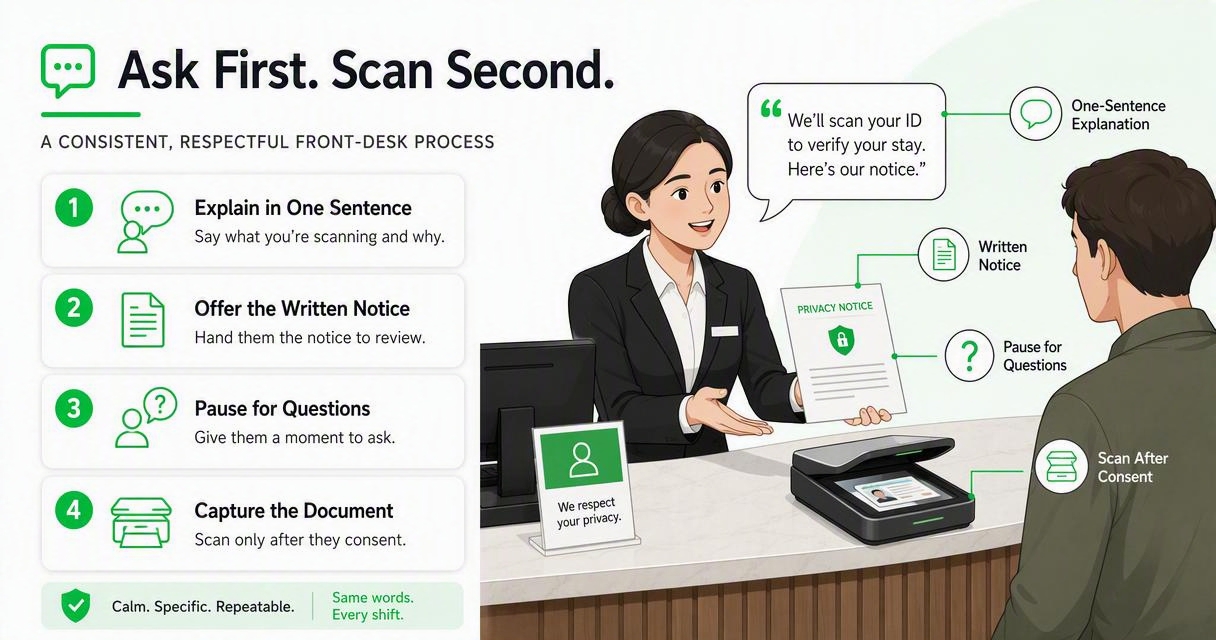
Front desk script for standard check-in
Use a script that sounds human, not legal. I recommend training the team to say the same core message, then adapt only the greeting.
- "For check-in, we scan your ID to verify the reservation and protect guest records."
- "The notice here explains what we capture, how long we keep it, and who can access it."
- "Please review this acknowledgement before I scan the ID."
- "If you have questions, I can answer them before we continue."
That script works because it separates verification from consent. The guest is not rushed into handing over a document before hearing why the scan is needed.
Script for a guest who hesitates
Some guests hesitate because they think the hotel is storing more than needed. Others have been affected by identity theft and want a direct answer.
- "I understand. We use the scan for identity verification and stay documentation, not for marketing."
- "Only authorized staff can access the record."
- "Our policy defines how long the record is retained."
- "If you prefer not to be scanned, I can explain the hotel's identity verification options and requirements."
If refusal comes up often, give staff a written escalation path. Your managers should decide in advance when manual verification is allowed, when scanning is required by policy, and when the hotel may decline check-in. For a deeper treatment of refusal scenarios, see Can a Guest Refuse Hotel ID Scanning?
What data should hotels collect?
Hotels should collect the minimum ID data needed for identity verification, stay documentation, risk control, and applicable legal duties. A consent notice should separate required fields from optional fields, because guests deserve to know whether the hotel stores a full image or only selected text fields.
Minimum practical data map
| Data element | Usually needed? | Notes for the consent notice |
|---|---|---|
| Full name | Yes | Used to match reservation and registration card. |
| Date of birth | Sometimes | Needed for age-restricted policies, alcohol packages, or underage guest controls. |
| Document type | Yes | Passport, driver's license, state ID, or other accepted ID. |
| Document number | Often | Useful for duplicate guest detection and dispute records. |
| Expiration date | Often | Helps confirm the ID is current. |
| Address | Depends | May already exist in the PMS or reservation source. |
| Full document image | Depends | Higher privacy sensitivity, so disclose clearly if retained. |
| ID photo crop | Depends | Useful for identity matching, but still sensitive biometric-adjacent information. |
Collecting less is usually easier to defend. If your property does not need a field for operations, security, payment defense, or law, don't collect it just because the scanner can read it.
This is where policy and system design meet. A scanner that allows field selection, role-based access, and retention settings makes the written consent easier to honor in practice.
How long should scanned ID records be kept?
Scanned ID records should be kept only as long as the hotel has a defined operational, legal, security, or payment documentation reason. The consent form should name the retention period or explain the retention schedule, then state that records are deleted or anonymized when no longer needed.
Retention schedule examples
| Record type | Common business reason | Consent form language to adapt |
|---|---|---|
| Active stay record | Check-in, incident response, payment verification | Kept during the stay and for a limited period after departure. |
| Chargeback evidence | Payment dispute support | Kept long enough to respond to card network or processor documentation requests. |
| Security incident record | Safety review, trespass documentation, DNR decisions | Kept under the hotel's incident retention policy. |
| Legal hold record | Claim, subpoena, law enforcement request, litigation | Kept while the legal hold remains active. |
Never let "forever" become the default. Long storage creates more exposure, more access questions, and more work when guests ask what happened to their data.
"The data subject shall have the right to withdraw his or her consent at any time." – European Union, General Data Protection Regulation, Article 7
Withdrawal rules vary by jurisdiction and by the hotel's lawful basis for processing. Still, the operational lesson is simple: your form should not promise deletion on demand if the hotel must keep a record for a payment dispute, legal hold, or required registration obligation.
For a longer policy model, use a dedicated hotel ID scanning privacy policy template for 2026 alongside the shorter check-in acknowledgement.
How GuestBan ID Scanning supports consent workflows
GuestBan ID Scanning supports consent workflows by helping hotels standardize ID capture, reduce manual handling, and keep guest identity documentation tied to an operational process. A good platform cannot replace legal review, but it can make the hotel's policy easier for front-desk teams to follow.
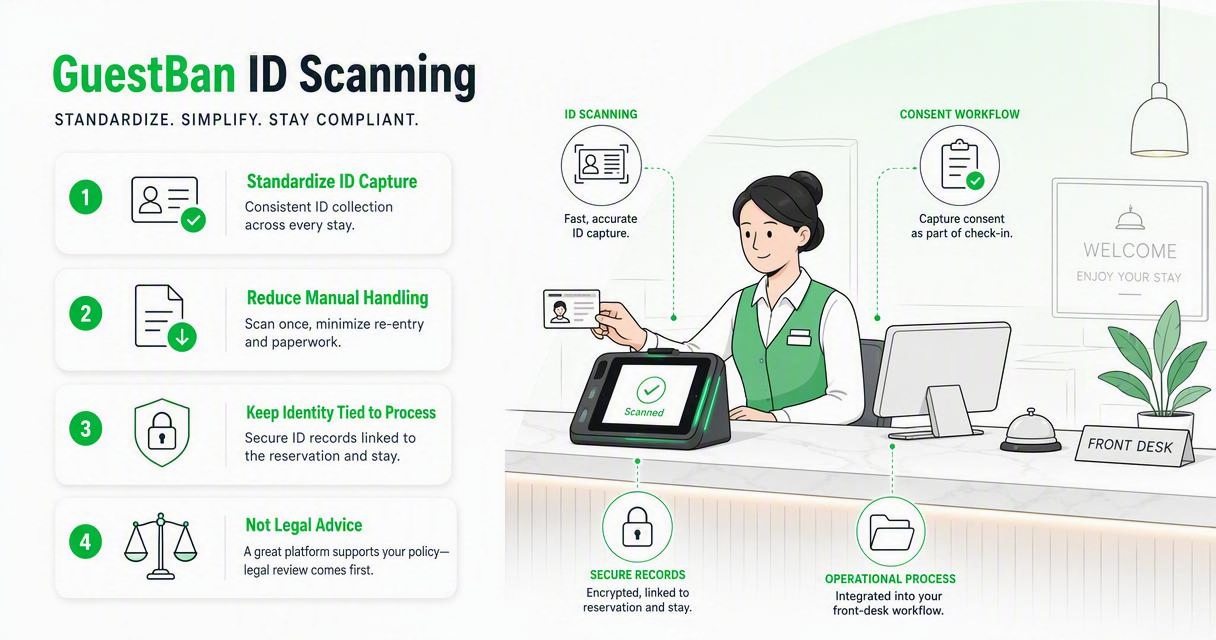
Operational controls to pair with your form
When I review a hotel scanning workflow, I look for controls that match the consent language. If the form says access is limited, the system should limit access. If the form says records are retained on a schedule, the system should support that schedule.
- Standardized capture: Staff follow the same scan process at each property.
- PMS-ready workflow: ID data can support registration and verification without extra retyping.
- Role awareness: Managers can separate front desk tasks from review or compliance tasks.
- Documentation value: Records can help with incident review and payment dispute support when policy allows.
- Training consistency: The same language can be taught across shifts and locations.
The GuestBan ID Scanning platform is especially relevant for operators who want one process across multiple properties instead of a mix of photocopies, screenshots, and handwritten notes. To compare software features and operational fit, review this guide to hotel ID scanning software.
For brand and implementation details, hotel teams can also visit guestban.com after drafting their internal consent language.
What should the actual consent form say?
The actual consent form should be short enough for check-in, but specific enough to document disclosure. Use this template as a starting point, then have counsel adapt it for your jurisdiction, brand standards, PMS setup, vendor contracts, and retention policy.
Sample hotel ID scanning consent form language
Guest ID Scanning Notice and Acknowledgement
To complete check-in, [Hotel Name] may scan your government-issued identification to verify your identity, confirm reservation details, support guest and staff safety, document the stay, and help prevent fraud or payment disputes.
The scan may capture your name, date of birth, document type, document number, expiration date, address, ID photo, and document image, depending on the ID type and hotel settings.
Access to scanned ID information is limited to authorized hotel, management, security, compliance, or service provider personnel who need it for approved hotel purposes.
We retain scanned ID information according to our retention policy and delete, anonymize, or restrict it when it is no longer needed, unless a legal, security, payment, or compliance reason requires continued retention.
By signing below, you acknowledge that you received this notice before ID scanning and had the opportunity to ask questions.
Guest name: ____________________ Date: __________
Signature: ______________________ Staff initials: _________
Keep the form separate from unrelated terms when possible. A guest should not have to read a full rental agreement to find the ID scanning disclosure.
Also, match the form to the real configuration. If your system does not store a document image, don't say it does. If it does store the image, don't hide that fact in a general privacy policy.
What will change for hotel consent in 2027?
Hotel consent will likely become more specific, more digital, and more audit-friendly in 2027 as ID scanning, self-check-in kiosks, mobile registration, and AI-assisted risk tools become more common. Guests will expect shorter notices, but regulators and brand owners will expect better proof that disclosure happened.
2027 readiness checklist
The hotels that handle this well will treat consent as an operating control, not a PDF hidden in a binder. Research on generative AI by Dwivedi, Kshetri, Hughes, and co-authors highlights how new digital systems raise policy and practice questions across organizations, which is relevant as hotels add more automation to identity workflows in the International Journal of Information Management.
Prepare now by building these habits:
- Use a consent version number, date, and property name.
- Keep a log showing when the guest received the notice.
- Review vendor contracts for data processing, breach notice, and deletion terms.
- Train staff to explain the scan in under 20 seconds.
- Audit random check-ins to confirm the script and system match the policy.
- Update signs, kiosk screens, and mobile check-in flows at the same time.
A paper form can still work, but digital acknowledgement is easier to search, audit, and connect to the guest record. That matters when a manager has to answer a privacy question six months after checkout.
FAQ
Is guest consent always required before hotel ID scanning?
Consent requirements depend on location, the type of data captured, and the hotel's legal basis for processing. Even when a hotel relies on contract, legal obligation, or legitimate business need, it should still give clear notice before scanning. Treat disclosure as a baseline practice, then confirm the exact consent requirement with local counsel.
Can a hotel refuse check-in if a guest will not allow an ID scan?
A hotel may often require lawful identity verification as a condition of check-in, but the answer depends on local law, brand policy, reservation terms, and whether a reasonable manual alternative exists. Staff should not improvise. Give them a written escalation process for refusals, exceptions, and manager approval.
Should the consent form be printed, digital, or both?
Digital forms are easier to timestamp, store, and audit, while printed forms can help during outages or low-tech check-in situations. Many properties use both: a digital acknowledgement for normal operations and a printed backup for exceptions. The wording should stay consistent across formats.
Does a privacy policy replace the check-in consent form?
No. A privacy policy explains the hotel's broader data practices, while the check-in form gives a short, timely disclosure before the scan occurs. Use both documents together. The form should summarize the key points, then point guests to the full privacy policy for more detail.
Who should approve the final wording?
Hotel management, operations, risk, IT, and legal counsel should all review the final wording. Operations confirms the language matches the front-desk workflow. IT confirms the system settings. Legal confirms jurisdiction-specific requirements. Risk management confirms retention and access rules match the hotel's incident and dispute documentation needs.
Conclusion
A hotel ID scanning consent form works best when it is short, specific, and operationally true. Start by mapping the data you capture, the reason you capture it, who can view it, and when it is deleted. Then train staff with one clear script and keep the signed or digital acknowledgement connected to the guest record.
If your team is replacing photocopies or inconsistent manual checks, evaluate GuestBan ID Scanning as part of a cleaner, policy-aligned check-in workflow. Draft the notice, confirm it with counsel, train the front desk, and run a 30-day audit to make sure the words on the form match what happens at the desk.