

TL;DR
Document every trespass notice with the guest identity, reason, notice delivery method, staff witnesses, safety actions, and follow-up plan. Use a consistent template, attach ID and incident records when allowed, and make handoffs easy for front desk, night audit, management, and security.
A trespass notice is only as useful as the record behind it. For hotel teams, hotel trespass notice documentation connects the front desk decision, the guest's identity, the facts of the incident, and the next-shift instructions that keep staff from guessing. I recommend treating every ban decision as an operational record, not just a legal form, and tools like GuestBan ID Scanning can help hotels keep guest identity capture and internal alerts more consistent across shifts and properties.
Table of Contents
What is hotel trespass notice documentation?
Hotel trespass notice documentation is the written record a hotel keeps when it tells a person they may not enter or remain on the property. It should identify the person, explain the conduct behind the decision, record how notice was delivered, and give staff clear instructions if the person returns.
Hotel trespass notice: A hotel's written or recorded notice that a person is not permitted to enter, remain on, or return to the property, subject to local law and company policy.
Municipal trespass guidance commonly focuses on notice, delivery, police coordination, and what to do if the person returns. For example, Loudoun County's public guidance says property owners may complete a trespass notification form or letter and send a copy by certified mail with return receipt requested. Eugene, Oregon describes a Trespass Letter of Consent as a legal document that lets police take enforcement action on private property under stated conditions.
For hotels, the missing layer is operations. A front desk agent needs to know who is banned, what happened, whether police were called, whether the person has aliases, and how to respond during a busy 11 p.m. check-in.
Key terms hotel teams should use consistently
- Banned guest: A person the hotel has decided not to rent to or allow back on property.
- Trespass warning: A notice telling a person they are not allowed to enter or remain on the property.
- DNR list: A "do not rent" list used internally to flag guests who should not receive a room.
- Incident report: The factual staff record of what occurred before, during, and after the event.
- Proof of notice: Evidence showing the person received, refused, or was sent the notice.
Why documentation matters before a person returns
Strong documentation matters because the second encounter often depends on what was recorded during the first one. If a banned guest returns and staff cannot confirm identity, notice, or prior facts, the hotel may lose time, escalate confusion, or give inconsistent instructions.
Hotels are open to the public, but they are still private property. That makes clarity essential. A guest ban should not live in one manager's memory, a sticky note, or an unsearchable email chain.
"An ounce of prevention is worth a pound of cure.", Benjamin Franklin, National Archives
The prevention work is practical. Record facts while memories are fresh. Preserve the ID details that law and policy allow. Tell the next shift exactly what to do if the person appears again. For deeper loss-prevention workflows, the related guide on ID scanning for hotel loss prevention teams covers DNR alerts, incident documentation, and multi-property risk control.
Operational reasons to keep clean records
- Shift continuity: Night audit, morning desk, security, and management see the same facts.
- Police response: Officers can review whether notice was given and what conduct occurred.
- Guest disputes: Managers can answer complaints with a timeline instead of opinions.
- Multi-property safety: Groups can identify repeat behavior across hotels when policy allows.
- Training quality: New staff learn what conduct triggers escalation and who approves bans.
What should a hotel document in a trespass notice file?
A hotel should document identity, behavior, notice delivery, witnesses, evidence, staff actions, law enforcement contact, and follow-up instructions. The record should be factual, time-stamped, and easy for authorized employees to find during check-in or after-hours incidents.
The best files separate three things: the incident, the notice, and the operational alert. The incident explains what happened. The notice explains what the person was told. The alert tells staff what to do later.
Trespass documentation checklist for hotel teams
| Record item | What to capture | Why it matters |
|---|---|---|
| Person's full name | Name from ID, reservation, loyalty profile, or police report | Helps confirm identity later |
| ID details | ID type, issuing state or country, partial number if policy allows, scan reference if used | Reduces mistaken identity |
| Physical description | Approximate age, distinguishing features, clothing at incident time | Helps when no ID is available |
| Contact details | Address, phone, email, reservation number | Supports certified mail or written follow-up |
| Incident facts | Date, time, location, conduct, direct quotes when relevant | Keeps the record factual |
| Staff witnesses | Names and roles of employees present | Supports later review |
| Evidence | Photos, video reference, messages, folio notes, damage records | Connects the decision to proof |
| Notice method | In person, written letter, certified mail, refusal, police-assisted notice | Shows how the person was told |
| Ban scope | Property only, brand group, parking areas, outlets, event spaces | Prevents staff confusion |
| Expiration or review date | Permanent, one year, six months, or management review | Keeps records current |
| Return instructions | Who to call, whether to rent, whether to ask the person to leave | Guides front desk action |
How should staff write the incident narrative?
Staff should write the incident narrative as a factual timeline, not a character judgment. The report should state what employees saw, heard, did, and documented, using direct quotes where useful and avoiding labels such as "crazy," "sketchy," or "bad guest."
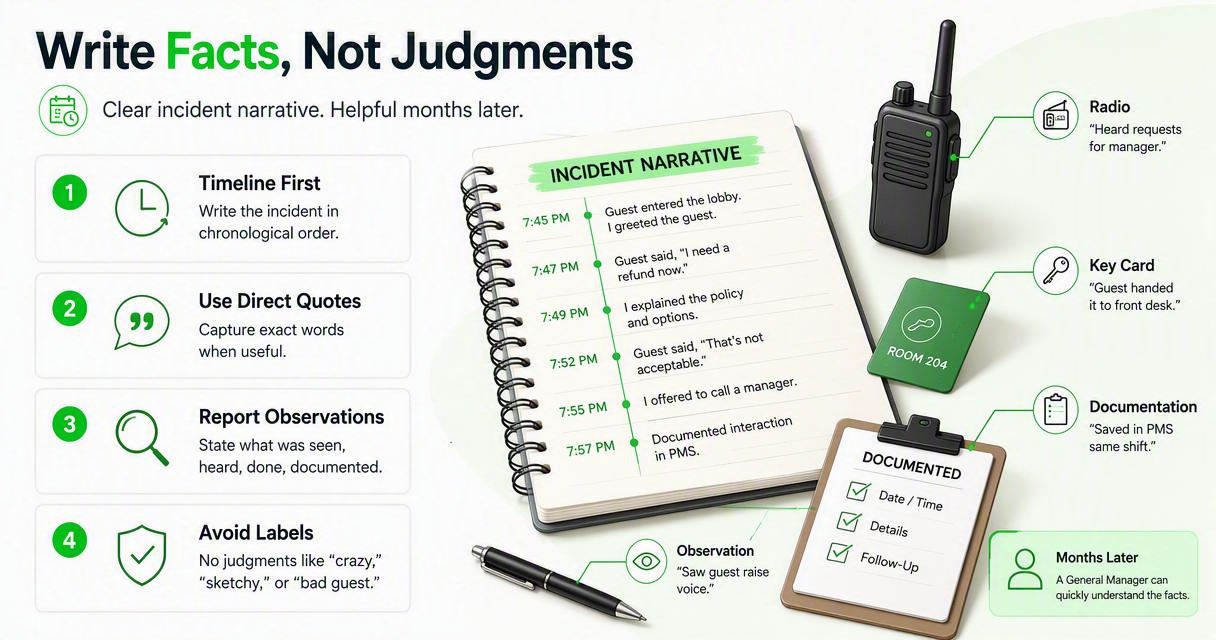
A good narrative can be read months later by a general manager, risk manager, police officer, or attorney without needing the original employee in the room. I prefer short timestamped entries because they reduce exaggeration and make video review easier.
Use plain language. "Guest struck the lobby counter with a closed fist at 10:42 p.m." is stronger than "guest became aggressive." "Guest said, 'I will come back tonight,' while standing near the front doors" is stronger than "guest threatened staff."
A simple narrative format front desk teams can follow
- Start with date, time, and location: Identify the exact area, such as lobby, parking lot, bar, hallway, or room floor.
- Identify who was present: List staff, guest, visitors, security, and police if applicable.
- Describe the conduct: Write observable facts in order.
- Record staff instructions: Note requests to stop, leave, pay, quiet down, or return keys.
- Document the notice: State the exact warning given and whether the person accepted, refused, or left.
- Attach references: Add camera numbers, folio numbers, photos, messages, or ID scan references.
- End with handoff instructions: Tell the next shift what to do if the person contacts or enters the hotel.
How do hotels prove the person received notice?
Hotels prove notice by recording how it was delivered, who delivered it, what was said or sent, and whether the person acknowledged, refused, or avoided receipt. Certified mail, signed forms, staff witness statements, police case numbers, and video references can all help establish the record.
Competitor government guidance tends to stress certified letters and return receipts. That advice is useful when the hotel knows the person's address, but hotels often face harder situations: a walk-in with no reservation, a visitor of a registered guest, or a person who refuses to identify themselves.
When the person refuses to accept a letter, document the refusal. If the address is unknown, document the reasonable steps taken to identify the person and deliver notice. Local police practices vary, so hotels should coordinate with counsel and law enforcement before standardizing forms.
Notice proof options and practical limitations
| Notice method | Best use | Documentation note |
|---|---|---|
| Signed written notice | Cooperative person still on site | Keep the signed copy and staff witness names |
| Verbal notice with witness | Urgent removal from lobby or lot | Record exact words and who heard them |
| Certified mail | Known address after the event | Save receipt, tracking, and returned envelope |
| Police-assisted notice | Safety risk or repeat return | Record agency, officer name, and case number |
| Refusal to accept | Person will not take paperwork | Note refusal and preserve video reference if available |
| Email notice | Known email from reservation | Keep sent message, timestamp, and delivery status |
What should not go into the record?
A trespass file should not include speculation, insults, irrelevant medical assumptions, protected-class comments, or unsupported accusations. The safest record is specific, necessary, and tied to hotel policy, safety, property protection, or payment risk.
Avoid writing that someone "looked homeless," "seemed mentally ill," or "was probably using drugs" unless a fact directly supports a safety or policy action. Instead, document conduct: sleeping in the lobby after being asked to leave, entering employee-only areas, refusing to stop yelling, damaging property, or attempting to check in with mismatched ID.
Privacy also matters. If your hotel scans IDs, define who can access them, how long records are kept, and when they are deleted. The article on how long hotels should keep scanned IDs is a useful next step for teams setting retention rules.
Language to avoid and language to use instead
- Instead of "suspicious person," write "person entered the lobby three times between 1:10 a.m. and 1:45 a.m. after being told the hotel was sold out."
- Instead of "drunk and dangerous," write "person stumbled, slurred words, and shoved the luggage cart into the front desk."
- Instead of "bad attitude," write "guest shouted profanity at the agent after the deposit policy was explained."
- Instead of "fake ID," write "ID name did not match the reservation name, and the guest declined to provide another form of identification."
How GuestBan ID Scanning supports the record
The GuestBan ID Scanning platform supports trespass and DNR documentation by helping hotels connect identity capture, guest-screening alerts, and staff handoff notes in one workflow. That matters most when a return visit happens after the original manager has gone home.
With GuestBan ID Scanning, a hotel can reduce manual retyping of ID details and make front desk checks more consistent. That does not replace legal review, police procedure, or management judgment. It gives authorized staff better information at the moment they need it.
A practical setup is simple: scan the ID at check-in where permitted, attach the incident record when a ban is approved, and create a clear alert that tells staff whether to decline rental, call management, or contact security. Hotels comparing broader systems can also review hotel guest screening alerts to understand how alerts fit into daily operations.
Where ID capture fits in a notice workflow
- Check-in: Capture ID details according to hotel policy and local law.
- Incident: Add a factual report if conduct triggers review.
- Decision: Require manager approval for a ban or trespass notice.
- Notice: Record how the person was told not to return.
- Alert: Create a staff-facing instruction tied to the person's profile.
- Review: Revisit the record on the scheduled expiration or legal review date.
How should multi-property hotel groups manage banned guests?
Multi-property hotel groups should standardize ban approval, identity matching, notice templates, retention rules, and staff permissions across every property. A single-property note is not enough when the same person may try another hotel in the group the next night.
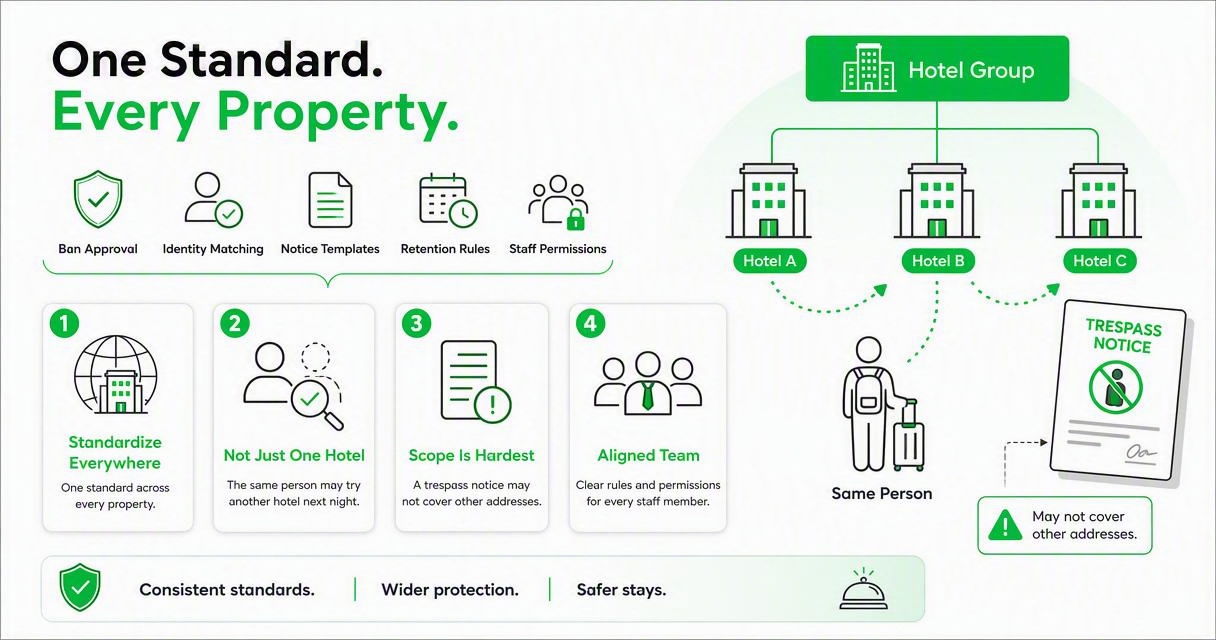
The hardest issue is scope. A trespass notice may apply to one parcel, one hotel, or a wider ownership group depending on local law, lease structure, and the wording of the notice. Do not assume a notice at Hotel A automatically applies at Hotel B.
Group-level records should separate legal status from operational risk. For example, "trespassed from Downtown Hotel through Dec. 31" is different from "manager review required before rental at any group property."
Policy controls for property groups
| Control | Recommended owner | Purpose |
|---|---|---|
| Ban approval threshold | General manager or regional manager | Prevents inconsistent staff decisions |
| Notice template | Legal or risk team | Keeps wording consistent |
| Alert permissions | Operations or IT | Limits access to staff with a business need |
| Retention schedule | Compliance or ownership | Avoids stale records |
| Cross-property review | Regional operations | Checks whether broader action is justified |
| Staff training | Front office manager | Makes night and day shifts respond the same way |
What should staff do if the person returns?
If a banned person returns, staff should stay calm, confirm identity only when safe, avoid physical confrontation, follow the written alert, and contact management, security, or police according to policy. The return encounter should become a new incident entry linked to the original notice.
Do not debate the earlier event at the desk. The front desk goal is safety and consistency, not winning an argument. A short script helps employees avoid improvising under stress.
"Sunlight is said to be the best of disinfectants; electric light the most efficient policeman.", Louis D. Brandeis, Other People's Money
In hotel operations, "sunlight" means clear records. The person who returns should not benefit from a shift change, a forgotten email, or a vague DNR note.
Return-visit response script
- If safe: "Our records show you are not permitted on this property. You need to leave now."
- If the person disputes it: "A manager can review the record later. Right now, you are being asked to leave."
- If the person refuses: "If you do not leave, we will contact law enforcement."
- After departure: Record the time, staff present, what was said, and whether police were called.
- If police respond: Add the agency, officer name if provided, case number, and outcome.
What to expect in 2027
Trespass documentation will become more identity-driven, more privacy-sensitive, and more connected across hotel operations in 2027. Hotels will still need human judgment, but staff will expect faster access to verified records, alerts, and incident history.
Three trends are already visible. First, more properties are replacing paper DNR binders with permission-based digital records. Second, front desk automation is making identity capture part of standard check-in, not a separate security task. Third, privacy questions are getting sharper as hotels store more guest data.
Night operations will feel the change most. After-hours staff often make safety decisions with fewer managers on site, so consistent records matter. For hotels refining those workflows, ID scanning for hotel night audit and after-hours check-in offers a focused operational guide.
GuestBan ID Scanning fits this direction because it helps make identity capture and guest alerts more usable at the desk. If your group is updating policies this year, include front desk staff in testing before rollout. They will spot unclear alert language faster than anyone.
Hotel trespass documentation FAQ
Common questions usually come down to notice, proof, privacy, and staff consistency. The answers below are general operational guidance, not legal advice, because trespass law and police procedures vary by location.
Can a hotel trespass a registered guest?
A hotel may be able to remove or trespass a registered guest for conduct that violates law, safety rules, payment requirements, or hotel policy, but the details depend on local law and the guest's status. Extended stays, tenancy rules, and local lodging regulations can change the process. Managers should involve counsel or police when occupancy status is unclear.
Does a trespass notice have to be in writing?
Written notice is usually easier to prove, but verbal notice may matter when staff need someone to leave immediately. Hotels should record the exact words used, who delivered the notice, who witnessed it, and whether the person left or refused. When possible, follow verbal notice with a written letter, certified mail, or police-documented contact.
How long should a hotel keep trespass records?
A hotel should keep trespass records according to its legal, insurance, privacy, and operational retention policy. Some records may need to be kept through a dispute window, claim period, or ban duration. Avoid keeping sensitive ID data forever by default. Set review dates so old alerts are confirmed, revised, or removed.
Should hotels share banned guest lists with other properties?
Hotel groups should only share banned guest information under a clear policy that covers ownership, legitimate business need, privacy, access controls, and local law. A shared alert can improve safety, but overbroad sharing can create risk. Keep the wording factual, limit access, and distinguish a legal trespass notice from an internal manager-review flag.
Conclusion
Hotel trespass notice documentation works best when it is factual, searchable, and built for the next employee who has to act. Start by standardizing one template: identity, incident timeline, notice method, proof, ban scope, and return instructions. Then train every shift to write observable facts, not opinions.
If your hotel still relies on paper DNR notes or scattered emails, make 2026 the year you tighten the workflow. Review your notice language with counsel, align with local police procedures, and test whether front desk staff can find the right record in under 30 seconds. To see how identity capture and guest alerts can support that process, visit guestban.com and evaluate whether GuestBan ID Scanning fits your property's risk-control plan.