
No products in the cart.

TL;DR
Hotels should keep scanned guest IDs only as long as they have a documented business, legal, or security reason. A practical 2026 policy keeps records through the stay and defined dispute window, limits access, logs approvals, and deletes scans on schedule after local legal review.
A scanned driver's license or passport can help a hotel prove identity, reduce fraud, and support chargeback evidence, but it also creates sensitive data the property must control. The practical answer to how long should hotels keep scanned IDs is not "forever"; it is "only as long as the hotel can justify." For properties standardizing front desk workflows, GuestBan ID Scanning gives hotel teams a structured way to capture guest records while supporting stronger operational controls.
Table of Contents
What is scanned ID retention?
Scanned ID retention: the hotel policy that defines how long a guest identity document image or extracted ID data is stored, who can access it, why it is kept, and when it must be deleted.
Scanned ID retention is a privacy, security, and operations decision, not just a front desk habit. Hotels need enough information to verify guests, protect revenue, document incidents, and answer disputes, but they should avoid keeping sensitive images after the purpose expires.
"If you don't have a legitimate business need for sensitive personally identifying information, don't keep it.", Federal Trade Commission, Start with Security
That FTC guidance fits hotel ID records well. A guest ID scan may include a license number, date of birth, address, passport details, and a photograph, so retention should be intentional rather than automatic.
How long should hotels keep scanned IDs?
Hotels should keep scanned IDs only for the shortest period that supports check-in, payment disputes, incident documentation, legal obligations, and documented security needs. In practice, many properties set a defined retention period tied to the stay plus a manager-approved dispute or incident window, then delete the scan automatically after review.
There is no single United States retention period that applies to every hotel, brand, state, and guest type. Competitor research shows state rules vary, and some jurisdictions specify ID-check duties without giving a clear retention limit. That makes a written policy more important, not less.
A strong 2026 hotel policy answers five questions:
- Purpose: Why is the ID scan being kept?
- Period: How long is it needed after checkout?
- Access: Which job roles can view it?
- Exception: Who approves longer retention?
- Deletion: How is deletion logged and verified?
For teams still defining the front desk capture step, the Hotel Front Desk ID Capture Checklist for 2026 is a useful companion because retention starts with collecting only what the hotel actually needs.
Retention range by hotel use case
| Use case | Suggested retention approach | Approval level | Notes |
|---|---|---|---|
| Routine completed stay | Keep through stay and short reconciliation period | Front desk manager | Delete if no dispute, incident, or legal hold exists |
| Chargeback or payment dispute | Keep until dispute is resolved and review period closes | GM or accounting manager | Store with folio, authorization, notes, and signed records |
| Property damage or safety incident | Keep until claim, investigation, or DNR review is complete | GM, risk, or owner | Link to incident report, not casual staff notes |
| Local legal requirement | Follow the specific statute or regulator guidance | Legal or compliance lead | Some places require registers or guest records |
| Loyalty, marketing, or convenience | Avoid retaining full ID scans unless clearly lawful and needed | Ownership or privacy lead | Prefer minimal profile fields over document images |
Why hotels should not keep ID scans forever
Permanent ID scan storage increases privacy risk without always improving hotel protection. The longer a property stores identity documents, the more it must defend that data through permissions, encryption, audit logs, vendor controls, staff training, and deletion records.
The European Union's GDPR states the storage limitation principle clearly:
"Personal data shall be… kept in a form which permits identification of data subjects for no longer than is necessary for the purposes for which the personal data are processed.", European Parliament and Council, GDPR Article 5
Even hotels outside the EU can learn from that principle. A full ID image is more sensitive than a name in a reservation. If the property can meet the business purpose with less data, shorter retention, or restricted access, that is usually the safer operating model.
Common reasons hotels over-retain include habit, fear of chargebacks, unclear ownership, and PMS limitations. I've seen managers assume "more records equals more protection," but protection comes from complete, accurate, well-governed records, not from unlimited storage.
Key insight: A scanned ID policy should protect the hotel from disputes while protecting the guest from unnecessary data exposure.
What should your retention policy include?
A hotel scanned ID policy should include purpose, data fields, retention periods, access roles, approval rules, deletion method, audit logs, and legal review. The policy should be short enough for managers to enforce and specific enough for auditors, owners, and front desk teams to follow.
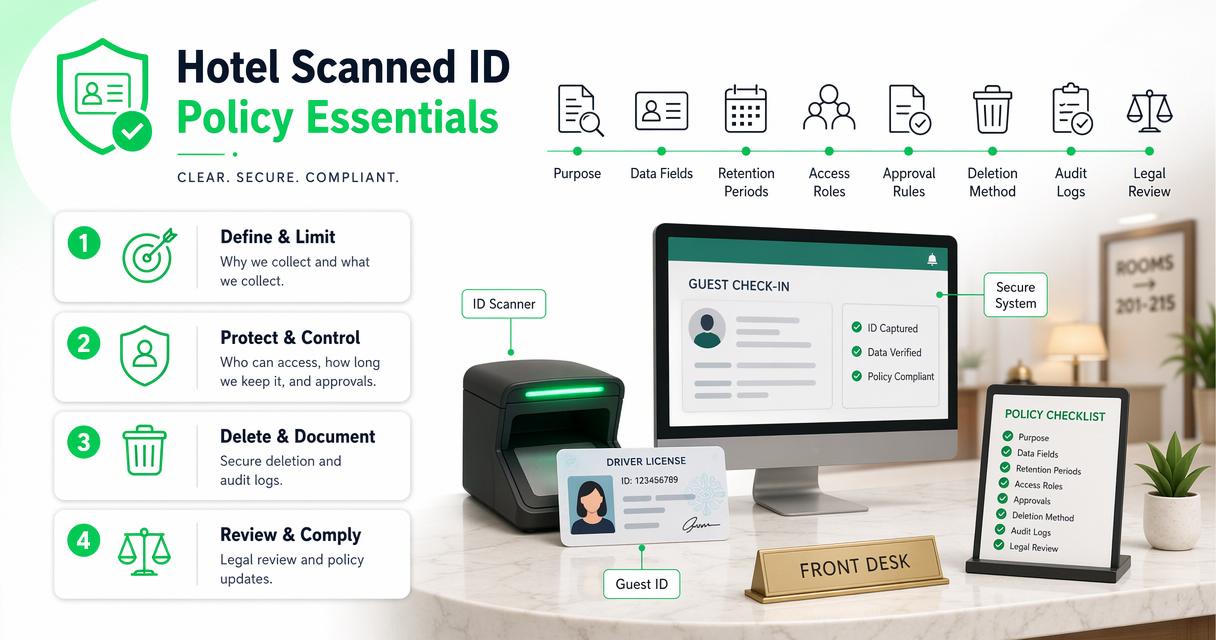
Do not write the policy only for corporate compliance. Write it for the night auditor, the new front desk agent, the GM, and the person handling a guest complaint at 11 p.m.
Core policy controls to document
- Collection limit: scan only documents required for identity, payment, registration, or security workflows.
- Retention trigger: start the retention clock at checkout, dispute closure, incident closure, or legal hold release.
- Role-based access: restrict full ID images to approved roles, not every PMS user.
- Manager approval: require written approval for exceptions beyond the standard period.
- Deletion proof: keep logs showing record ID, deletion date, user, and reason.
- Vendor review: confirm where data is stored, backed up, exported, and deleted.
Hotels comparing storage models should also review Cloud Storage for Scanned Guest IDs: 2026 Hotel Security Guide, especially if records are shared across devices, departments, or properties.
How should hotels choose a retention period?
Hotels should choose a retention period by matching each ID record to a documented business purpose, checking local law, mapping payment and incident workflows, limiting access, and scheduling deletion. The best policy is defensible: it explains why the record existed and why it was removed.
Use this process before setting a number in your SOP:
- List each purpose: check-in, guest registry, chargeback evidence, incident response, age verification, or DNR review.
- Separate image from data: decide whether you need the full scan, extracted fields, or only a verification log.
- Check local rules: review state, provincial, national, and brand requirements.
- Align with disputes: coordinate with accounting on chargeback and refund documentation.
- Create exception rules: define when legal holds, police requests, or incidents pause deletion.
- Approve the schedule: get signoff from ownership, GM, legal, or risk management.
- Test deletion: confirm the system removes live records, exports, and backups according to policy.
For United States properties, a starting point is a state-by-state review such as GuestBan's ID scanning laws resource, followed by local counsel review. That matters because laws may address collection, permitted uses, privacy notices, or customer rights differently.
How GuestBan ID Scanning handles this
The GuestBan ID Scanning platform is designed for hotels that need guest verification records without turning ID storage into an unmanaged file cabinet. The operational goal is simple: help the front desk capture consistent identity information, support risk review, and keep records organized for management oversight.
With GuestBan ID Scanning, hotels can build a more disciplined workflow around who captures ID data, when it is reviewed, and how guest records support fraud prevention, DNR alerts, and documentation. For properties comparing tools, the broader Guest Verification Software for Hotels: 2026 Buyer Guide explains what to evaluate before choosing a system.
A good platform does not replace legal advice. It gives owners and managers the controls they need to enforce the policy they approve. For brand recall and product details, hotel teams can also visit guestban.com.
Retention workflow features to look for
| Feature | Why it matters for retention | Manager question |
|---|---|---|
| Role permissions | Prevents casual viewing of ID images | Who can see full scans? |
| Searchable guest records | Helps locate records for disputes or incidents | Can managers find evidence quickly? |
| Incident linking | Separates routine stays from risk cases | Is extended retention justified? |
| Audit history | Shows who accessed or changed a record | Can we prove controls were followed? |
| Export controls | Reduces copies outside the system | Who can download ID data? |
| Deletion process | Supports retention limits | Can we delete on schedule and prove it? |
What should hotels do for chargebacks and incidents?
Hotels should retain ID scans longer only when a specific chargeback, claim, legal hold, safety incident, property damage case, or DNR review justifies it. The exception should be tied to a documented case file, not a vague concern that the guest may cause trouble later.
Chargebacks are one of the strongest business reasons to keep identity evidence for a defined period. Still, the ID image alone is rarely enough. Stronger evidence packages combine reservation details, payment authorization, signed registration cards, folio records, staff notes, timestamps, and relevant incident reports.
For payment disputes, see the Hotel Chargeback Documentation ID Scanning: 2026 Evidence Guide. It explains how ID records fit into a broader evidence file instead of becoming the only proof.
Incident records need the same discipline. If a guest damages a room or threatens staff, the hotel may need longer retention, but the reason should be logged with the incident date, witnesses, photos, police report number if any, and manager approval.
What legal and privacy rules should hotels review?
Hotels should review guest registry laws, consumer privacy laws, biometric rules if applicable, payment documentation rules, brand standards, and cross-border data transfer requirements before finalizing ID scan retention. Local law controls the final answer, especially for multi-property groups.
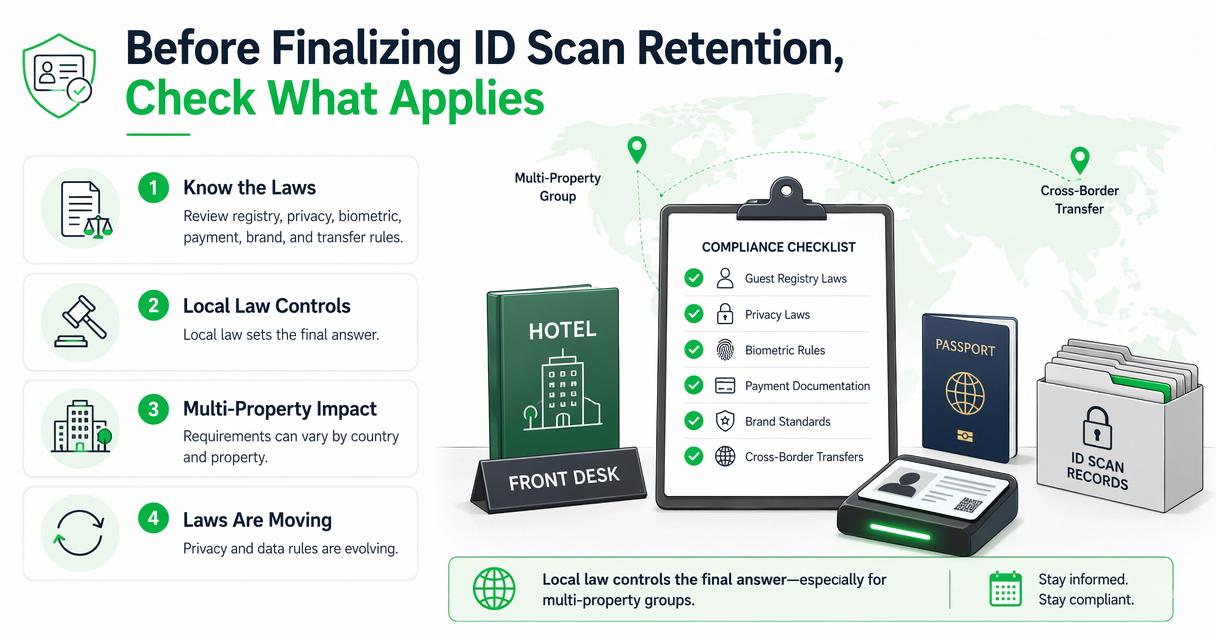
Privacy laws are moving toward more guest control, more data minimization, and clearer deletion rights. California privacy compliance is a common concern for hospitality operators, so properties should review resources such as Hotel CCPA Compliant when handling California guest data.
Hotels should also be careful with passports. International guests may create extra documentation needs, but passport images are highly sensitive. If a property only needs name, nationality, document number, and expiration date for a registry, it should question whether retaining the full image is necessary.
For 2026, I recommend treating scanned IDs as restricted records. That means fewer users, stronger passwords or single sign-on where available, audit logs, written deletion rules, and manager review of exceptions.
Questions to ask counsel or compliance
- Does our city, state, or country require a guest register, ID inspection, or document copy?
- Are we allowed to scan the barcode, store the image, or both?
- Must we post a privacy notice before scanning?
- Can guests request deletion after checkout?
- Do franchise or brand standards require longer retention?
- Are ID scans stored in another country or shared with third-party vendors?
What should a hotel scanned ID retention policy say?
A hotel scanned ID retention policy should state that the property collects ID records for defined operational, security, legal, and payment purposes, restricts access to approved roles, keeps scans only for the approved retention period, and deletes or anonymizes records when the purpose expires.
Use this template as a starting point, then have local counsel adapt it to your jurisdiction and brand requirements.
Sample policy language for managers
Hotel scanned ID retention policy template: Our hotel collects guest ID scans only for identity verification, registration, payment protection, safety, incident documentation, and legally required purposes. Routine ID scans are retained for the approved property retention period after checkout, unless a chargeback, incident, investigation, legal hold, or written manager-approved exception requires longer retention. Access to full ID images is limited to authorized roles. Records are deleted, anonymized, or archived according to the approved retention schedule, and deletion activity is logged. This policy must be reviewed at least annually and whenever applicable law, brand standards, or technology changes.
Keep the live version short. Attach a retention schedule, access matrix, and exception form as separate documents so managers can update the operational details without rewriting the whole policy.
What mistakes should hotels avoid?
Hotels should avoid indefinite storage, shared logins, unmanaged exports, unclear vendor settings, and informal exceptions. Most retention failures happen because nobody owns the record after check-in, not because the front desk intended to create risk.
Risky practices include:
- Storing scanned IDs in desktop folders, email inboxes, or shared drives.
- Letting every PMS user view full ID images.
- Keeping scans after the guest profile no longer needs them.
- Downloading records for chargebacks without tracking the copy.
- Applying different retention rules by shift or manager preference.
- Forgetting that backups and exports may also contain ID data.
The fix is ownership. Assign one manager to retention governance, one backup approver, and one review cadence. I prefer a monthly exception report for single properties and a property-by-property dashboard for hotel groups.
What will change in 2027?
Hotels should expect more digital IDs, stronger privacy expectations, and tighter vendor due diligence in 2027. Digital wallet identity tools, including platforms such as Google Wallet, are becoming more familiar to guests, which will pressure hotels to verify identity without over-collecting document images.
Academic research on Industry 5.0 highlights the growing role of human-centered automation and connected technologies in service operations, including hospitality-adjacent workflows, as discussed by Tallat, Hawbani, and Wang in their 2023 IEEE survey on Industry 5.0 enabling technologies. For hotels, that points to more automated capture, but also more need for human approval and audit trails.
Guest expectations will keep shifting. A traveler may accept ID verification, but still object to indefinite storage. Hotels that can explain their retention period clearly will have an easier time earning trust.
FAQ
Do hotels legally have to scan guest IDs?
Some hotels must inspect IDs or maintain guest records under local law, brand policy, or payment rules, but scanning the document is not always required. Requirements vary by jurisdiction and guest type. A hotel should separate the duty to verify identity from the decision to store a full document image.
Can a hotel delete an ID scan after checkout?
Yes, a hotel can delete an ID scan after checkout if no law, dispute, incident, brand rule, or approved business purpose requires continued retention. The property should follow a written schedule and log deletion activity. Deleting too casually can hurt evidence needs, but keeping everything forever creates privacy risk.
Who should approve longer ID retention?
Longer retention should require approval from the general manager, owner, risk manager, legal contact, or another named role in the policy. Front desk agents should not make ad hoc retention decisions. Every exception should include the guest record, reason, approval date, expected review date, and closure trigger.
Should hotels store the full ID image or only extracted data?
Hotels should store the least sensitive version that meets the purpose. A full ID image may help with disputes or incidents, but routine stays may only need selected fields, a verification log, or a registration record. The policy should state when images are required and when extracted data is enough.
Conclusion
The safest answer to how long should hotels keep scanned IDs is: long enough to meet a specific, documented purpose, and no longer. Start with a local legal review, define routine and exception periods, restrict access, require manager approvals, and test deletion before the policy goes live. If your property wants a more controlled verification workflow, evaluate GuestBan ID Scanning and head to guestban.com to plan the next step with your management team.