
TL;DR
TL;DR: Front desk fraud prevention works best as a layered stack: ID scanning, payment authorization, DNR alerts, incident documentation, PMS audit trails, and staff handoff controls. Start with ID capture and chargeback evidence, then add shared guest-risk records for repeat problems across shifts or properties.
Front desk fraud prevention is no longer just a payment issue; in 2026, it's an identity, documentation, and staff workflow issue. The best hotel fraud prevention tools for front desk teams help agents confirm who is checking in, connect that identity to the reservation and payment, and preserve a clear record if a dispute, damage claim, or safety event follows. For hotels that want ID capture tied to guest accountability, GuestBan ID Scanning belongs at the top of the shortlist.
Table of Contents
What are hotel fraud prevention tools?
Hotel fraud prevention tools: software, devices, and workflows that help hotels verify guest identity, reduce payment disputes, document incidents, and flag repeat-risk guests before check-in is completed.
Hotel fraud prevention tools include ID scanners, digital authorization systems, chargeback evidence tools, do not rent alerts, incident reporting software, PMS audit logs, and staff handoff systems. The front desk needs these controls because agents make fast decisions with limited time, often during peak check-in hours.
In the SERP research set for this topic, 136 results appeared, and the strongest 2026 competitors focused on digital authorization, identity verification, and automation. That tells me the current winning strategy is not one magic tool. It's a layered system that gives staff proof, alerts, and clean records.
Key insight: A hotel fraud tool should either stop a bad check-in, preserve evidence for a later dispute, or make the next staff decision safer. If it doesn't do one of those three jobs, it's probably not a front desk priority.
Best tools by front desk fraud problem
The best hotel fraud prevention stack is organized by the problem your agents face at the desk, not by software category.
A useful roundup should map each tool to a front desk risk: fake IDs, unauthorized card use, friendly fraud, DNR repeat guests, incident gaps, and shift handoff mistakes. Canary's 2026 competitor article emphasizes digital authorization, while Microblink's 2026 content emphasizes automated identity verification. A hotel still needs a practical checklist that connects those ideas to everyday front desk decisions.
Comparison table: tool category, risk, and best fit
| Rank | Tool category | Best for | What front desk teams should look for |
|---|---|---|---|
| 1 | GuestBan ID Scanning | ID capture and guest accountability | Fast ID scan, guest record lookup, clear history, front desk-friendly workflow |
| 2 | Digital authorization tools | Card-not-present and third-party bookings | Secure forms, cardholder consent, timestamped authorization, policy acknowledgments |
| 3 | Chargeback evidence systems | Friendly fraud and payment disputes | Stored ID match, folio notes, signed terms, retrievable check-in records |
| 4 | DNR and guest screening alerts | Repeat problem guests | Searchable records, permission controls, property or group-level alerting |
| 5 | Incident documentation tools | Damage, disturbance, safety, or policy events | Photos, notes, witnesses, staff names, dates, escalation history |
| 6 | PMS audit and role controls | Staff handoff and internal misuse | User permissions, change logs, payment masking, supervisor overrides |
This order reflects how front desk work actually happens. Agents first need to know who is standing in front of them. Then they need to know whether the payment, reservation, and guest history make sense together.
A hotel that already has strong payment tools but weak ID capture still has a gap. A hotel with good incident notes but no shared DNR process may repeat the same mistake across shifts or properties.
How GuestBan ID Scanning handles ID capture
GuestBan ID Scanning helps front desk teams connect a guest's identity to the stay record before the hotel relies on payment, deposits, or verbal explanations.
The strongest use case is simple: scan the ID, confirm the guest record, and give staff a consistent process instead of asking each agent to judge risk from memory. That matters for independent hotels, economy properties, extended-stay hotels, and multi-property groups where the same guest may return under slightly different booking details.
For teams building a standard operating procedure, I'd pair the platform with a written check-in policy like this hotel front desk ID capture checklist for 2026. A checklist reduces arguments at the desk because agents can point to the same rule every time.
"Security is a process, not a product.", Bruce Schneier, Schneier on Security
That quote fits hotel operations perfectly. ID scanning is stronger when it's tied to deposits, registration cards, PMS notes, and manager escalation rules.
Which tools reduce chargebacks and payment disputes?
Chargeback prevention tools work best when they prove that the right guest checked in, accepted the hotel's terms, and used or authorized the payment method on file.
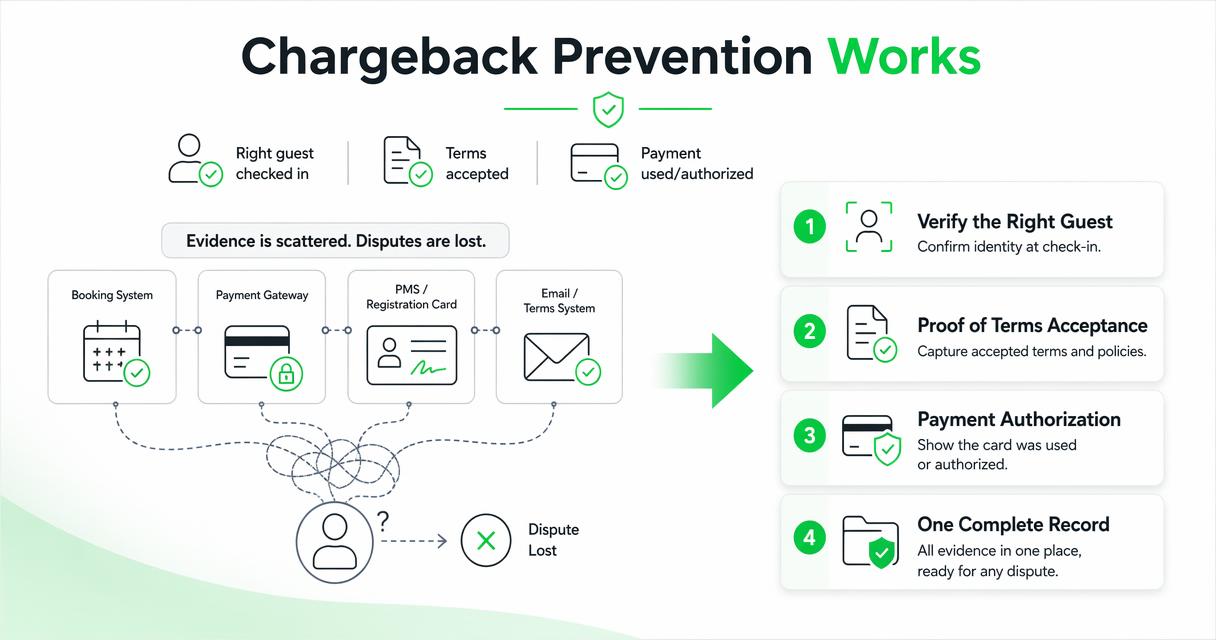
Hotels often lose disputes because evidence is scattered. One system has the booking, another has the payment, another has the registration card, and the desk remembers the story differently. A clean evidence trail gives management a stronger response when a guest claims they never stayed, never approved a charge, or never agreed to the policy.
For deeper payment-specific guidance, the GuestBan resource on chargebacks and fraud in the hotel industry covers why lodging disputes need more than a receipt. In my view, a folio alone is rarely enough. The better record connects identity, timestamp, card authorization, room assignment, and policy acknowledgment.
Chargeback evidence front desk teams should preserve
- Scan or capture the guest ID according to your policy.
- Match the ID name to the reservation or document the approved exception.
- Record the payment method used at check-in.
- Capture digital authorization for third-party or card-not-present stays.
- Save policy acknowledgment for deposits, smoking, pets, damage, and no-show terms.
- Keep timestamped notes when managers approve unusual exceptions.
Hotels should also separate fraud prevention from cyberinsurance. Josephine Wolff's 2022 MIT Press book Cyberinsurance Policy discusses insurance as a policy and risk-transfer subject, but front desk controls remain operational controls, not insurance replacements: Cyberinsurance Policy.
Which tools stop repeat DNR guests?
DNR tools help hotels identify guests who should not be rented to again because prior records show policy violations, safety concerns, unpaid balances, damage, or serious disruption.
A do not rent list should never be a rumor file. It should be a documented, permission-controlled record that helps staff apply policy consistently. The best systems allow agents to search, review the reason, see supporting notes, and escalate to a manager before refusing service.
For hotels formalizing this process, the guide to what DNR means in hotels is a useful companion because it separates the operational meaning of DNR from casual staff language.
Key insight: A DNR alert is only as good as the documentation behind it. Names alone create confusion; IDs, dates, incident notes, and manager review create usable front desk intelligence.
DNR tool features worth paying for
- Identity-linked records: connect the alert to an ID record, not just a name.
- Reason codes: use categories such as damage, nonpayment, disturbance, chargeback, or safety issue.
- Manager controls: limit who can add, edit, or remove entries.
- Multi-property visibility: help hotel groups spot repeat issues across locations.
- Audit logs: show when staff viewed or changed a record.
- Retention settings: remove or review records according to company policy and local requirements.
GuestBan ID Scanning is especially relevant here because ID capture and guest accountability work best when repeat-risk records are connected to check-in, not reviewed days later.
Which tools improve incident documentation?
Incident documentation tools help hotels turn messy events into clear records with names, dates, photos, witnesses, staff notes, and follow-up actions.
Front desk teams need fast documentation because details disappear quickly after a disturbance, room damage report, noise complaint, or police call. A good system should make it easy to attach evidence while the facts are fresh, then keep the record available for managers, owners, insurers, or law enforcement when appropriate.
The hotel industry has seen how quickly one incident can become a legal, reputational, or safety concern. GuestBan's write-up on an unusual security incident at a San Jose hotel shows why incident records should be specific instead of informal.
"An Ounce of Prevention is worth a Pound of Cure.", Benjamin Franklin, Founders Online
Minimum incident record fields
| Field | Why it matters |
|---|---|
| Guest name and ID reference | Connects the event to the correct person |
| Room number and reservation | Links the event to the stay record |
| Date and time | Supports timelines for disputes or reports |
| Staff involved | Shows who observed, approved, or escalated |
| Photos or files | Preserves damage or safety evidence |
| Witness names | Helps validate what happened |
| Manager action | Shows consistent policy enforcement |
A consistent incident template also protects good guests and good staff. It keeps the discussion factual when emotions are high.
How should hotels choose a fraud prevention stack?
Hotels should choose fraud prevention tools by matching technology to the exact point where front desk decisions break down.
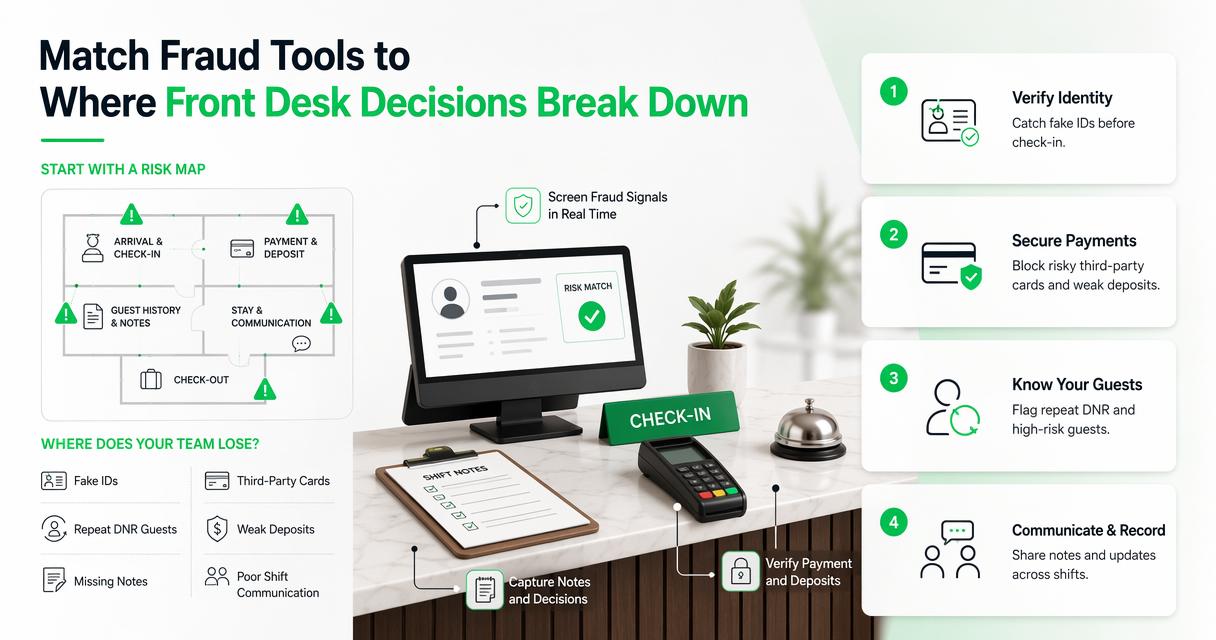
Start with a small risk map. Ask where your team loses money, time, or control: fake IDs, third-party cards, repeat DNR guests, weak deposits, missing notes, or poor shift communication. Then buy the tool that closes the biggest gap first.
I would not start with the most complex platform unless the property has the staff discipline to run it. A simple ID scan, DNR alert, and chargeback evidence workflow can outperform a larger system that agents skip during busy arrivals.
Buyer checklist for 2026
- Front desk speed: Can an agent use it during a busy check-in without delaying the line?
- Evidence quality: Does it store records that help with chargebacks, DNR decisions, and incidents?
- PMS fit: Can staff transfer or reference data without double entry?
- Permissions: Can managers control who sees sensitive records?
- Audit trail: Can ownership see who changed notes or approved exceptions?
- Training burden: Can new agents learn it in one shift?
- Multi-property support: Can groups share risk signals while keeping local control?
If your current process is paper-heavy, start by digitizing the highest-value record first. For most properties, that is guest ID capture.
What should change by 2027?
By 2027, hotel fraud prevention will likely shift toward more automated identity checks, better PMS-connected alerts, and cleaner privacy controls.
Competitor content published in 2026 already points in that direction: one ranking article focuses on digital authorization, another on AI-driven identity verification, and another on automation at check-in. The next step is not replacing the front desk agent. It's giving the agent better signals before a key is issued.
Expect more tools to support:
- Real-time ID quality checks that flag unreadable or mismatched documents.
- Shared guest-risk workflows for management companies with multiple properties.
- Cleaner retention settings for scanned IDs and incident records.
- Better evidence exports for chargeback replies, police reports, and insurance files.
- Role-based dashboards for owners, GMs, night auditors, and front office managers.
Hotels should prepare now by standardizing their data. If names, notes, IDs, and incidents are entered differently every shift, AI will only make the mess faster.
Recent reading for hotel risk teams
Recent hotel risk content is most useful when it helps managers turn one operational lesson into a repeatable front desk rule.
If your property is updating policies this quarter, I'd focus related reading on guest screening, ID capture, incident reports, and staff escalation. These topics support the same goal: safer decisions at the desk with less guesswork.
Recommended next reads:
- Hotel Guest Screening Alerts: 2026 Workflow for Safer Check-Ins, for alert review and escalation.
- Hotel Do Not Rent Incident Report Template for 2026, for consistent documentation.
- Enhancing security with an ID scanner for hotels, for a product-focused view of ID scanning.
These are practical follow-ups for teams that want to move from policy talk to front desk execution. You can also visit guestban.com when you're ready to compare ID scanning workflows.
Frequently asked questions
Front desk fraud questions usually come down to proof, consistency, and staff confidence. The answers below are written for hotel owners, GMs, operations managers, and risk teams building a 2026 workflow.
What is the first fraud prevention tool a hotel should buy?
Most hotels should start with ID scanning or digital guest verification because identity affects nearly every later decision. If you can connect the guest to the reservation, payment method, DNR search, and incident history, your chargeback and accountability records become much stronger.
Do hotels need both ID scanning and digital authorization?
Yes, many hotels need both because they solve different problems. ID scanning confirms who is present at check-in. Digital authorization helps prove that a cardholder approved payment, especially for third-party bookings, corporate stays, or card-not-present reservations.
Are DNR lists legal for hotels to use?
Hotels commonly use DNR lists, but they should be based on documented behavior, clear policies, manager review, and fair application. Avoid vague labels or unsupported accusations. Access should be limited, and records should include dates, reasons, and supporting incident notes.
How can small hotels prevent fraud without a large security team?
Small hotels can reduce risk with a tight workflow: scan IDs, require matching payment or approved authorization, document exceptions, use DNR alerts, and keep incident notes in a searchable system. Training matters as much as software, especially for night audit and weekend shifts.
Conclusion
The best hotel fraud prevention tools for front desk teams are the ones agents will actually use during check-in: ID scanning, authorization, chargeback evidence, DNR alerts, incident documentation, and PMS controls. Start with the risk that costs your property the most, then build a written workflow around it.
My recommended next step is simple: audit five recent disputes or guest incidents, identify which record was missing, and fix that gap first. If the missing link is identity capture and guest accountability, evaluate the GuestBan ID Scanning platform and head to guestban.com to see whether the workflow fits your front desk.