

TL;DR
Hotel reservation fraud detection works best when hotels score booking signals before arrival, not only at check-in. The strongest approach combines payment checks, identity consistency, channel-specific rules, and a clear escalation SOP for front desk teams.
Fraudulent bookings rarely look dramatic at first: a late-night same-day reservation, a mismatched card, a rushed phone request, or a guest asking to change payment after arrival. Hotel reservation fraud detection gives independent hotels a practical way to separate normal booking friction from patterns that deserve review. For a broader prevention stack, Innstrata has related guidance on hotel fraud prevention tools that pairs well with the detection-first workflow below. Table of Contents
- What is hotel reservation fraud detection?
- Which booking signals should trigger manual review?
- How should OTA, direct, and phone reservations be scored?
- What is the front desk SOP for suspicious reservations?
- What should hotels expect in 2027?
What is hotel reservation fraud detection?
Hotel reservation fraud detection is the process of identifying suspicious booking, payment, identity, and behavior signals before a stay creates financial loss or operational risk. In 2026, effective detection means scoring reservations across channels, reviewing exceptions quickly, and documenting outcomes so future rules improve.
Hotel reservation fraud detection: A structured screening method that flags high-risk reservations using booking metadata, payment behavior, guest identity signals, and staff observations before check-in.
Detection is not the same as denial. A flagged booking should move into verification, not automatic cancellation, because legitimate travelers also book late, change cards, or use virtual payment methods.
Digital operations have made hotels faster, but also more exposed. Research on digital transformation describes how organizations are reworking service models around data and connected systems, a shift visible in hospitality reservations, payments, and guest messaging Paul, Ueno, and Dennis, 2024.
“All models are wrong, but some are useful.”, George E. P. Box, All models are wrong
The practical lesson for hotels is simple: a score is a triage tool, not a verdict. The goal is to make suspicious patterns visible early enough for trained staff to verify them.
Which booking signals should trigger manual review?
Manual review should trigger when a reservation combines payment risk, identity mismatch, unusual urgency, or channel behavior that does not match normal property patterns. One weak signal may be harmless, but two or more related signals should move the booking into a documented verification queue.
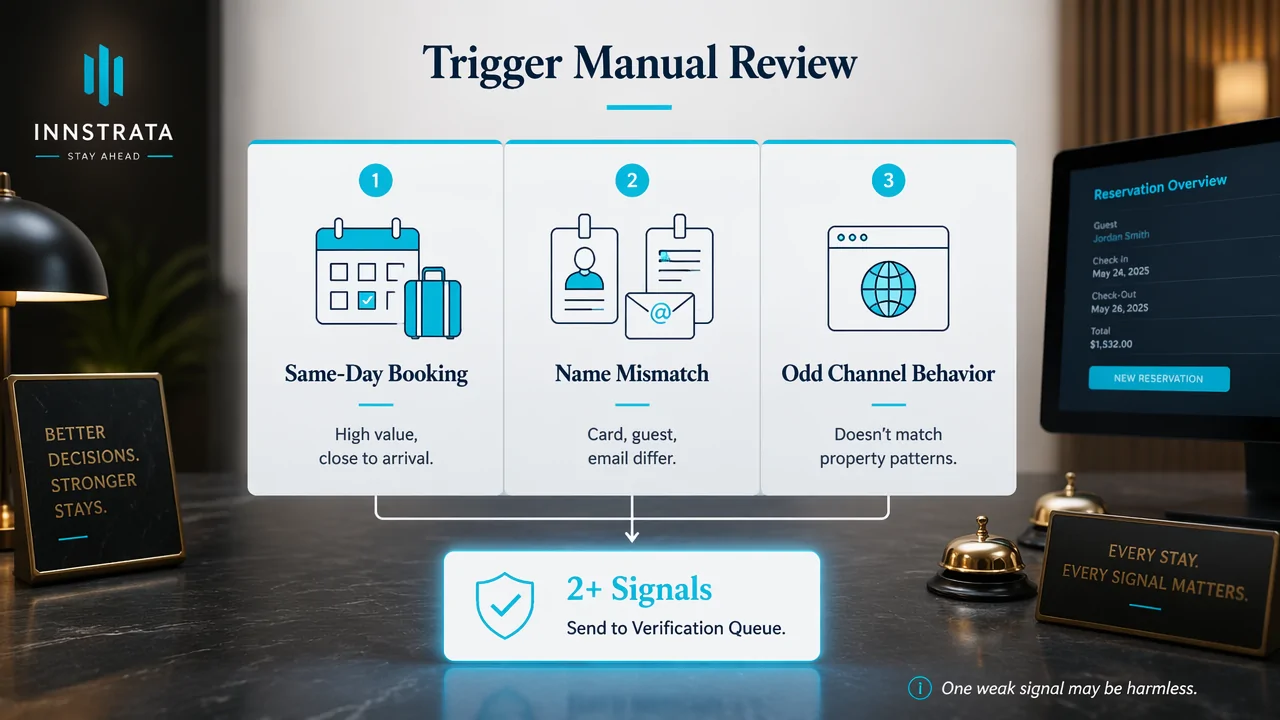
High-risk signals before arrival
- Same-day booking plus high-value stay: Review when a new guest books multiple rooms, premium room types, or several nights close to arrival.
- Cardholder and guest mismatch: Verify when the card name, booking name, email, and phone number point to different people without a clear corporate or family reason.
- Repeated declined cards: Treat several failed authorization attempts as a stronger signal than one decline.
- Unusual communication pressure: Escalate requests that demand immediate action, off-platform messaging, or payment changes outside standard policy.
- Local booking with weak stay reason: Review local reservations for high-risk dates when the guest avoids basic questions about stay purpose.
- Multiple bookings from similar details: Flag clusters using repeated phone numbers, emails, addresses, device hints, or payment patterns.
A useful front desk rule is to separate facts from feelings. Staff should record what happened, not write assumptions about a guest. That protects legitimate travelers and gives managers better data for future rules.
Reservation risk score thresholds
| Risk score | Typical pattern | Action |
|---|---|---|
| 0 to 2 | Normal booking details with one minor inconsistency | Keep booking active and monitor |
| 3 to 5 | Two moderate signals, such as same-day arrival plus card mismatch | Request verification before arrival |
| 6 to 8 | Multiple payment, identity, or behavior signals | Manager review before check-in |
| 9+ | Clustered repeat signals or suspected organized activity | Hold room assignment, escalate, and document decision |
Score rules should be visible to managers and front desk leads. Hidden rules create inconsistent guest treatment, while visible thresholds help each shift make the same decision from the same facts.
How should OTA, direct, and phone reservations be scored?
OTA, direct, and phone reservations should be scored differently because each channel exposes different data, payment controls, and fraud behaviors. A hotel should keep one shared risk framework, then adjust the weight of signals by channel instead of treating every booking source the same.
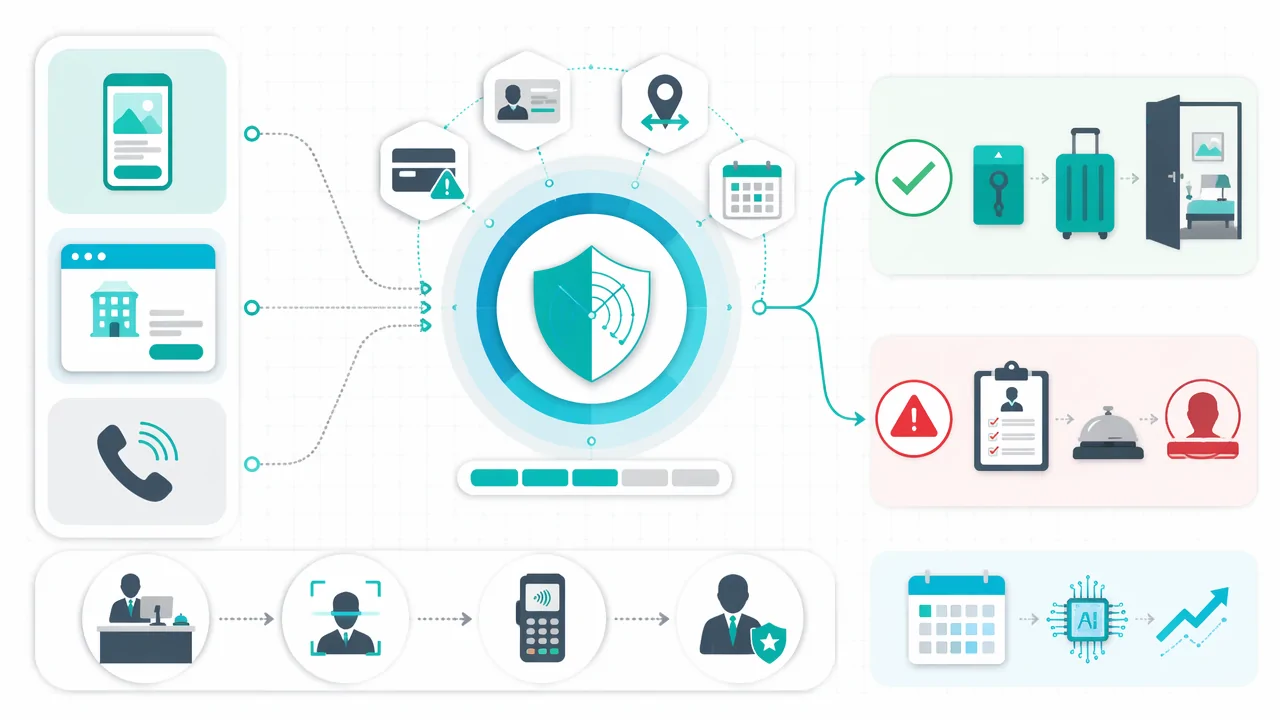
Channel-specific fraud triage table
| Booking channel | Signals that matter most | Verification approach |
|---|---|---|
| OTA, including Booking.com, Expedia, and Agoda | Virtual card timing, guest messaging pattern, cancellation behavior, profile age where available | Follow OTA payment rules, keep messages on-platform, document exceptions |
| Direct website | Card authorization result, IP or device hints where available, email domain, booking velocity | Use secure payment tools and verify high-risk mismatches before arrival |
| Phone reservation | Caller urgency, refusal to provide standard details, third-party card use, unusual room requests | Read policy clearly, collect required fields, escalate before approving exceptions |
| Walk-in linked to prior booking | ID-card mismatch, local address, declined card, request to pay later | Apply check-in checklist and require approved payment before access |
Agoda is an online travel agency owned by Booking Holdings, and it sits in the same broad OTA category as other intermediaries that pass reservations, guest messages, and payment instructions to hotels. The key for operators is not to distrust OTAs, but to understand which details the channel controls and which details still require property-level checks.
Rate and channel strategy also affect fraud exposure. Properties trying to lower channel risk can pair detection rules with a plan to reduce OTA dependency for independent hotels while keeping profitable third-party demand.
Direct booking signals need commercial context
Direct reservations give hotels more control over payment timing, website terms, and guest communication. That control creates better detection data, but it also places more responsibility on the property to review exceptions consistently.
Demand context matters. A same-day direct booking on a slow Tuesday may be normal, while the same booking pattern during a sold-out event may deserve a higher score. Forecasting practices from independent hotel demand planning can help managers distinguish normal compression demand from unusual booking clusters.
What is the front desk SOP for suspicious reservations?
A front desk SOP for suspicious reservations should define what staff verify, when managers are called, how notes are written, and which actions are allowed before arrival or check-in. The best SOP is short enough for a busy shift and strict enough to prevent improvisation.
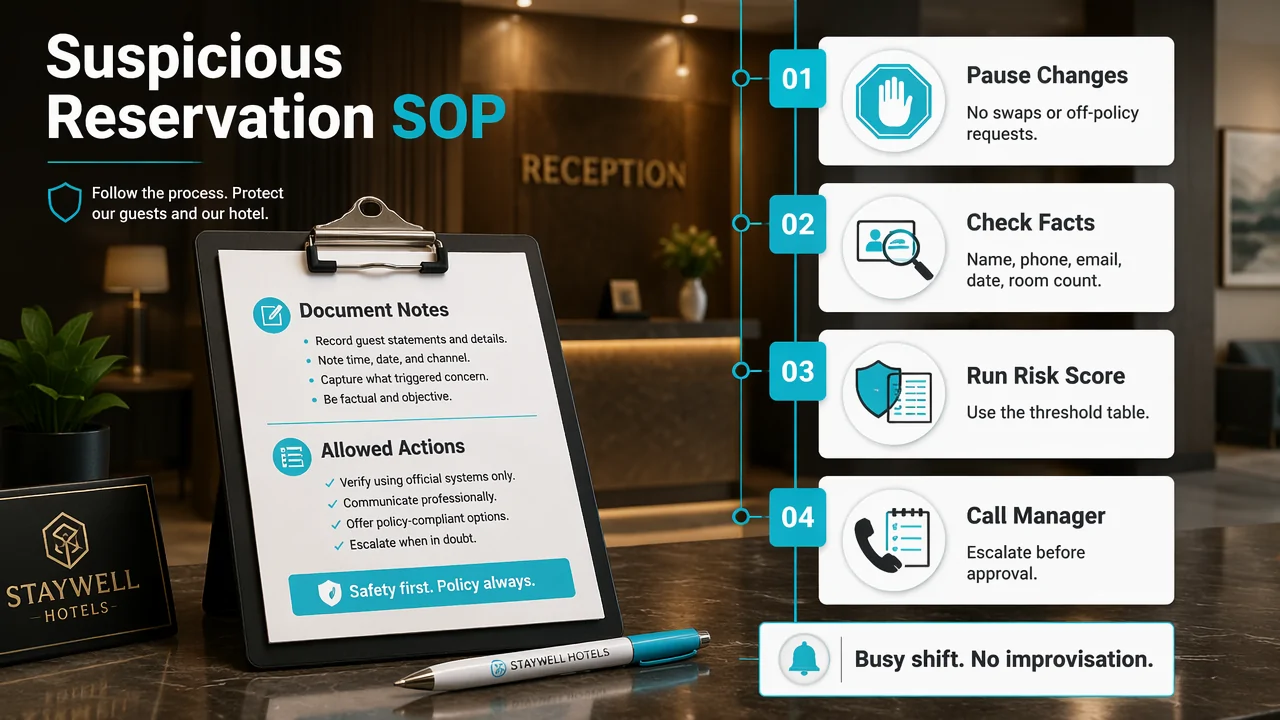
Seven-step response workflow
- Pause nonstandard changes: Do not approve card swaps, name changes, or off-policy payment requests until verification is complete.
- Check reservation facts: Compare name, phone, email, arrival date, room count, rate, notes, and payment status.
- Run the risk score: Apply the property threshold table before contacting the guest.
- Verify through approved channels: Use the booking platform, official phone number, or direct email already on file.
- Escalate at the threshold: Manager review starts when the score reaches the property’s escalation level.
- Document neutral facts: Record dates, times, staff initials, signals, and final action in the PMS or case log.
- Review outcomes weekly: Mark false alarms, confirmed problems, and rule changes so the score improves.
Front desk training should include live examples. The related hotel check-in fraud red flags checklist gives staff a 2026 reference for ID, card, behavior, and reservation review at arrival.
Training video for payment awareness
Video examples are useful because fraud detection is partly pattern recognition. Staff learn faster when training shows how payment behavior, confidence, and urgency can appear normal until the details are checked.
How Innstrata handles detection workflows
The Innstrata platform is relevant when independent hotels need a repeatable way to monitor reservation risk, rate behavior, and operational exceptions across one property or a small portfolio. It supports the stronger operating habit behind fraud control: consistent review of signals instead of scattered judgment calls.
With Innstrata, managers can connect detection routines with broader commercial oversight. That matters because fraud, rate parity, demand spikes, and channel mix often show up together in the same booking window. More context is available at innstrata.com.
What should hotels expect in 2027?
Reservation fraud detection in 2027 will become more data-driven, more automated, and more dependent on cross-system context. Independent hotels should expect better scoring tools, more synthetic identity attempts, and greater pressure to prove that review decisions are consistent and policy-based.
Likely changes for independent operators
- More AI-assisted fraud attempts: Generative tools can make fake emails, guest messages, and support requests sound more natural. A 2023 multidisciplinary paper on generative conversational AI outlines the broader opportunities and risks of these systems for practice and policy Dwivedi, Kshetri, Hughes, and coauthors.
- More useful operational data: Big-data research continues to examine how organizations use data to change business models and decisions Acciarini, Cappa, and Boccardelli, 2023.
- More portfolio-level controls: Regional groups will need shared rules so one property’s incident becomes useful intelligence for the next.
“An ounce of prevention is worth a pound of cure.”, Benjamin Franklin, Founders Online
That quote fits hotel operations because the cheapest fraud case is usually the one detected before keys, room access, or chargeback exposure.
FAQ
What is the fastest way to detect a fake hotel reservation?
The fastest method is to compare payment, identity, timing, and communication signals in one checklist. A same-day booking is not enough by itself. A same-day booking with a mismatched card, repeated declined authorizations, and urgent off-platform requests should trigger review before arrival.
Should hotels cancel every suspicious reservation?
Hotels should not cancel every suspicious reservation automatically. A fair process verifies facts first, applies written thresholds, and escalates to a manager when the score is high. Automatic cancellation can harm legitimate guests and may create inconsistent treatment across shifts.
Which channel has the highest fraud risk?
No single channel is always highest risk. OTA, direct, phone, and walk-in reservations each expose different weak points. Phone bookings often lack digital signals, direct bookings depend on payment controls, and OTA bookings require careful handling of platform rules and virtual cards.
How often should fraud detection rules be updated?
Rules should be reviewed monthly for small properties and weekly during high-demand periods, events, or recent incidents. Reviews should compare confirmed problems, false positives, staff notes, and chargeback outcomes so the score stays accurate instead of becoming a stale checklist.
Can small hotels use machine learning for detection?
Small hotels can use machine learning indirectly through PMS, payment, or risk platforms, but a simple rules-based score is often the best starting point. Libraries such as scikit-learn support classification and clustering, yet clean data and consistent labels matter more than advanced algorithms.
Conclusion
Hotel reservation fraud detection works when it becomes a daily operating habit: score the booking, verify the exception, document the outcome, and update the rule. Independent hotels should start with the threshold table, train front desk teams on the seven-step SOP, and review outcomes every week during high-risk periods. For operators ready to connect fraud signals with broader hotel intelligence, visit innstrata.com and evaluate how Innstrata can support a more consistent reservation review process.