
TL;DR
ID scanning helps night auditors verify identity, document late arrivals, reduce manual entry, and create a clear record when a payment, behavior, or DNR issue appears. Hotels should pair scanning with a written after-hours workflow, escalation rules, retention limits, and PMS handoff checks.
Late-night check-in is where small front desk shortcuts become expensive records gaps. ID scanning for hotel night audit and after-hours check-in gives the night auditor a repeatable way to capture the guest's identity, match the reservation, support payment disputes, and document risk before a room key is issued. ID scanning: a hotel front desk process that captures identity document data and an image or record, then ties it to the reservation, guest profile, incident notes, or audit trail. Platforms such as GuestBan ID Scanning fit this control point by helping hotels standardize guest ID capture during the hours when management oversight is lowest.
Table of Contents
What is ID scanning for night audit?
ID scanning for night audit is the use of a scanner, mobile camera, or kiosk workflow to capture a guest's government ID during the overnight shift and attach that record to the stay. It supports identity verification, data accuracy, payment review, guest history checks, and the night auditor's closing documentation.
A night auditor is the hotel employee who works reception during the night shift while also reconciling daily activity, a role consistent with the standard industry definition summarized in Wikipedia research. That mix matters because the auditor is both a guest-facing agent and the person creating the record managers may review the next morning.
"If you collect information, protect it.", Federal Trade Commission, Protecting Personal Information: A Guide for Business
A scan should never be treated as a casual copy. It is a controlled guest record with a business purpose, access rules, and a retention schedule.
Why after-hours arrivals need tighter controls
After-hours arrivals need tighter controls because the night auditor often handles check-in, payment questions, guest behavior, room access, and reporting with fewer coworkers available. A consistent ID capture step reduces guesswork and gives the morning manager a clean record to review.
Late arrivals are not automatically risky, but the operating conditions are different. Staff may be tired, the lobby may be quiet, and guests may be frustrated after travel delays. Those conditions make skipped fields, weak notes, and rushed approvals more likely.
Hospitality technology research from Hospitality and Tourism Information Technology explains how hotel systems connect front desk activity, guest data, and operating decisions across the property USF M3 Publishing. For night audit, that connection is practical: the check-in record becomes the evidence trail.
Late-night risk points and scanning controls
| Risk point | What can go wrong | ID scanning control |
|---|---|---|
| Limited staffing | One employee makes a judgment call alone | Standard scan rules reduce subjective handling |
| Rushed check-in | Name, address, or DOB is mistyped | OCR capture reduces manual entry gaps |
| Payment dispute | Guest later denies the stay | ID, reservation, timestamp, and notes support review |
| Guest behavior concern | Prior incident is missed | Scan can trigger a DNR or guest history check |
| Weak handoff | Manager sees only a short note | Scan-linked record gives context for review |
The goal is not to make the front desk feel like a checkpoint. The goal is to make every late-night approval clear enough that another manager can understand it at 8 a.m.
How should hotels run after-hours ID scanning?
Hotels should run after-hours ID scanning as a short, written workflow: scan the ID, match it to the booking and payment, review alerts, document exceptions, and escalate only when the rulebook says to. The workflow should be simple enough for a solo night auditor to follow under pressure.
A good process starts before the guest arrives. Managers should decide which IDs are accepted, who must be scanned, what fields are required, and when a supervisor must be contacted. For a deeper operational template, use this hotel front desk ID capture checklist for 2026.
Five-step overnight workflow
- Confirm the reservation first. Match name, arrival date, rate plan, room type, and booking source.
- Scan the ID before issuing keys. Capture the required fields and confirm the photo reasonably matches the person present.
- Match ID to payment. Check whether the cardholder, reservation holder, and registered guest align with hotel policy.
- Review alerts and notes. Look for DNR records, prior incidents, age restrictions, or manager instructions.
- Document exceptions. If anything differs, add a short note, timestamp the action, and follow the escalation rule.
I prefer workflows that are boring, because boring steps get followed at 2 a.m. If the process depends on memory or personal judgment, the hotel will get inconsistent records.
What should the night auditor capture?
The night auditor should capture only the ID information the hotel has a defined business reason to keep: guest name, document type, document number where policy allows, date of birth when needed, scan timestamp, staff user, reservation link, and exception notes. Capture less, organize it better, and review access regularly.
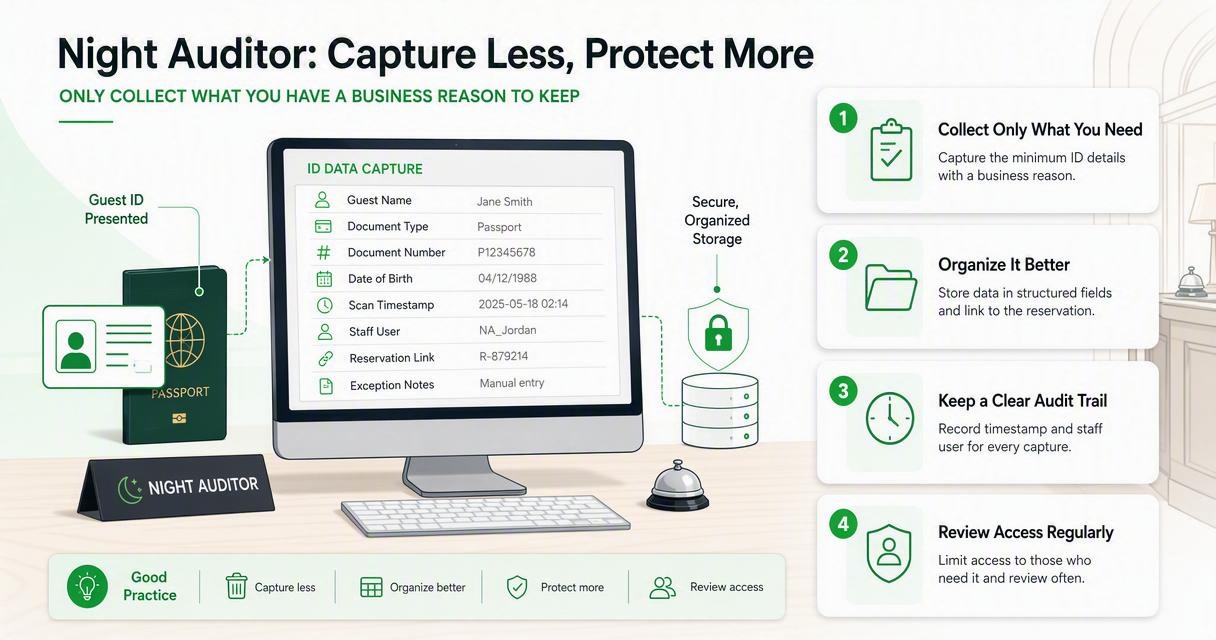
Over-collection creates privacy burden. Under-collection creates weak evidence. The best middle ground is a documented data map that says which fields are required, optional, masked, or deleted after a set period.
Recommended capture fields by purpose
| Field | Primary purpose | Manager note |
|---|---|---|
| Full name | Reservation match | Required for most check-ins |
| ID image or scan record | Identity documentation | Restrict access by role |
| Date of birth | Age-restricted stays or local rules | Avoid casual use |
| Address | Registration record | Follow local requirements |
| Scan timestamp | Audit trail | Useful for chargeback review |
| Staff user | Accountability | Use unique logins, not shared accounts |
| PMS reservation ID | Record matching | Prevent orphaned scans |
| Exception note | Handoff clarity | Keep factual and brief |
Hotels that want a broader automation view can compare ID capture, PMS transfer, and guest record practices in this hotel guest data capture automation guide. The practical win is fewer blank fields and fewer mystery records.
How GuestBan ID Scanning handles this
GuestBan ID Scanning handles after-hours check-in by giving hotels a structured way to capture guest ID data, connect it to guest risk controls, and support cleaner front desk documentation. The platform is most useful when managers want the same check-in standard followed across every shift, not just during supervised daytime hours.
The strongest use case is consistency. A night auditor should not have to decide from scratch how to handle every late arrival. With GuestBan ID Scanning, the scan becomes part of a repeatable guest verification workflow rather than a loose image saved somewhere on a workstation.
For hotels evaluating scanner setup, hardware choices, and operational fit, GuestBan's guide to hotel ID scanning software covers the broader front desk use case.
Where it fits in the night audit flow
- Before key issuance: confirm the guest record and capture the ID.
- During review: check guest history, DNR status, and notes tied to the person.
- At exception handling: document mismatches, refusals, or manager approvals.
- During morning handoff: give managers a record that is easier to review than a handwritten note.
This is especially helpful for multi-property groups. The general manager can set one rule, train every desk, and review exceptions with the same structure across locations.
How does scanning support chargeback defense?
Scanning supports chargeback defense by linking the guest's identity record to the stay, payment timing, staff action, and reservation details. It does not guarantee a win, but it gives the hotel a more organized evidence packet when a cardholder disputes a late-night stay.
Chargebacks often become hard to defend when the property has a signed folio but no reliable identity trail. A scan-linked record can help show who checked in, when the check-in occurred, which reservation was used, and what exceptions were noted.
"An ounce of prevention is worth a pound of cure.", Benjamin Franklin, National Archives Founders Online
Prevention, in this setting, means getting the record right before the guest receives access to the room.
Evidence packet for disputed stays
A strong dispute packet may include:
- ID scan record or approved identity verification record
- Reservation confirmation and booking source
- Folio, authorization, and payment timestamps
- Staff user who completed check-in
- Notes about cardholder mismatch or third-party authorization
- Signed registration card if the property still uses one
- Camera reference or incident number, if policy allows
Hotels focused on dispute readiness should read the related guide on hotel ID scanning for chargeback prevention. The scan is one part of the file, not the whole defense.
How should hotels handle refusals and exceptions?
Hotels should handle ID scan refusals and exceptions with a written policy that gives staff approved options, not improvisation. The night auditor should explain the requirement, offer any approved alternative, document the refusal, and escalate when policy requires manager input.
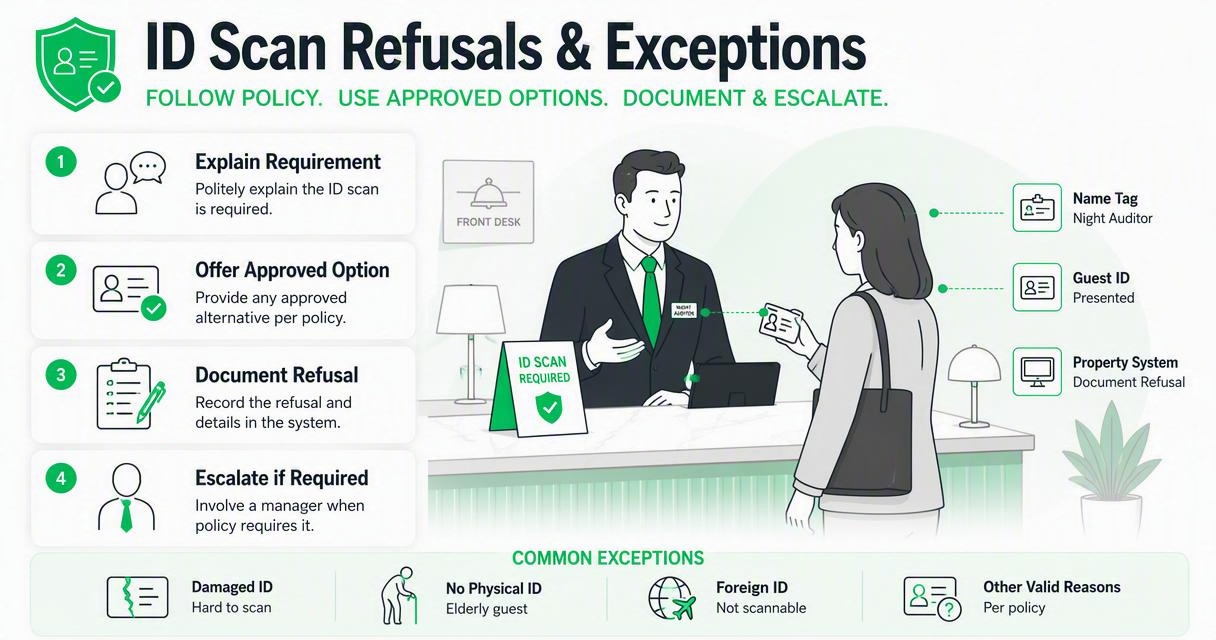
Common exceptions include damaged IDs, expired IDs, third-party bookings, cardholder mismatches, privacy objections, and guests who arrive after the posted check-in window. Each exception should have a matching front desk response.
The safest wording is plain and non-accusatory: "Our hotel requires ID verification for all registered guests before we issue keys." That keeps the interaction focused on policy, not suspicion.
Escalation rules for night auditors
| Situation | Auditor action | Manager review needed? |
|---|---|---|
| Guest refuses scanning | Explain policy and approved alternative | Yes, if no alternative is accepted |
| ID name differs from booking | Verify allowed name change process | Often |
| Cardholder not present | Follow third-party authorization policy | Yes |
| DNR or guest history alert | Pause check-in and follow escalation script | Yes |
| Guest becomes aggressive | Stop debate and follow safety protocol | Yes |
A refusal policy should protect the employee as much as the hotel. When the rule is written, the auditor can point to the standard instead of negotiating alone.
What privacy rules should managers set?
Managers should set privacy rules that define why IDs are scanned, who can view records, how long scans are retained, when data is deleted, and how staff explain the process to guests. Privacy is not the opposite of security. It is part of a secure check-in program.
Access control matters most at night because fewer leaders are watching the workflow in real time. Use named user accounts, permission levels, audit logs, and periodic record reviews. Shared logins make accountability weak.
Technology trends are moving toward more connected hotel systems. A 2023 IEEE survey on Industry 5.0 describes the broader shift toward human-centered digital systems, automation, and connected technologies IEEE Communications Surveys & Tutorials. Hotels should adopt that mindset carefully: automate the record, but keep human judgment for exceptions.
Policy items to review in 2026
- Notice: tell guests why ID is required and how records are handled.
- Minimum data: collect only fields tied to check-in, safety, billing, or legal duties.
- Retention: set a deletion schedule by record type and local requirements.
- Access: limit viewing to trained staff with a business need.
- Audit logs: review who accessed guest records and when.
- Training: teach night auditors the exact words to use with privacy questions.
For retention planning, use this 2026 scanned ID retention guide. I would review retention at least once a year with counsel or a qualified compliance advisor.
What will change by 2027?
By 2027, hotels should expect more ID capture to move into connected front desk workflows that combine mobile pre-arrival verification, PMS matching, risk alerts, digital registration, and manager dashboards. The best systems will reduce typing without removing staff judgment from unusual cases.
Large language model research is already improving how software can interpret user intent in mobile interfaces, as shown in 2023 ACM work on conversational interaction with mobile UI ACM Digital Library. In hotels, that points toward smarter prompts for staff, cleaner exception notes, and faster retrieval of guest records.
Still, automation should not become blind approval. A late-night workflow should help the auditor see the right information, ask the right question, and escalate at the right time.
Practical upgrades to plan now
- Standardize scan rules across properties. Multi-property groups should remove local guesswork.
- Connect scans to guest history. A scan is more useful when it checks the current stay against known records.
- Improve manager dashboards. Morning review should show exceptions first, not every clean check-in.
- Train for scripts, not theory. Give auditors exact wording for refusals, mismatches, and privacy questions.
- Test retrieval speed. If evidence takes hours to find, the record system is not audit-ready.
GuestBan ID Scanning is built for this direction: clear guest capture, better handoffs, and records that support front desk decisions.
FAQ
These are the questions hotel managers most often ask before tightening overnight ID procedures.
Can hotels scan IDs for late-night check-in?
Hotels can generally require identity verification as part of check-in, but the exact scanning rules depend on jurisdiction, brand policy, and data handling practices. Managers should define the purpose, limit access, post clear guest-facing language, and confirm retention rules with legal or compliance advisors.
Should every guest be scanned or only the primary guest?
Most hotels start with the registered guest who receives the room and is tied to the folio. Some properties scan all adult occupants for safety, local compliance, or risk-control reasons. The policy should be consistent by property type and written clearly enough that night staff apply it the same way.
Does ID scanning replace the PMS check-in process?
ID scanning does not replace the PMS. It improves the identity and documentation layer around check-in. The PMS still manages room status, rates, folios, payments, and guest profiles. The best setup connects scan records to PMS reservations so managers do not search across disconnected systems.
What if the scanner or internet fails overnight?
Every hotel should have a downtime procedure. That may include manual ID review, a temporary paper log, supervisor notification, delayed upload, and a morning reconciliation task. Staff should not invent a workaround during the shift. The backup process needs the same privacy and access rules as the normal workflow.
Conclusion
A safer overnight check-in program starts with a written rule, not a new device. Map the late-night workflow, decide what the auditor must capture, define escalation triggers, set retention rules, and test whether managers can retrieve a clean record the next morning.
If you are reviewing ID scanning for hotel night audit and after-hours check-in, start with one property, train the night team, review a week of exceptions, and then standardize the process. To see how GuestBan ID Scanning can support that workflow, visit guestban.com and schedule a practical review of your current after-hours check-in process.