

TL;DR
Prepaid reservations usually still require a valid photo ID at check-in because payment status does not prove identity, age, authorization to stay, or responsibility for damages. Hotels should publish a clear ID policy, train staff on exceptions, and use secure ID capture to reduce disputes.
Yes, do hotels need ID for prepaid reservations in most real-world operations, because a paid folio is not the same thing as a verified guest. Front desk teams still need to confirm who is receiving the room, whether the guest meets age rules, and who accepts house rules, incidental charges, and liability.
Prepaid reservation: a hotel booking paid before arrival through the hotel, an online travel agency, a company, or a third party, while identity verification still happens at check-in.
Many operators now use GuestBan ID Scanning to make that check faster, more consistent, and easier to document without turning the front desk into a paperwork bottleneck.
Table of Contents
Why prepaid reservations still require ID
Prepaid reservations still require ID because payment confirms money moved, not that the arriving person is the correct guest. In hotel operations, identity is tied to room access, safety records, age restrictions, chargeback evidence, and accountability for damages.
A prepaid booking can come from an OTA, employer, travel agent, gift card, or family member. None of those channels guarantee that the person at the desk is authorized to occupy the room.
Key insight: Treat payment, identity, and room authorization as three separate checks. One completed check should not automatically satisfy the other two.
Prepaid payment vs. check-in verification
| Check | What it proves | What it does not prove |
|---|---|---|
| Prepayment | The room or rate was paid in advance | The arriving person is the named guest |
| Photo ID | The guest's identity and age | That the card can cover incidentals |
| Card authorization | Funds may be available for deposits or damages | That the cardholder is staying |
| Signature or e-registration | Acceptance of hotel terms | That the booking source was low-risk |
Digital payments are becoming normal, but they do not replace identity proofing. A 2023 study on mobile-wallet service dimensions focused on satisfaction and loyalty, not lodging identity verification or hotel liability controls Cogent Business & Management.
What should hotels check at arrival?
Hotels should check a government-issued photo ID, reservation name, age eligibility, payment or deposit method, and any third-party authorization before issuing keys. This keeps the process fair to legitimate guests while giving staff a consistent basis for declining unsafe or mismatched stays.
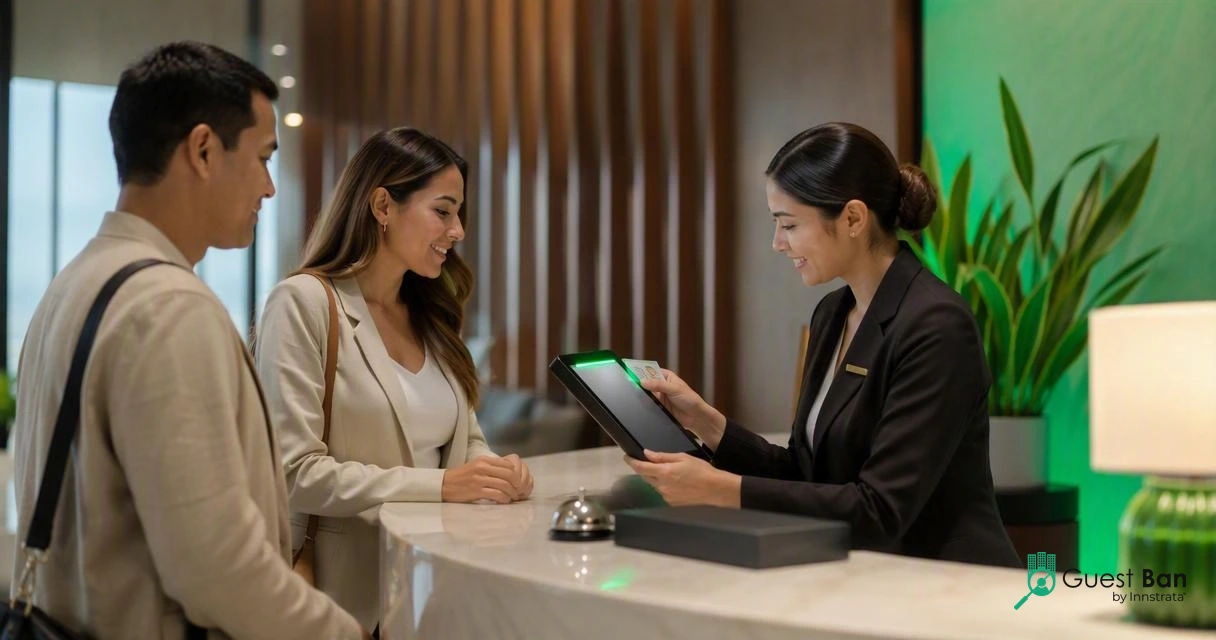
The exact rule depends on brand standards, local law, property risk, and guest type. For foreign guests, passport handling may also apply, and operators should review passport scanning requirements for foreign guests before collecting more data than needed.
Front desk checklist for prepaid arrivals
- Ask for a valid photo ID from the person receiving the room.
- Match the ID name to the reservation, approved occupant list, or written authorization.
- Confirm the guest meets the property's minimum check-in age.
- Collect or confirm an incidental hold when your policy requires it.
- Record acceptance of house rules, smoking fees, pet rules, and damage responsibility.
- Escalate mismatches to a manager before issuing keys.
"Don't give your personal or financial information in response to a request that you didn't expect.", Federal Trade Commission, How To Avoid a Scam
That FTC advice is written for consumers, but it supports the same operating principle for hotels: unexpected payment stories, mismatched names, and pressure to bypass verification deserve a second look.
How should hotels handle common exceptions?
Hotels should handle exceptions with written authorization, not informal promises. Corporate travel, OTA bookings, and third-party-paid stays are common, but each one needs a clean link between the payer, the reservation, and the person receiving the room.
I recommend writing these rules before a sold-out night, not during one. When staff improvise, guests hear different answers from different shifts, and managers inherit avoidable disputes.
Exception rules that reduce confusion
- Corporate bookings: accept a company-paid stay when the guest is named in the booking or listed in an approved travel profile.
- OTA reservations: require the arriving guest's ID even when Expedia, Booking.com, or another channel collected payment.
- Third-party-paid stays: require a credit card authorization form or approved virtual card process before arrival.
- Family or gift bookings: require the actual occupant's ID and age check at arrival.
- Emergency no-ID cases: manager approval, added verification questions, and a documented exception are safer than silent rule-breaking.
For properties seeing repeated mismatches, no-show disputes, or suspicious prepaid bookings, review your workflow against hotel reservation fraud detection practices. Prepayment can reduce one risk, but it can also hide another if staff stop verifying the guest.
How should a hotel policy be worded?
A hotel ID policy should say plainly that prepayment does not waive check-in verification. The best wording is short, visible before arrival, and consistent across the booking engine, confirmation email, OTA profile, and front desk signage.

Vague wording causes friction. A guest who paid in advance may feel the hotel changed the deal if the ID rule appears for the first time at 11 p.m.
Sample prepaid reservation ID policy
Sample policy: All guests must present a valid government-issued photo ID at check-in, including prepaid reservations. The name on the ID must match the reservation or an approved authorization on file. A payment card or deposit may be required for incidentals, damages, or unpaid charges. The hotel may refuse check-in when identity, age, or authorization cannot be verified.
Add property-specific details after legal review:
- Minimum check-in age, such as 18, 21, or local requirement.
- Accepted ID types, such as driver's license, passport, state ID, or military ID.
- Deposit rules for prepaid, rewards, OTA, and company-paid stays.
- Refund handling when a guest cannot meet check-in requirements.
The policy should also cover refusal questions. A useful starting point is GuestBan's guide on what hotel operators need to know about ID scanning policies.
Data minimization for ID capture
Hotels should collect only the identity data needed for the business purpose, legal duty, or safety rule. NIST gives a useful privacy principle for any ID workflow:
"Organizations should minimize the use, collection, and retention of PII to what is strictly necessary to accomplish their business purpose and mission.", NIST, SP 800-122
With GuestBan ID Scanning, operators can standardize capture steps, reduce manual typing, and support clearer guest records. For automation planning across front desk workflows, see hotel guest data capture automation.
What should operators expect in 2027?
Hotels should expect more digital check-in, mobile keys, virtual cards, and automated ID capture in 2027, but not the end of identity checks. The likely shift is from manual desk inspection to earlier, cleaner verification before the guest reaches the lobby.
E-business adoption research continues to show that technology changes cost, process, and staffing decisions for small businesses, not just customer convenience Electronic Commerce Research. Hotels should treat ID verification as an operating system, not a last-minute desk task.
Practical upgrades for hotel teams
- Move ID requirements into confirmation emails and pre-arrival messages.
- Use digital registration for repeat guests, while keeping manual review for exceptions.
- Train staff to separate prepaid room charges from incidental authorization.
- Audit declined check-ins monthly to find unclear policy language.
- Keep a manager-approved exception log for no-ID or mismatched-name cases.
The GuestBan ID Scanning platform fits properties that want a repeatable check-in standard across one hotel or many. If your team is updating policies this year, visit guestban.com after you define your ID, deposit, and exception rules.
FAQ
Prepaid hotel ID rules are easiest to enforce when staff can answer the same guest questions the same way every time.
Can a guest check in if someone else prepaid the room?
Yes, but the hotel should verify that the arriving guest is authorized to use the reservation. The payer can usually handle charges before arrival, but the occupant still needs photo ID, age verification, and acceptance of hotel rules. For third-party stays, use written authorization rather than verbal approval.
Can a hotel refuse a prepaid guest with no ID?
Yes, many hotels can refuse check-in when the guest cannot prove identity, meet age rules, or show authorization for the stay. The refund result depends on the booking terms, OTA rules, local law, and hotel policy. Staff should escalate the decision to a manager and document the reason.
Does an OTA payment replace a hotel deposit?
No, OTA payment usually covers room and tax, but it may not cover incidentals, smoking fees, pet damage, minibar charges, or other costs. Hotels should disclose deposit rules before arrival and apply them consistently to prepaid and non-prepaid reservations.
Do hotels need ID for prepaid reservations at every property?
Do hotels need ID for prepaid reservations? In practice, yes at most professionally managed properties, though exact rules vary by country, brand, and property type. Operators should publish the requirement clearly, train staff on exceptions, and keep verification proportional to risk.
Conclusion
Prepayment should make arrival smoother, not weaker. Your next step is to review every guest touchpoint, booking engine, OTA listing, confirmation email, and front desk script, and make sure each one says that valid ID is required for prepaid stays. If your team wants faster, more consistent verification, evaluate GuestBan ID Scanning and use guestban.com as a starting point for tightening your check-in process.