

TL;DR
TL;DR: A guest may refuse an ID scan, but a hotel may usually require lawful identity verification as a condition of check-in. Use a written policy, offer a manual alternative when appropriate, document the interaction, and escalate only when the guest refuses all acceptable verification.
A refused ID scan at the front desk is not just a privacy conversation, it is an operations, safety, fraud, and guest-service decision happening in real time. The practical answer to "can a guest refuse hotel ID scanning" is yes, a guest can say no to scanning, but the hotel can usually require identity verification through a lawful, consistently applied policy. Many hotels pair that policy with GuestBan ID Scanning so staff can capture guest records, reduce manual entry, and keep check-in decisions auditable without turning every objection into a confrontation.
Table of Contents
What does hotel ID scanning mean?
Hotel ID scanning: the process of electronically capturing information from a guest's government-issued ID, passport, or driver's license to verify identity, support guest records, reduce fraud risk, and document check-in.
Hotel ID scanning is different from simply looking at an ID. A visual check confirms that the guest has an acceptable document. A scan may capture fields such as name, date of birth, document number, address, expiration date, image, timestamp, or a copy of the ID, depending on the system and hotel policy.
For a deeper operational workflow, hotel teams can use a hotel front desk ID capture checklist to define accepted documents, required fields, escalation triggers, and retention steps before staff face a refusal at the desk.
Key takeaway: The guest may object to the scan, the copy, the storage, or the purpose. Train staff to identify which objection they are hearing before deciding what to do next.
Can a guest refuse hotel ID scanning?
A guest can refuse hotel ID scanning, but that refusal does not automatically give the guest a right to check in without acceptable identity verification. In most hotel operations, the key distinction is refusing the scan versus refusing to show ID at all, and the hotel's next step should follow written policy and local law.
Front desk teams should treat the first refusal as a request for clarification, not as misconduct. A calm explanation often resolves the issue: the hotel verifies identity to match the reservation, reduce chargebacks, protect staff, and maintain accurate guest records.
Some guests will accept a visual inspection or manual entry if they do not want a scanned image retained. Others may refuse every form of verification. Those are very different scenarios.
Refusal scenarios and practical responses
| Guest response | What it usually means | Practical hotel response |
|---|---|---|
| "You can look at it, but don't scan it." | Privacy concern about electronic capture | Offer visual inspection plus manual entry if policy allows |
| "I don't want you keeping a copy." | Retention concern | Explain retention period, access controls, and deletion process |
| "I don't have ID." | Verification gap | Ask for accepted alternatives or escalate to manager |
| "I won't show anything." | Refusal of identity verification | Decline check-in if policy and law support it |
| "I booked online, so you already know me." | Misunderstanding of OTA data | Explain that reservation data is not proof of identity |
I recommend training agents to say, "We need to verify identity to complete check-in. If you do not want the ID scanned, I can ask a manager whether a manual verification option is available." That sentence preserves control without sounding punitive.
When may a hotel decline service after refusal?
A hotel may be justified in declining service when the guest refuses all acceptable identity verification, the policy is lawful, the rule is applied consistently, and the refusal prevents the hotel from meeting security, payment, age, registration, or risk-control requirements.
The safest position is not "we scan everyone, no exceptions." A better position is "we verify every adult guest under a consistent policy, and scanning is our standard method unless an approved alternative applies." That wording gives managers room to handle privacy, accessibility, and technical issues.
Hotels should be especially careful when a refusal intersects with protected characteristics, disability accommodation, domestic safety concerns, or a language barrier. A refusal to scan is not a reason to be rude, threaten a guest, or make assumptions about intent.
Decline-service checklist for managers
- Confirm the guest understands the policy and why ID verification is required.
- Offer an approved alternative if one exists, such as visual inspection and manual entry.
- Check payment rules, age restrictions, local registration duties, and brand standards.
- Escalate to the manager on duty before canceling the stay.
- Document the facts, not opinions, in the guest record.
- Process refunds or cancellation fees according to booking terms and law.
"The right to be let alone.", Samuel D. Warren and Louis D. Brandeis, The Right to Privacy
That famous privacy phrase still matters at the front desk. Hotels need identity controls, but guests deserve a clear explanation of what is collected and why.
What alternatives can hotels offer?
Hotels can offer manual ID verification, partial data capture, manager review, passport inspection, payment matching, or a delayed scan only if those alternatives still satisfy the property's legal, safety, and financial controls.
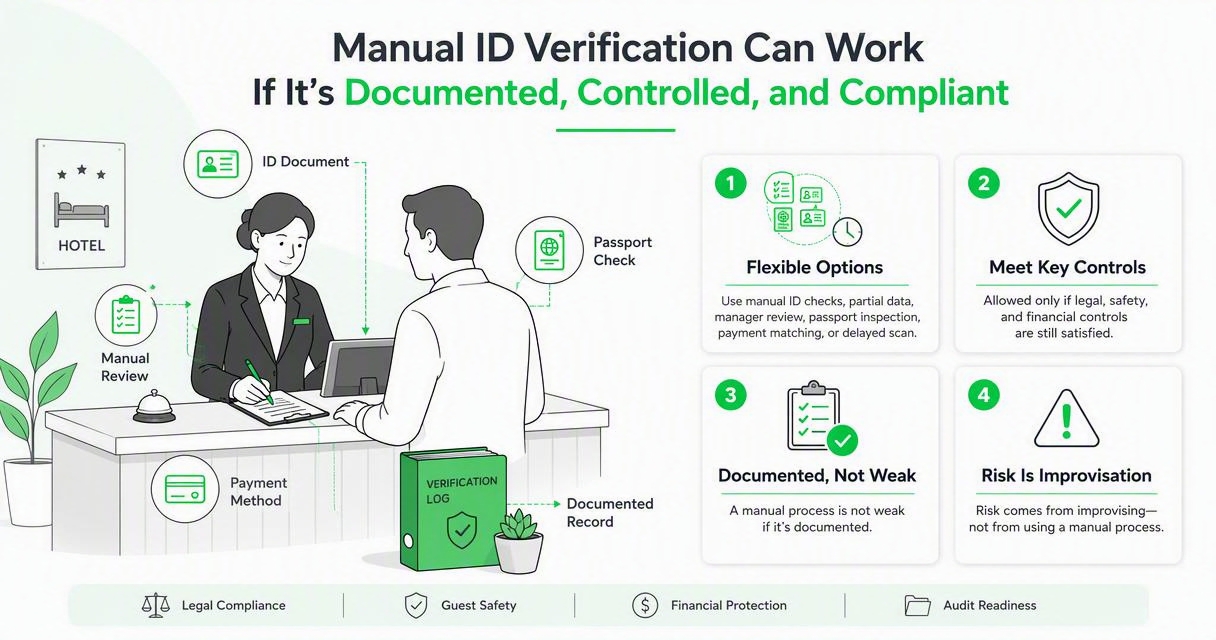
A manual process is not a weak process if it is documented. The risk comes from improvising. Staff should know which fields to record, when to ask for a second document, and when a manager must approve the exception.
For fraud-heavy properties, a scan may also support chargeback defense by linking the guest, ID, payment card, reservation, and timestamp. The related guide on hotel ID scanning for chargeback prevention explains why retrievable records matter when a cardholder disputes a stay.
Verification options by risk level
| Option | Best fit | Main limitation |
|---|---|---|
| Visual inspection only | Low-risk repeat guest with matching payment | Harder to audit later |
| Manual data entry | Guest objects to scanning but shows valid ID | Typing errors and slower check-in |
| Scan without image retention | Privacy-sensitive guest where system supports it | May not satisfy every evidence need |
| Manager-approved exception | Accessibility, system outage, unusual case | Must be rare and documented |
| Decline check-in | Guest refuses all verification | Requires calm escalation and policy support |
A good policy also defines what is not acceptable. For example, a social media profile, a photo of a card, or a name on an email account should not replace a government ID unless counsel and brand policy approve it.
What should staff say at the front desk?
Staff should use short, neutral language that explains the hotel's verification requirement, offers an approved alternative when available, and avoids debating privacy law in the lobby.
Scripts matter because refusals often happen during peak arrival time. I have seen the best outcomes when agents slow the conversation down, lower their voice, and move the guest away from the line if possible.
Front desk script for scan refusal
- "For every check-in, we verify a valid government ID against the reservation and payment method."
- "Our standard process is to scan the ID so the record is accurate and auditable."
- "If your concern is the scan, I can ask a manager whether manual verification is available."
- "If we cannot verify identity through an approved method, we cannot complete check-in."
- "I can provide our privacy and retention summary before you decide."
Avoid phrases like "everyone has to do it," "it's the law everywhere," or "if you have nothing to hide, it shouldn't matter." Those lines sound dismissive and may be inaccurate.
"Privacy is not an option, and it shouldn't be the price we accept for just getting on the Internet.", Gary Kovacs, TED Talk transcript
That quote is about online tracking, but the lesson applies here: explain the exchange clearly. A guest is more likely to cooperate when they understand the purpose, retention period, and safeguards.
What policy language should hotels use?
A strong hotel ID scanning policy says what is required, why it is required, what data is collected, how long records are retained, who can access them, and what happens if the guest refuses all approved verification methods.
Policy language should be visible before the confrontation. Add it to booking confirmations, pre-arrival messages, front desk signage, and staff SOPs. If the first time a guest hears about scanning is after a long travel day, the agent starts at a disadvantage.
Sample policy wording for managers
"At check-in, all adult guests must present an accepted government-issued photo ID for identity verification. Our standard process is electronic ID scanning to improve accuracy, reduce fraud, and maintain required guest records. If a guest objects to scanning, management may review approved alternatives. Guests who refuse all accepted identity verification methods may be unable to check in."
The policy should not promise more than the hotel can deliver. If your system stores ID images, say so. If it stores extracted fields only, say that. If retention varies by property, do not publish a single universal promise.
Hotels reviewing storage rules should also read the 2026 guide on how long hotels should keep scanned IDs. Retention is where many ID programs become harder to defend than the scan itself.
How should hotels document the refusal?
Hotels should document ID scan refusals with objective facts, approved alternatives offered, manager decisions, payment handling, and the final outcome, without labeling the guest as suspicious unless specific behavior supports that note.
Good documentation protects both sides. It helps the guest understand the decision, and it gives the hotel a record if there is a chargeback, incident, complaint, or internal audit.
Refusal documentation fields
- Date, time, property, and staff member.
- Reservation name and booking channel.
- Type of ID presented, if any, without unnecessary extra details.
- Exact concern stated by the guest, such as "does not want scanned copy stored."
- Alternative offered and whether the guest accepted it.
- Manager approval, denial, or exception reason.
- Final action: checked in, canceled, walked, refunded, or declined.
- Any follow-up needed for privacy, billing, or security review.
Do not write emotional notes like "guest was difficult" or "guest probably hiding something." Use observable facts: "Guest raised voice after being told manual verification was not available," or "Guest declined to present ID and left the property."
Hotels focused on broader risk records can compare ID refusal notes with guest screening alerts for safer check-ins, especially when a property manages repeat incidents across shifts or locations.
How GuestBan ID Scanning supports compliant workflows
A well-designed ID program helps hotels verify guests consistently while giving managers enough control to handle exceptions professionally.
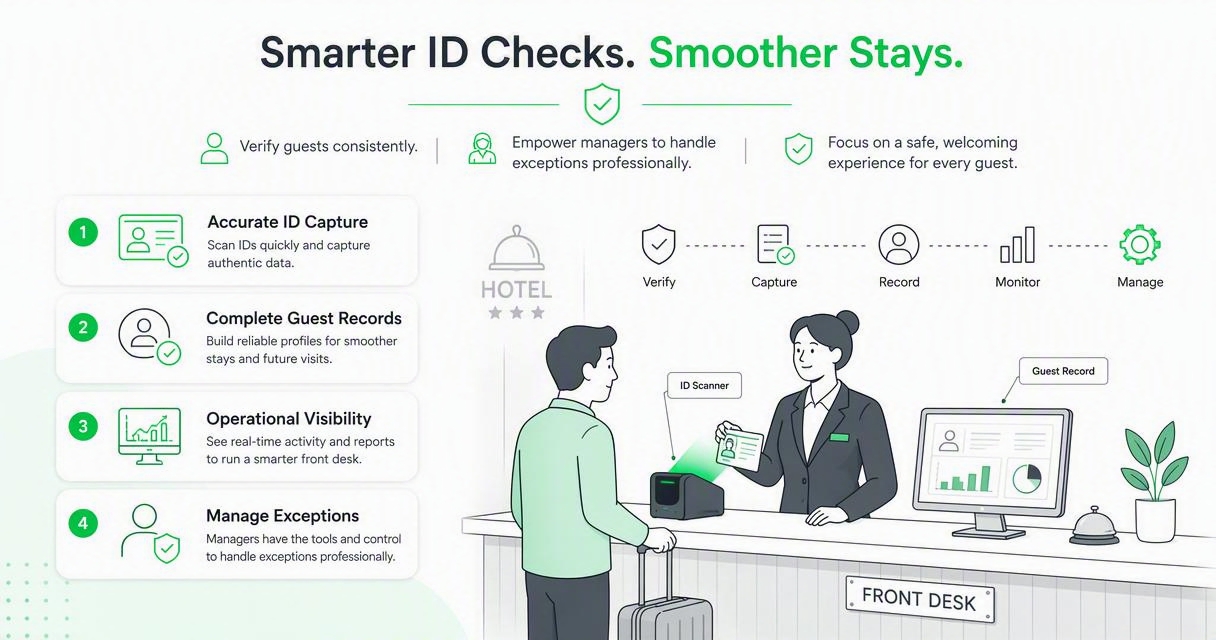
With GuestBan ID Scanning, hotels can build a front desk workflow around accurate ID capture, guest records, and operational visibility. The goal is not to win an argument with a guest, it is to help staff make the same decision the same way across shifts and properties.
GuestBan ID Scanning is especially useful for operators who want a clearer connection between ID verification, risk notes, and retrievable records. For multi-property groups, that consistency can reduce guesswork when one location handles a guest who has stayed elsewhere in the portfolio.
Where the platform fits in the workflow
| Workflow need | Why it matters | How a scanning platform helps |
|---|---|---|
| Standard check-in | Keeps agents consistent | Captures ID data in a repeatable process |
| Manager review | Reduces front desk pressure | Creates a record for exception decisions |
| Record retrieval | Supports audits and disputes | Connects guest data to stay history |
| Risk visibility | Helps protect staff and guests | Surfaces relevant records during check-in |
Hotels can learn more at guestban.com when they are ready to move from informal ID checks to a documented verification workflow.
What privacy safeguards should be in place in 2026?
Hotels should treat scanned IDs as sensitive records in 2026, with limited access, clear retention, encryption where available, audit logs, staff training, and deletion rules that match legal, brand, and operational needs.
The future of travel verification is moving toward more automation, including facial recognition and biometric authentication. A 2022 paper in Information Systems Frontiers studied AI-driven facial recognition in travel and tourism, showing why identity tools are becoming more advanced and more sensitive at the same time (Gupta, Modgil, and Lee, 2022).
Biometric systems also raise liveness and fraud-detection questions. A 2021 systematic review on iris liveness detection describes authentication as a technical field focused on distinguishing real biometric traits from spoofing attempts (Khade, Ahirrao, and Phansalkar, 2021). Most hotels are not using iris tools at check-in, but the privacy lesson is relevant: stronger identity systems need stronger controls.
Minimum safeguard checklist
- Publish a short privacy notice for ID collection.
- Limit access to trained staff with role-based permissions.
- Store only the data the hotel has a reason to keep.
- Set retention periods before scanning begins.
- Review logs for access, exports, and deletion.
- Train staff on what to say when guests ask privacy questions.
Security programs should also account for human-risk issues. Guest identity checks can support broader safety initiatives, including hotel efforts to take a stand against human trafficking when paired with training and escalation procedures.
What changes should hotels expect in 2027?
Hotels should expect more guest questions about ID storage, more automation in PMS-connected verification, and greater scrutiny of biometric or AI-assisted identity tools in 2027.
Two trends are already clear. First, guests are more aware that scanned documents can contain sensitive personal information. Second, operators want faster check-ins without losing evidence for fraud, safety, and compliance decisions.
A practical 2027-ready policy should be consent-aware, channel-aware, and system-aware. That means pre-arrival notices should match what actually happens at the desk, OTA guests should receive the same ID expectations as direct-booking guests, and managers should know what the software stores.
2027 preparation priorities
- Update booking confirmations with ID verification language.
- Review whether PMS integrations transfer only needed fields.
- Separate ID scan refusal from broader guest misconduct policies.
- Test front desk scripts during busy arrival windows.
- Audit retention settings at least once per year.
GuestBan ID Scanning fits that direction because it focuses on front desk identity capture and usable records rather than making staff invent a process under pressure. If your team is planning a 2027 workflow refresh, visit guestban.com and compare your current SOP against what actually happens during a sold-out night.
FAQ
Can a hotel force a guest to scan their ID?
A hotel generally should not frame scanning as physical force or coercion. The better rule is that the hotel may require identity verification as a condition of check-in, subject to local law, contract terms, and nondiscrimination rules. If the guest refuses scanning, offer approved alternatives if your policy allows them.
Can a guest check in if they show ID but refuse a scan?
A guest may be able to check in if the hotel permits visual inspection or manual entry as an alternative. That decision should not be made casually at the desk. The property should define when manual verification is acceptable, what fields must be recorded, and when manager approval is required.
Is it safer to scan every ID with no exceptions?
Scanning every ID can improve consistency, but a no-exceptions approach can create service and accommodation problems. A safer policy verifies every adult guest while allowing manager-approved alternatives for privacy, accessibility, system outage, or unusual cases. Consistency matters, but so does reasonable judgment.
What if a guest says ID scanning violates their privacy?
Staff should acknowledge the concern and explain the purpose, data collected, retention period, and access controls. If the guest still objects, follow the approved alternative process. Do not argue legal conclusions at the desk. Escalate to a manager, document the facts, and apply the same policy used for similar guests.
Can a hotel refuse check-in if the guest has no ID?
A hotel may often refuse check-in when a guest cannot provide acceptable ID, especially when identity verification is needed for payment, age rules, registration, or safety. The manager should review booking terms, local law, and any special circumstances before canceling or charging fees.
Conclusion
The practical answer to "can a guest refuse hotel ID scanning" is yes, but the hotel does not have to ignore its identity-verification standards. Build a written policy, publish it before arrival, train staff on calm scripts, offer approved alternatives when appropriate, and document every exception. If your current process depends on whoever is working the desk, use this week to update your SOP, review retention rules, and contact your verification provider about a cleaner workflow. For hotels ready to standardize ID capture, GuestBan ID Scanning gives teams a more consistent way to verify guests and preserve the records managers need.