

TL;DR
Hotel ID scanning helps front desk teams confirm age faster, reduce manual entry errors, and apply underage guest policies more consistently. It does not replace legal advice or staff judgment, so hotels should pair scanning with a written policy, exception workflow, privacy notice, and clear escalation steps.
Underage guest prevention hotel ID scanning works best when it turns a tense front desk judgment call into a consistent, documented workflow. In 2026, hotels are not just checking IDs for room access; they are also protecting age-restricted amenities, alcohol service, chargeback evidence, staff safety, and multi-property risk records. [Hotel ID scanning]: the process of electronically reading a government ID, capturing selected identity fields, and helping staff verify age, identity, and policy eligibility during check-in. For hotels that want a purpose-built option, GuestBan ID Scanning supports guest data capture and front desk risk workflows without making staff rely on handwritten notes.
Table of Contents
What is underage guest prevention hotel ID scanning?
Underage guest prevention hotel ID scanning is the use of an ID scanner at check-in to confirm a guest's age, capture accurate identity details, and help staff apply a property's minimum-age policy consistently.
The scanner reads data from a driver's license, passport, or other supported ID, then compares the date of birth against the hotel's policy. Staff still decide what to do next, but the system reduces missed birthdates, typo-driven records, and uneven enforcement between shifts.
The concept matters because age rules vary by property, brand, jurisdiction, and service. The Wikipedia summary of the legal drinking age explains that the minimum age for consuming alcohol can differ from the age for purchasing it. In the United States, alcohol regulation is especially state-driven because the Twenty-first Amendment gives states and territories power over intoxicating liquors, as summarized in Wikipedia's list of alcohol laws of the United States.
Key takeaway: ID scanning is an operational control, not a legal shield. It helps staff prove they followed a documented process, but hotels still need local legal review for age rules, ID retention, alcohol service, and privacy disclosures.
Why hotels use ID scanning for age checks
Hotels use ID scanning for age checks because manual ID review is easy to rush, especially during peak arrivals, night audit, and group check-ins.
A front desk agent may be verifying the cardholder, checking payment authorization, assigning a room, handling a line, answering calls, and explaining deposits at the same time. In that setting, a birthdate can be misread, skipped, or entered incorrectly.
ID scanning gives the agent a structured prompt: scan, confirm identity, check age, review policy result, document the outcome. I like this approach because it supports the employee rather than pretending every age decision depends on perfect memory under pressure.
Hotels also use age verification to protect related areas:
- Room rental eligibility: Many properties require the registered guest to meet a minimum age.
- Alcohol access: Bars, minibars, lounges, and event spaces need age-aware controls.
- Incident follow-up: Accurate guest records help managers review what happened.
- Chargeback response: Better identity capture can support payment dispute documentation.
- Multi-property consistency: Groups can apply the same policy across locations.
For a deeper operational view, GuestBan's guide to hotel ID scanning for chargeback prevention explains how identity capture can support payment-risk workflows beyond age checks.
Where ID scanning fits in the check-in workflow
ID scanning fits after the reservation is found and before keys, access credentials, or restricted amenities are issued.
A simple sequence keeps the process clear for the guest and defensible for the hotel. The goal is not to interrogate guests; it is to verify that the person standing at the desk matches the reservation and meets the policy requirements.
- Greet the guest and locate the reservation. Confirm name, arrival date, room type, and payment method.
- Request an accepted government ID. Explain that ID verification is required by property policy.
- Scan the ID. Capture permitted fields and verify that the document appears to match the guest.
- Review the age result. Compare date of birth with the property's minimum check-in age and any amenity rules.
- Apply the policy. Approve, escalate, request an eligible adult, or follow the exception process.
- Document the outcome. Record who reviewed the case, what decision was made, and any manager approval.
- Issue access only after approval. Do not release keys or restricted benefits before the policy decision is complete.
This sequence is especially useful for after-hours teams. If your risk profile includes late arrivals, walk-ins, or limited manager coverage, the related guide on ID scanning for hotel night audit and after-hours check-in gives more detail on overnight documentation and escalation.
How to handle an underage guest at the front desk
Hotels should handle an underage guest by pausing check-in, confirming the policy result, escalating to a manager when required, documenting the decision, and offering approved alternatives without arguing at the desk.
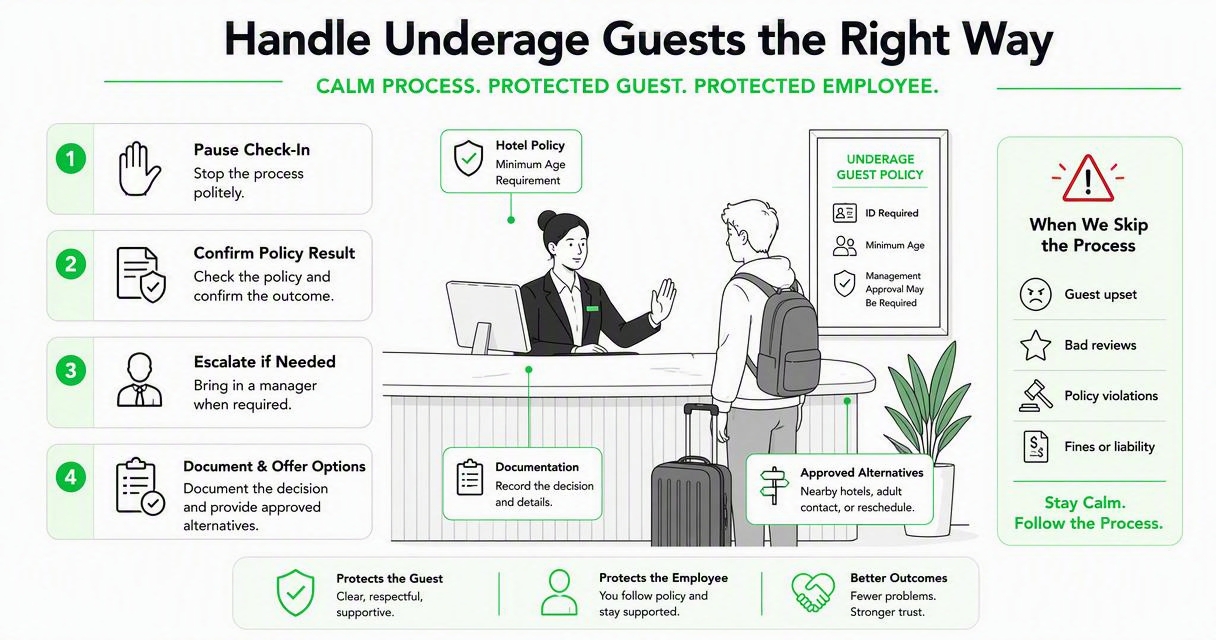
A calm process protects the guest experience and the employee. The worst outcomes usually happen when staff improvise, debate the guest, or make exceptions that nobody records.
Use this workflow when the scan shows the guest is below the minimum age:
- Pause the transaction. Do not issue keys, parking passes, pool bands, minibar access, or alcohol privileges.
- Confirm the scan result. Have the agent visually review the ID date of birth and photo.
- Check the written policy. Use the property's minimum-age rule, not memory or "what we did last time."
- Escalate if needed. Call the manager on duty, security, or the approved remote contact.
- Ask for an eligible adult if policy allows. The adult should present ID and accept registration responsibility.
- Document the decision. Record the scan, time, staff member, policy basis, and final action.
- Offer approved next steps. These may include cancellation guidance, rebooking options, or waiting for an adult.
Key takeaway: The agent's job is to apply the policy, not negotiate a new one. Exceptions should be rare, manager-approved, and recorded in the guest record.
What policies should hotels define before scanning IDs?
Hotels should define minimum age, accepted IDs, exception authority, privacy disclosures, retention periods, and staff escalation paths before ID scanning goes live.
A scanner makes weak policy visible. If the rule is unclear, the technology will only help staff find the conflict faster. I recommend writing the policy in plain English and training agents with examples from real desk situations.
Policy decisions to document before launch
| Policy area | What to define | Why it matters |
|---|---|---|
| Minimum check-in age | Exact age required for the registered guest | Prevents inconsistent shift-by-shift decisions |
| Accepted IDs | Driver's license, passport, state ID, military ID, or other approved documents | Helps agents avoid subjective document calls |
| Underage exception rules | Parent, guardian, military, local resident, corporate booking, or event exceptions | Keeps exceptions controlled and reviewable |
| Restricted amenities | Bar, minibar, casino, spa, pool, gym, or club access rules | Separates room eligibility from amenity access |
| Data capture fields | Name, date of birth, address, ID number, image, or partial fields | Supports privacy-by-design decisions |
| Retention schedule | How long scanned data is kept | Reduces unnecessary data exposure |
| Escalation path | Manager, security, owner, or central operations contact | Gives staff support during conflict |
| Guest notice | What guests are told before or during scanning | Builds transparency and reduces complaints |
Privacy needs special care. The GDPR's core principles remain useful even outside Europe because they express a practical standard for guest data handling.
"Personal data shall be: processed lawfully, fairly and in a transparent manner in relation to the data subject.", European Parliament and Council of the European Union, GDPR Article 5
Hotels should also plan for refusal. A guest may object to scanning, and staff need a prepared answer. The guide Can a guest refuse hotel ID scanning? covers the operational questions that come up when a guest will show ID but does not want it scanned.
How GuestBan ID Scanning handles age verification workflows
GuestBan ID Scanning helps hotels turn age verification into a repeatable front desk workflow with structured guest records, scanning, and staff-facing documentation.
The GuestBan ID Scanning platform is built for hospitality teams that need more than a generic scanner. Age checks are most useful when they connect to guest records, policy notes, incident context, and staff handoff. That matters for independent hotels and groups managing multiple properties because a single bad check-in process can create problems across locations.
A practical setup usually includes:
- Fast ID capture so agents are not manually typing birthdates during a rush.
- Clear guest records that show who checked in and when.
- Operational notes for manager review and shift handoff.
- Policy consistency across front desk, night audit, and management.
- Support resources so new employees know what to do when a scan triggers an age concern.
GuestBan ID Scanning is not a substitute for legal advice, local alcohol compliance, or a hotel's own policies. Its value is in helping teams apply those policies the same way, especially when a guest is young, upset, or arriving after hours.
For hotel teams comparing scanner options, GuestBan's overview of scanner ID solutions for hotels is a useful next resource.
What ID scanning does and does not prove
ID scanning proves that staff followed a documented identity-capture step, but it does not prove every ID is genuine, every law was satisfied, or every future guest action was prevented.
That distinction matters. Overpromising creates risk for owners and frustration for employees. A scan is evidence of a process; it is not a magic guarantee.
A hotel can reasonably expect scanning to help with:
- Reading date-of-birth fields more consistently than manual entry.
- Creating a time-stamped record connected to check-in.
- Reducing accidental typos in guest data.
- Supporting manager review after a dispute or incident.
- Prompting staff before access is granted.
A hotel should not claim scanning alone will:
- Detect every fake or altered ID.
- Replace visual inspection by trained staff.
- Override local age, lodging, alcohol, or privacy laws.
- Make an underage exception safe without manager review.
- Eliminate the need for written policies and training.
NIST's digital identity definition is a useful reminder that identity systems represent people through data; they do not remove all uncertainty.
"Digital identity is the unique representation of a subject engaged in an online transaction.", National Institute of Standards and Technology, NIST SP 800-63-3
For loss prevention teams, the right question is not "Did the scanner solve the risk?" The better question is "Did our staff use a consistent control and preserve the right evidence?"
How to choose an age-verification scanner for hotels
Hotels should choose an age-verification scanner by matching the tool to front desk speed, PMS workflow, privacy controls, reporting needs, and support availability.
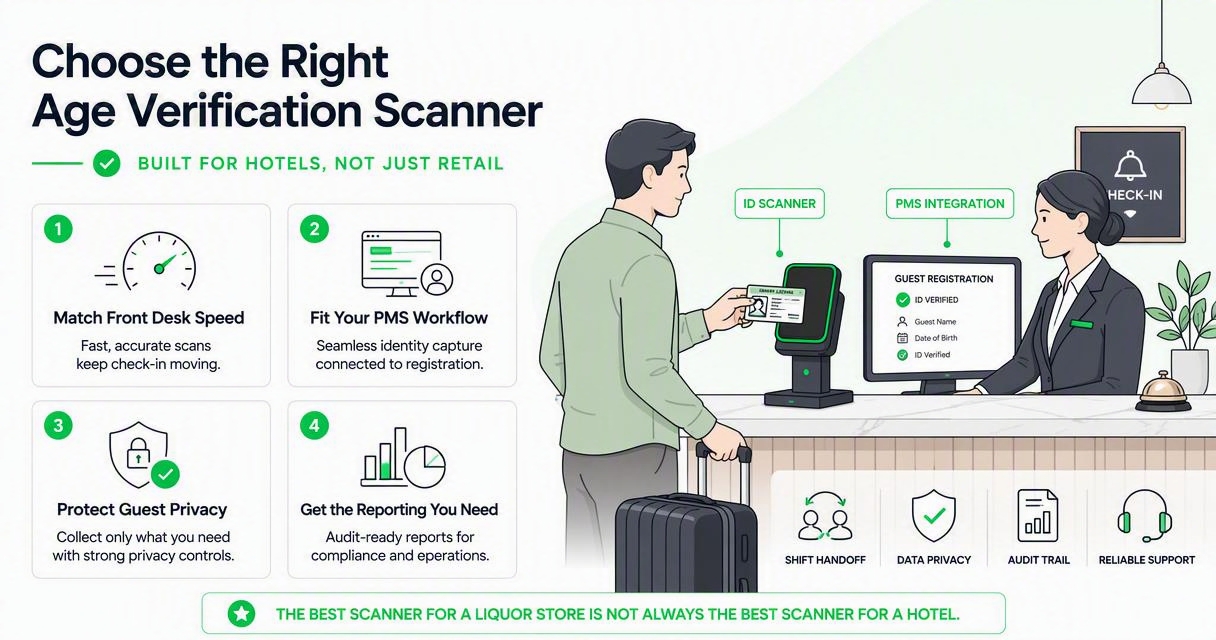
The best scanner for a liquor store is not always the best scanner for a hotel. Hotels need identity capture connected to room registration, shift handoff, guest history, and sometimes multi-property visibility.
Buyer checklist for hotel age-verification tools
| Evaluation factor | What to ask | Strong answer |
|---|---|---|
| Hospitality fit | Was the tool designed for hotel check-in? | Yes, it supports front desk guest records and hotel workflows |
| ID types | Which documents can it read? | Common government IDs and passports used by your guest base |
| Age prompts | Can staff quickly see policy eligibility? | Date of birth is captured and easy to review |
| PMS workflow | Does it reduce duplicate typing? | It supports smooth data capture and operational handoff |
| Privacy controls | Can access and retention be managed? | Staff permissions and retention settings are configurable |
| Multi-property use | Can groups standardize policy? | Shared reporting and consistent workflows are available |
| Support | Who helps during rollout? | Training, resources, and responsive support are included |
| Documentation | Can managers review decisions later? | Records show scan activity, notes, and staff actions |
When I evaluate hotel tools, I also look for how the system behaves during messy moments. A guest may arrive without a wallet, present an expired document, dispute the policy, or ask why the hotel scans IDs. The scanner should make the next step clearer, not harder.
Support quality matters as much as hardware. Front desk turnover is real, and a tool that only one manager understands will not survive a busy weekend. Make sure the vendor provides training resources, support channels, and clear contact options before rollout.
What should hotels tell guests about ID scanning?
Hotels should tell guests that ID scanning is used to verify identity, confirm age eligibility, support property safety, and maintain accurate registration records.
Short, plain-language explanations work better than defensive scripts. Most guests accept ID checks when staff explain the purpose and apply the rule consistently.
Use a script like this:
"For guest safety and registration accuracy, we scan government ID at check-in to verify identity and confirm eligibility under our property policies. We only use the information for approved hotel operations and handle it according to our privacy policy."
Place the same message in three places:
- Booking confirmation: Tell guests before arrival that ID is required.
- Front desk signage: Keep the explanation visible and calm.
- Privacy policy: Explain data fields, access, retention, and guest rights.
Hotels writing or updating their notice can adapt the Hotel ID Scanning Privacy Policy Template for 2026. A clear privacy notice also helps staff because they can point to written policy instead of inventing explanations under pressure.
What to expect in 2027
Hotel age verification will likely become more integrated with digital identity, mobile check-in, and property-level risk systems by 2027.
The direction is clear: guests want faster check-in, while hotels need stronger proof that staff followed policy. That tension will push more properties toward automated ID capture, privacy-aware retention settings, and better links between the front desk, PMS, payment disputes, and incident documentation.
Expect three practical changes:
- More pre-arrival verification. Hotels will ask guests to complete ID steps before arrival, then confirm the person at the desk matches the record.
- Stronger privacy expectations. Guests will ask what is captured, why, who can see it, and when it is deleted.
- More policy automation. Systems will flag age, local resident rules, DNR records, and payment-risk signals in one workflow.
The winning hotels will not be the ones that scan the most data. They will be the ones that capture the right data, explain it clearly, and train staff to act consistently.
FAQ
These are the questions hotel managers most often ask when they connect ID scanning with minimum-age check-in rules.
Can hotel ID scanning prevent every underage check-in?
No. ID scanning can reduce manual errors and help staff identify a guest who is below the property's minimum age, but it cannot guarantee that every fake, borrowed, or altered ID will be caught. Hotels should pair scanning with visual inspection, staff training, manager escalation, and written policies.
Should hotels scan every guest or only young-looking guests?
Most hotels get better consistency by applying one documented ID policy to all registered guests rather than asking agents to judge appearance. A universal process reduces bias concerns, avoids awkward desk interactions, and creates cleaner records. Local law and brand standards should still guide the final policy.
What should staff do if a parent books for an underage guest?
Staff should follow the property's written exception policy. Some hotels require the parent or guardian to be physically present, present ID, and accept responsibility as the registered adult. Others do not allow the exception. The key is to avoid ad hoc approvals and document any manager-authorized decision.
Does ID scanning create privacy obligations for hotels?
Yes. If a hotel captures ID data, it should define what information is collected, why it is collected, who can access it, how long it is retained, and how guests can ask questions. Privacy expectations vary by jurisdiction, so hotels should review policies with counsel.
Conclusion
Underage guest prevention hotel ID scanning is most effective when it supports a clear policy, not when it stands alone. Start by writing your minimum-age rules, exception process, privacy notice, and escalation path. Then train every shift to scan, verify, decide, and document the same way.
If you want a hospitality-focused system for guest identity capture and front desk consistency, evaluate GuestBan ID Scanning as part of your 2026 risk-control plan. To see how it can fit your check-in process, visit guestban.com and prepare your current age policy, ID requirements, and exception rules before you contact the team.