

TL;DR
Verify the primary guest, then decide whether other adults need verification based on local law and documented operational needs. Separate viewing an ID from scanning and storing it; apply a written policy consistently and collect only the information your property needs.
Scanning every adult guest's ID isn't automatically the right hotel policy. When managers ask, "should hotels scan every guest ID," I recommend separating three decisions: whose identity to verify, whether to scan their document, and what information to retain. Those decisions don't have to produce the same answer. A primary-guest policy may suit one property, while another needs every adult occupant registered. For 2026, the useful standard is a written, property-specific procedure that balances legal requirements, documented risk, guest expectations, and front-desk capacity.
Table of Contents
Should hotels scan every guest ID?
Hotels should scan every guest ID only when applicable requirements or a documented operational purpose justify it. My recommended starting point is primary-guest verification, followed by a separate assessment of other adult occupants. Viewing identification, extracting selected fields, and retaining a document image are different actions that need separate policy decisions.
Guest ID scanning: Digitally reading an identity document to capture information, potentially including a document image, depending on the system and settings.
Guest verification: Checking that a person's identity matches the booking or registration details.
Guest screening: Evaluating a guest against defined risk criteria, rather than simply confirming identity.
The distinction matters because reading a driver's license doesn't, by itself, establish that someone is safe or authorize a background check. See the fuller explanation of hotel guest verification versus screening.
Keep the three decisions separate
Decide whom to verify first, how to capture information second, and what to retain third. One check-in requirement shouldn't automatically trigger all three actions.
What legal and privacy checks come first?
Hotel ID scanning policy should begin with a jurisdiction-specific review of guest registration, identity verification, copying, reporting, and retention requirements. Ask qualified local counsel which occupants must be identified and which records must be kept. Don't assume a requirement to record guest details also requires storing a complete ID image.
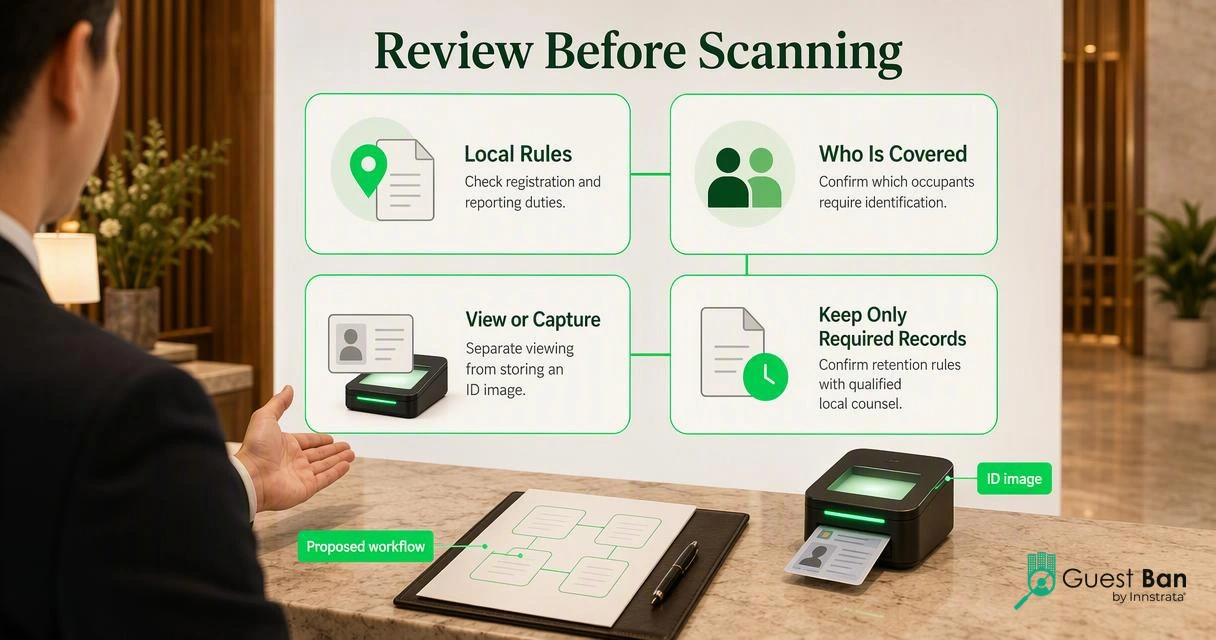
Ask counsel about each collection step
Give counsel your proposed workflow, not just the question "Can we scan IDs?" A useful review should answer:
- Coverage: Does registration apply to the booking holder, every adult occupant, or another defined group?
- Capture: Is viewing enough, or must particular information be recorded?
- Storage: Are document copies required, permitted, or restricted?
- Retention: Which records need a defined deletion date?
- Disclosure: What notice, lawful basis, or consent process applies?
International arrivals deserve a specific procedure. Use the foreign guest passport guide as an operational starting point, then confirm requirements locally.
Make the purpose understandable to guests
Explain what staff will collect, why it's needed, who can access it, and how long it stays. I recommend documenting a process for guests who question scanning, including manager escalation and any lawful alternative.
Don't collect extra fields simply because the scanner can read them. An occupant register may need different information from a billing record. Keep those purposes distinct, and limit staff access accordingly.
Choose a policy by property type
The best hotel ID policy matches verified local requirements and the property's actual operating needs, rather than applying one rule across every location. The matrix below provides starting points for management review, not legal conclusions. Every-adult verification can mean inspecting documents without retaining copies.
Property-level decision matrix
| Property type | Starting policy to assess | When broader verification may fit | Operational tradeoff |
|---|---|---|---|
| Business hotel | Verify the primary guest | Additional adults need individual registration or access credentials | Faster arrivals versus less occupant detail |
| Family resort | Verify the responsible adult; record occupancy | Local rules require other adults to register | Family convenience versus registration workload |
| Extended-stay property | Consider verifying every registered adult | Long stays require accurate occupant records | More onboarding work versus clearer occupancy records |
| Property with documented recurring incidents | Consider every-adult verification | Incident review supports a consistent identification requirement | Added check-in time and privacy obligations |
| Multi-property group | Set a group baseline with local addenda | Laws and operating needs differ by location | Consistency requires location-specific training |
Use objective triggers instead of intuition
Broader checks should follow written triggers, such as adding an adult occupant or issuing an independently controlled room credential. Avoid ad hoc decisions based on appearance, accent, nationality, or staff discomfort.
For example, a fictional business hotel might verify the booking holder at arrival, then verify another adult when adding that person as a registered occupant. That ties collection to a defined action rather than everyone passing through the lobby.
I would also measure check-in duration, manual corrections, and escalation frequency during a pilot. Scanning every adult may improve occupant records, but managers should know whether peak arrivals need another staffed station.
How GuestBan ID Scanning handles this
GuestBan ID Scanning provides an ID-scanning option for hotels evaluating digital guest identification. I recommend assessing it against your approved collection policy: define eligible guests, identify required fields, review the intended workflow, and test staff handoffs. Use the demonstration to confirm how the proposed setup supports your property's specific procedure.
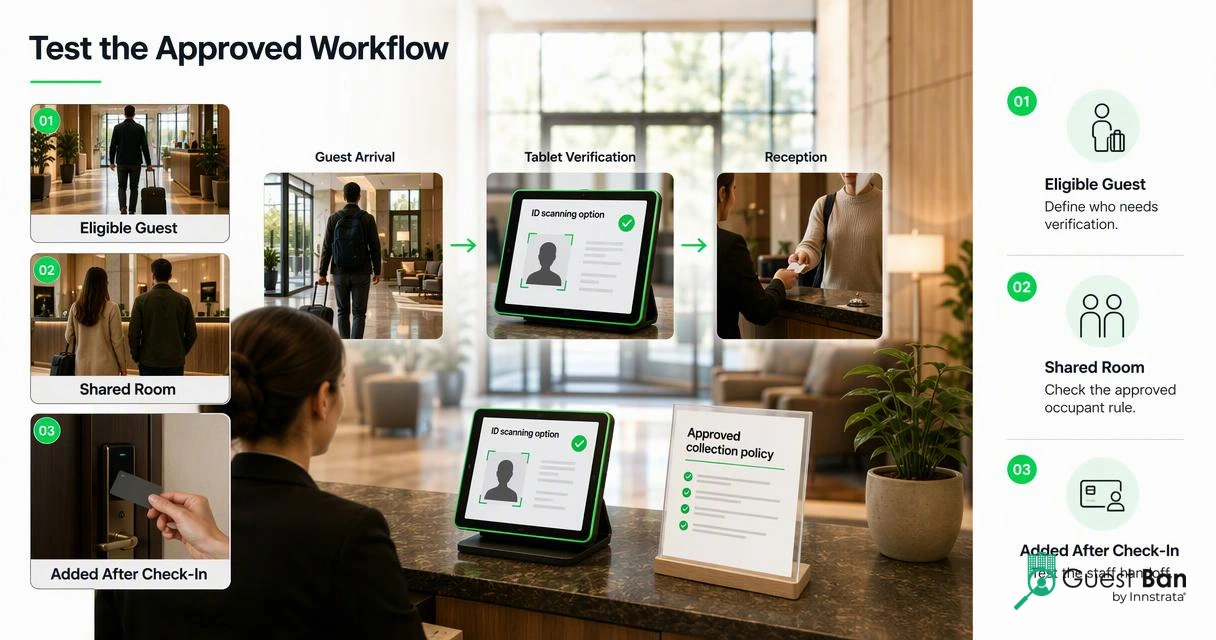
Evaluate the platform against your workflow
A written workflow gives the demonstration a concrete purpose. Bring sample arrivals covering a solo traveler, two adults sharing a room, and an adult added after check-in.
- Identify which person requires verification in each scenario.
- Specify the approved information staff should capture.
- Confirm available document handling and storage settings.
- Review any proposed PMS connection and staff permissions.
- Assign responsibility for training and periodic policy review.
For a focused next step, explore GuestBan ID Scanning and compare the demonstrated workflow with your written requirements. Managers planning PMS data entry can also review hotel guest data capture automation.
FAQ: Adult occupants, minors, and stored images
These check-in questions should have written answers before staff apply a broader identification policy.
Should every adult in a hotel room show ID?
Every adult should show ID when applicable registration requirements or a justified property policy call for individual verification. Otherwise, primary-guest verification may be sufficient for your workflow. Specify how accompanying adults, later arrivals, and room changes are handled so staff don't invent different rules on each shift.
Should hotels scan children's identification?
I wouldn't make scanning children's identification a default without confirming a specific requirement and purpose. Record required occupancy information and follow applicable registration rules. A family check-in policy should distinguish the responsible adult's verification from any information needed about minors, with a clear escalation route for unusual cases.
Does scanning an ID require keeping its image?
Scanning and retaining an image are separate policy decisions, although available settings depend on the product. Confirm whether your proposed system reads fields, stores images, or does both. Ask which information is necessary, how access is controlled, and when records are deleted before approving the configuration.
Conclusion
Choose a policy before choosing a scanner. This week, have your general manager, privacy lead, and local counsel define who gets verified, which fields are collected, and how exceptions work. Then request a GuestBan ID Scanning demonstration at guestban.com using your real check-in scenarios, and pilot the approved workflow at one property before expanding.