

TL;DR
TL;DR: ID scanning helps hotel loss prevention teams connect a verified guest identity to reservations, incidents, payments, DNR alerts, and staff notes. The strongest workflow is not just scanning an ID, it is building an auditable record that front desk, night audit, management, and multi-property teams can act on consistently.
A hotel incident report is only as strong as the guest identity attached to it. ID scanning for hotel loss prevention teams gives general managers, risk managers, and front desk leaders a defensible way to verify who checked in, document what happened, and recognize repeat risk across shifts or properties. For hotels evaluating modern guest-risk workflows, GuestBan ID Scanning is built around that exact operational gap: turning check-in identity capture into usable loss-prevention intelligence.
Table of Contents
What is ID scanning for hotel loss prevention teams?
ID scanning for hotel loss prevention teams: a hotel workflow that captures and verifies government-issued ID data, links it to a guest stay, and makes that record available for incident documentation, internal alerts, DNR decisions, and management review.
ID scanning for hotel loss prevention teams is not just a faster check-in tool. It is a risk-control process that connects identity, reservation data, payment context, timestamps, staff notes, and property-level alerts in one retrievable record.
For a hotel, the goal is practical: reduce anonymous behavior, improve documentation quality, and help staff make consistent decisions when the same guest, cardholder, or incident pattern appears again.
Key insight: A scanned ID does not prevent every bad stay, but it gives the hotel a stronger factual record when a dispute, damage claim, disturbance, police request, or DNR review happens later.
Why do hotels need stronger identity records in 2026?
Hotels need stronger identity records because risk now moves faster than paper logs, shift notes, and memory can handle. A guest may check in late, extend a stay, change rooms, dispute a payment, damage property, or visit another location before managers connect the pattern.
The legal and operational stakes are also higher. Hotels are expected to take guest safety seriously, document incidents clearly, and avoid ad hoc decisions that appear inconsistent. Related hospitality risk cases, including the discussion around the Motel 6 sex trafficking lawsuit in 2026, show why front desk records and escalation workflows matter beyond payment disputes.
Common loss-prevention events that depend on identity
- Room damage discovered after checkout
- Noise, threats, or repeat police calls
- Chargebacks tied to disputed stays
- Unauthorized occupants or party rooms
- Smoking, pet, or cleaning-fee disputes
- DNR guest attempts under a variation of a name
- Long-stay guest conduct issues
- Staff safety concerns during night audit
“Security is a process, not a product.”, Bruce Schneier, Schneier on Security
That quote fits hotels well. A scanner by itself is a device. A loss-prevention workflow is the process that turns ID capture into better decisions.
How does ID scanning improve repeat-offender recognition?
ID scanning improves repeat-offender recognition by standardizing guest identity capture, reducing spelling variation, and matching new check-ins against internal hotel records. This helps staff identify prior incidents before a room is assigned, rather than after damage or disruption occurs.
Manual name searches fail when employees type nicknames, transpose dates, misspell addresses, or skip documentation during a rush. Scanning creates a cleaner identity record at the start of the stay.
For properties that use DNR policies, ID scanning should connect directly to a controlled alert process. A practical starting point is understanding how do-not-rent list software for hotels supports property rules, documentation, and staff review.
Identity signals worth matching before check-in
| Signal | Why it matters | Loss-prevention use |
|---|---|---|
| Legal name | Reduces spelling and nickname gaps | DNR match, incident lookup |
| Date of birth | Helps distinguish similar names | Safer identity confirmation |
| ID number or document metadata | Adds a stronger match point | Repeat-offender recognition |
| Address | Supports pattern review | Local-party risk, billing disputes |
| Reservation and timestamp | Shows who checked in and when | Incident timeline |
| Staff notes | Adds context to the scan | Manager review and handoff |
I recommend treating matches as decision support, not automatic denial. A good workflow prompts staff to review the record, compare the facts, and escalate when needed.
What should a defensible hotel incident record include?
A defensible hotel incident record should include the scanned ID reference, reservation details, payment context, timestamps, staff names, objective notes, guest communications, photos if allowed by policy, and management actions taken. The record should explain what happened without relying on memory.
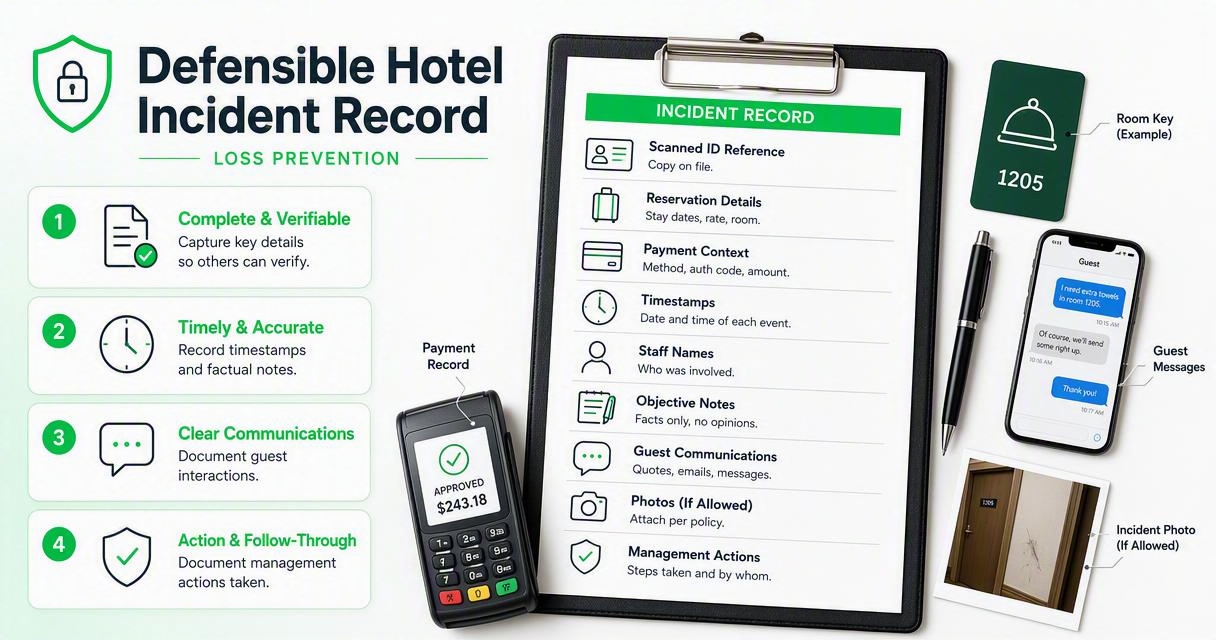
Loss prevention breaks down when records are emotional, incomplete, or scattered across binders, PMS notes, text messages, and camera footage. Good documentation is boring, consistent, and easy to retrieve.
“In God we trust. All others must bring data.”, W. Edwards Deming, The W. Edwards Deming Institute
That is the standard hotel teams should apply. If a manager later reviews a guest complaint, chargeback, staff safety concern, or DNR placement, the file should show facts, not guesses.
Minimum documentation checklist
- Confirm the guest identity from the scan.
- Link the scan to the reservation or folio.
- Add the incident time, location, and staff involved.
- Describe observable behavior without insults or speculation.
- Attach allowed supporting evidence, such as photos or written notices.
- Record the manager decision, refund decision, fee decision, or DNR review.
- Note any police, security, or medical involvement.
- Set a follow-up task for unresolved items.
For after-hours teams, the same rules matter even more because fewer managers are on site. The related guide to ID scanning for hotel night audit and after-hours check-in explains how late-night handoffs should be documented.
How should front desk teams use alerts without overreacting?
Front desk teams should use alerts as structured prompts, not as final judgments. An alert should tell staff what record exists, what policy applies, and when to escalate to a manager before declining service or adding a guest to a DNR list.
This distinction matters. Hotels need safety controls, but they also need fair, consistent service. A vague note like “bad guest” creates risk. A documented record saying “smoking fee dispute on May 4, manager approved DNR after signed room inspection report” is far more useful.
GuestBan ID Scanning supports this stronger model by tying identity capture to reviewable guest records and internal alert workflows, rather than leaving staff to interpret disconnected notes.
A safer alert-response workflow
- Low-risk alert: verify identity, review note, proceed if no policy issue exists.
- Medium-risk alert: pause assignment, notify supervisor, document the decision.
- High-risk alert: follow hotel policy, involve management, and record the outcome.
- Unclear match: do not accuse the guest; compare identifiers and escalate quietly.
Manager rule: Alerts should reduce surprises, not create arguments at the desk.
Training should include exact language for staff. A calm phrase such as “I need a manager to review this reservation before we complete check-in” is usually better than explaining internal risk flags to the guest.
How does multi-property visibility change loss prevention?
Multi-property visibility helps hospitality groups identify recurring guest-risk patterns that a single location would miss. A guest who damages a room at one property, disputes payment at another, and causes a disturbance at a third may look isolated unless records are connected.
Groups managing economy hotels, extended-stay properties, or roadside assets often face the same names moving across nearby locations. Shared visibility gives regional managers better context, especially when properties operate with different staffing levels.
The challenge is governance. Not every note should be shared forever, and not every incident deserves group-wide action. Risk managers should define what qualifies for escalation, who can view records, and when old records should be reviewed or removed.
Property-level versus group-level records
| Record type | Best kept local | Best shared across group |
|---|---|---|
| Minor service complaint | Yes | No |
| Noise warning with no damage | Yes | Sometimes |
| Verified room damage | Yes | Yes |
| Threat to staff or guests | Yes | Yes |
| Chargeback with signed stay evidence | Yes | Yes |
| DNR decision after manager review | Yes | Yes |
Extended-stay hotels should be especially careful because risk can build over weeks, not one night. For that workflow, see the guide to ID scanning for extended-stay hotels.
What privacy rules should loss prevention teams set?
Loss prevention teams should set privacy rules that explain what ID data is collected, why it is collected, who can access it, how long it is kept, and how guests can ask questions. The best policy is plain, short, and actually followed by staff.
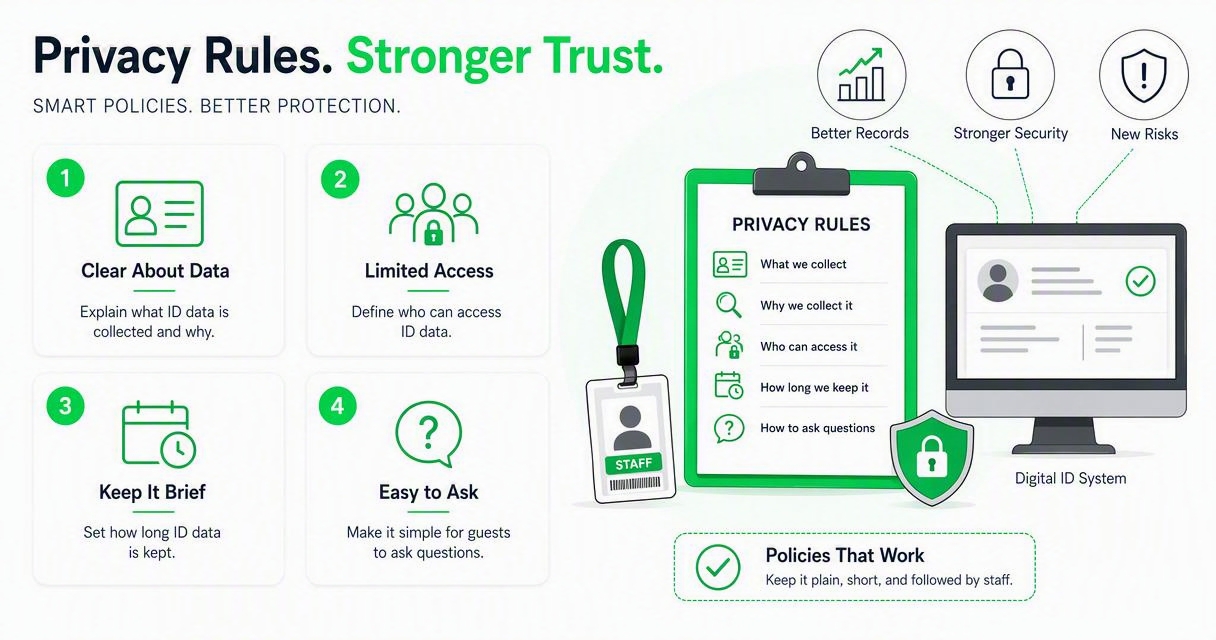
Modern digital identity systems can improve records, but they also create governance duties. Research on digital technology adoption, such as Wang, Su, Zhang, and Li’s 2021 review of digital technologies and public health applications in the International Journal of Environmental Research and Public Health, highlights the broader need to pair digital tools with privacy, security, and implementation controls (source).
A hotel does not need to collect every possible data point. Collect what supports check-in, safety, payment defense, legal compliance, and documented risk control. Restrict everything else.
Practical privacy controls for scanned IDs
- Post a clear ID scanning notice at the desk.
- Train staff on what to say when a guest asks why ID is scanned.
- Limit access to managers, front desk leads, and approved risk staff.
- Use role-based permissions instead of shared logins.
- Define retention periods with legal counsel.
- Delete records when policy says they should be deleted.
- Audit unusual access to guest records.
For hotels drafting language, a useful companion resource is the hotel ID scanning privacy policy template for 2026.
How GuestBan ID Scanning handles hotel loss-prevention workflows
GuestBan ID Scanning is designed for hotel teams that need ID capture to feed operational risk decisions, not just populate a check-in form. The strongest fit is a property or group that wants identity verification, guest records, internal alerts, and DNR review to work together.
The GuestBan ID Scanning platform is especially relevant when managers want front desk teams to stop relying on memory. A scan can become the anchor for a stay record, an incident file, and a future alert that another employee can understand months later.
Hotels comparing device-first scanners should focus on workflow depth. A scanner that reads a license is useful. A platform that helps the team connect identity, notes, alerts, and property policy is more valuable for loss prevention. You can learn more at guestban.com.
GuestBan workflow fit by hotel role
| Hotel role | What they need | How the workflow helps |
|---|---|---|
| General manager | Consistent decisions | Reviewable records and clear escalation |
| Loss prevention lead | Pattern recognition | Identity-linked incidents and alerts |
| Front desk manager | Staff compliance | Standard check-in and handoff steps |
| Night auditor | After-hours confidence | Clear prompts and documentation trail |
| Regional operator | Multi-property context | Shared visibility into serious risk records |
If you are still choosing a scanner type, compare features in this guide to the best ID scanner for hotels before buying hardware.
What should hotels expect from ID scanning in 2027?
Hotels should expect ID scanning in 2027 to become more connected to PMS data, guest screening alerts, payments, and incident management. The direction is clear: fewer isolated tools, more unified guest-risk records.
I expect three changes to matter most. First, regional hotel groups will demand better multi-property controls. Second, staff training will shift from “scan the ID” to “document the decision.” Third, privacy and retention reviews will become part of normal risk management.
“Trust, but verify.”, Ronald Reagan, Ronald Reagan Presidential Library
That phrase captures the future of hotel check-in. Most guests are legitimate, and the workflow should remain professional. Verification simply gives the hotel a reliable record when trust is not enough.
2027 readiness checklist
- Standardize ID scanning across shifts.
- Connect scans to PMS, folio, and incident records where possible.
- Review DNR criteria with legal or ownership approval.
- Set retention rules before expanding scan volume.
- Train staff on alert language and escalation.
- Audit records monthly for quality and consistency.
Hotels that do these basics will be better positioned than properties that buy hardware without changing the underlying process.
FAQ: hotel ID scanning and loss prevention
Can a hotel scan a guest ID for loss prevention?
A hotel may scan guest IDs when it has a lawful business purpose and follows applicable state, local, and privacy requirements. Common purposes include verifying identity, supporting payment records, improving safety, and documenting incidents. Managers should use a written policy, train staff, and avoid collecting data the property does not need.
Should every incident lead to a DNR record?
No. A DNR record should usually be reserved for documented conduct that violates hotel policy, creates safety concerns, causes damage, involves fraud, or creates serious operational risk. Minor complaints and misunderstandings should stay in local notes unless management decides the pattern justifies escalation.
Does ID scanning replace front desk judgment?
No. ID scanning supports front desk judgment by giving staff better records, cleaner identity data, and alerts that can be reviewed. Employees still need training on guest service, escalation, privacy, and when to involve a manager. The tool should make decisions more consistent, not automatic.
How long should hotels keep scanned IDs?
Retention depends on the hotel’s legal obligations, risk tolerance, payment dispute window, brand rules, and local privacy law. A practical policy should state the retention period, deletion process, access controls, and exceptions for active disputes or investigations. Hotels should review retention rules with counsel before deployment.
Conclusion
ID scanning for hotel loss prevention teams works best when it becomes part of a disciplined operating system: verify the guest, connect the stay record, document incidents clearly, review alerts fairly, and make serious records visible to the right managers. Start by auditing your current incident files, then choose one workflow to standardize first, such as DNR review, night-audit check-in, or chargeback evidence. If you want a platform built around hotel identity capture and risk records, evaluate GuestBan ID Scanning and visit guestban.com to plan your next step.